Islamic Holy Books

Notes on Ergun Mehmet Caner and Emir Fethi Caner’s
Unveiling Islam
Chapters 4 and 5: The Qur’an (Mother of Books)
and Sunnah and Hadith (The Other Books)

According to Muslims, the Qur’an is the exact, dictated revelation of Allah to Muhammad. As such, Muslims look down upon translations as being inferior–whereas the Arabic original is sacred.

The illiterate Muhammad “wrote” down the dictated “revelation” of Allah using a variety of scribes–one of whom left the Islamic faith saying that this “revelation”, far from being inspired dictation, was open to imaginative editing by the scribes. The rest of the Qur’an was kept as oral tradition until the death of several individuals with knowledge of the holy words. Then scribes set to work transcribing the oral recitations of Muhammad’s intimates.

The Islamic “canon” was determined by relatively arbitrary means. One imam gathered together all copies of the Qur’an–then a highly variable document containing the written oral tradition of different individuals–and chose one that was written in the dialect he preferred. Having chosen the one document, he burned all others and commissioned scribes to copy the chosen document to be carried throughout the Islamic world.

According to the Qur’an, the Bible is a revelation from Allah but is flawed and unfulfilled. The Qur’an regularly contradicts Scripture, for instance, saying that the Trinity includes Mary, that blood is unimportant, and that Jesus was not crucified.

Within the Qur’an, there are many contradictions–and even more odd teachings and doctrines. For example, the Qur’an is of two minds as to whether there is an unforgivable sin and what that sin consists of. On one occasion, the Qur’an states that Christians can be found in heaven, while another Surah (verse) declares that all Christians are destined for hell.

While the Qur’an is known to be the holy book of Islam, few are aware that the Sunnah and the Hadith (Sayings and Examples) are the foundation of most Islamic custom and law. It is here, in the Sunnah and Hadith, that the dietary laws, the marriage laws, the laws of cleanliness and modesty and fasting are found.

These writing contain a great deal that is adhered to today–but also contain strange superstitions (for instance, that genetic traits are passed on to offspring depending on whether the man or the woman reaches orgasm first during intercourse) and unusual prescriptives (such as drinking camel urine as medicine).

Addendum (May 10, 2010): Ergun Caner’s testimony as a converted Muslim has been challenged by several bloggers who claim that he has grossly exaggerated the extent of his Muslim upbringing. Readers of this book ought to be aware that the Caners may or may not have the experiential knowledge of Islam that they claim to have, and should therefore be careful to test the statements found in this book against other reliable sources.


Recap (Mar 21-27)

On bekahcubed

Book Reviews:

Photo Albums:

  • Winter 2010
    This is a shorter show than many because most of my pictures from this winter are of us working on Dan and Debbie’s wedding quilt. And I don’t want them to see those until after the rehearsal dinner (where we’ll be gifting them the quilt). So, look forward to seeing quilting photos after June 18!

On the web

Laugh out loud funnies:

  • Carrie has some great reading-related funnies. My favorite:
    Lemony Snicket Comic
  • Jon Acuff of Stuff Christian’s Like to his daughter:

    “John Piper just quoted the entire book of Philippians in a sermon? How do you know about John Piper? You’re six, are you a Calvinist? You can tell daddy anything. Are you secretly listening to Mark Driscoll and John Piper when I think you’re playing on the My Little Pony website?”

    Read the rest on memorization

Books for the TBR list:

  • Discovering God in Stories from the Bible by Philip Graham Ryken
    Studying God through the stories He’s chosen to record (for that purpose).
  • Think Twice by Lisa Scottoline
    One woman buries her twin sister alive and assumes her twin’s life in order to escape the mess of her own. Not my usual reading, but this book has me REALLY curious.

News to take note of:

  • Lack of food skills = poor nutrition. That’s what I’ve been saying–and why my focus as a dietitian is on practical skills!
  • Outbreak of measles in unvaccinated community. Little upsets me more than those who continue to promote the idea that MMR vaccination is linked to autism. There is NO scientific evidence for this position (the one article that sparked the debate was later retracted because of faulty research technique.) Please, pay attention to the science and do what’s actually best for your child (and consequently for the health of your community)–vaccinate your kids!
  • A text from my sister regarding one of her clients at the Community Health Center (CHC) reproductive clinic she works in:

    “Baby’s heart will begin to beat in the next few days. Please pray with me that it will be allowed to continue beating.”

    I regularly pray for Anna’s clients who are considering abortion–and am thankful that Anna has the opportunity to be a voice for truth and life in that arena. This news about how the new health care bill may affect CHCs worries me. What will this mean for Anna? What will it mean for the dozens of children we war over in prayer? Lord, let life prevail, even as the war intensifies.

Projects to try:
Because we all know Rebekah needs more projects! :-P

Thought-provoking posts:

  • Sam Crabtree on priorities in Christian environmentalism

    “More important than preserving wonderful national park settings for people to see is to preserve souls in order that they may see the new earth, which will be superior to the wonderful old earth. It would be a tragedy to preserve the planet for people who would dwell in hell and never see the new earth, when they could have been born from above and lived forever in the glorious new earth. Saving souls is more important than saving whales—though saving one need not preclude saving the other.”

    HT: Desiring God

  • J.D. Greear answers the question: “On what grounds should I move to another church?”

    “It is infants and toddlers, not adults, whose primary concern in being fed and having their bottoms wiped by others… Ironically, some of the “seasoned” Christians who complain the most about “not getting anything out of their church” act more like toddlers than mature believers! The church is not about you… and being fulfilled as a Christian is not about hearing spine-tingling preaching each week, but about using your spiritual gifts in the church.”

    HT: Vitamin Z


A Short History of Islam

Notes on Ergun Mehmet Caner and Emir Fethi Caner’s
Unveiling Islam
Chapter 3: The Story of Islam (A Trail of Blood)

Chapter 3 gives a brief overview of Islamic history, starting with the “four horsemen of Muhammad”, the four imams under whose leadership Islam violently took over the Arabian peninsula (from AD 632-661). Next there was an age of aggressive expansion during which Islam’s military forces extended the rule of Allah across North Africa, east to China, and as far north as France (AD 661-1095). After Muslims attacked a group of pilgrims to Jerusalem, the Crusades began an era of Christian/Muslim conflict which strengthened Islam and weakened Christianity (1095-1291). After this point, Islam moved to defend themselves against Genghis Khan and the Mongolians. This was successful not because of military might but because Mongolian leaders were converted and enforced the new religion top down (1298-1515). It was then that Islam shifted from its largely offensive, conquest-driven role in the world to a more defensive position as the Turkish empire.

But the Caner brothers make clear that this defensive position is a sidenote, an anomaly in Islamic history. The goal of Islam is, and always has been, to conquer the world at the edge of a sword. Current Islamofascism is not a radical sect of Islam–but a return to what has always been Islam’s goal.

“War is not a sidebar of history for Islam; it is the Muslim duty to bring world peace via the sword….It is the duty of the believer in Jesus Christ to persuade Muslims compassionately, wait for them patiently, and pray for them earnestly.”
-Caner and Caner, Unveiling Islam, p 78

Lord, give us the grace to do so.

Addendum (May 10, 2010): Ergun Caner’s testimony as a converted Muslim has been challenged by several bloggers who claim that he has grossly exaggerated the extent of his Muslim upbringing. Readers of this book ought to be aware that the Caners may or may not have the experiential knowledge of Islam that they claim to have, and should therefore be careful to test the statements found in this book against other reliable sources.


My Life, Currently

I’m trying to think of something interesting to post. Something non-bookie. An anecdote or a piece of silliness.

I’ve got nothing.

Today I’m taking 18 books to the library. That’ll put me down to 36 books checked out–assuming I don’t check out any more.

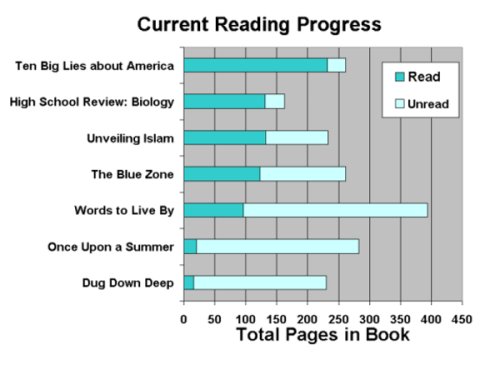
I am currently in the middle of seven books.

Reading Progress

Apart from that, I’m…uh, reading the Bible. And, uh, reading (and creating study materials for) Wardlaw’s Perspectives in Nutrition. And, well, reading Health Promotion Practice and Research.

Exciting, I know.

At some point, my life may not be so reading heavy. But now is not that time.

Sorry.


Prophet of Peace

Notes on Ergun Mehmet Caner and Emir Fethi Caner’s
Unveiling Islam
Chapter 2: Muhammad (The Militant Messenger)

Islam encourages trust in the Koran and emulation of Muhammad’s life. Yet Muhammad himself was unsure at first whether his “revelation” was from God or a demon–his wife convinced him that it was of god. While proclaiming that the Qur’an is the exact words of Allah as received by himself, Muhammad changed the wording of the “revelation” at the suggestion of his scribe. Beyond this, Muhammad condoned and lived a violent life, took on many brides (11 in all, one of whom was only nine years old when their “marriage” was consummated), and was capricious in his judgments.

“Clearly Jesus was a far superior prophet of peace and mercy. Muhammad was ruthless in war, not considering ethical ramifications when he was caught up in the height of savagery. The only life Jesus Christ voluntarily gave up was His own. His character offers continuous, unassailable compassion.”
Caner and Caner, Unveiling Islam, page 52

The history of Islam’s founder belies the common notion that Islam is a religion of peace. Muhammad was far from peaceful, rarely merciful, and plainly immoral (even by modern standards). This stands in sharp contrast to Jesus the Christ, who staged no revolts, murdered no one, and judged no one (except by the truth of His character according to John 3:17-19). He did nothing wrong. Even His worst enemies were incapable of bringing false accusation against Him (Matthew 26:59-60). As the Caner brothers so insightfully point out, “The only life Jesus Christ voluntarily gave up was His own.” He, and He alone, is a true prophet of peace.

Addendum (May 10, 2010): Ergun Caner’s testimony as a converted Muslim has been challenged by several bloggers who claim that he has grossly exaggerated the extent of his Muslim upbringing. Readers of this book ought to be aware that the Caners may or may not have the experiential knowledge of Islam that they claim to have, and should therefore be careful to test the statements found in this book against other reliable sources.


Always Room for One More

Reading My Library

I grew up in an 1100 square foot (+ unfinished basement) home with my parents and 6 siblings.

We barely managed to fit the dining room table into the dining room–and barely managed to fit ourselves around the table.

But despite all this, we regularly had family, friends, and neighbors over to play or be babysat–and to enjoy dinner with us.

I remember aunts or friends asking Mom if she was really sure that she wanted to babysit their kids. Mom would reply “What’s one or two more?”

I loved that attitude–and still love it–“What’s one or two more?”

No matter how squished we were in the first place, one or two or three more was still plenty do-a-ble.

Always Room for One More
Always Room for One More by Sorche Nic Leodhas is a children’s story I can definitely identify with. Based on an old Scottish song, the tale tells the story of “Lachie MacLachlan and his good wife, and his bairns to the number of ten.” They live in a little house, but Lachie declares that there’s “always room for one more.”

He invites in a tailor, a sailor, a Piper, a shepherd, soldiers, and more. The whole house is full with dancing and singing, and always with room for one more–until the poor little house simply bursts. Literally.

Poor little house. Poor Lachie MacLachlan. Poor Missus MacLachlan and ten MacLachlan bairns.

Except maybe not.

The many dozens of people to whom they’ve shown hospitality pitch together to rebuild their house–a new house, twice as big as the old–where there’s “always room for one more.”

I’m not precisely sure why this story is filed in my local library as jP Alger (indicating author name Alger.) The text is copyrighted by a Leclaire G. Alger–but I see no indication of who this Alger is or why he or she’s got the copyright. At any rate, it’s filed under A, so I’ve read it along with my books by author “A”.

The back of the book states that the story is an old Scottish popular song that has been handed down at least four generations in the author Sorche Nic Leodhas’s family. Leodhas has half-translated the work into words that can be understood by American readers–but has left in enough Scottish phrases to make the tale’s roots clear.

This was a delightful tale that I enjoyed very much. I definitely recommend that you look it up.


Allah and Eternal Security

Notes on Ergun Mehmet Caner and Emir Fethi Caner’s
Unveiling Islam
Chapter 1 : Security, Politics, and Jihad

“One must love Allah in order for Allah to love that person in return. In Christianity, God loved people first in order to secure their salvation.”
-Caner and Caner, Unveiling Islam (p. 31)

According to Caner and Caner, Islam is a religion of constant fear–fear of Allah and fear of hell–but with no love and no hope for eternal security. Even the best followers of Islam have little hope of Paradise. The closest one can get to eternal assurance in Islam is to die the death of a martyr.

“The Qur’an promises Paradise to those who die in battle for Islam more certaintly than it promises salvation to anyone else.”
-Caner and Caner, Unveiling Islam (p. 36)

How my heart grieves for these who have no hope except to kill themselves on the chance that they might be saved. How my heart rejoices that I have assured eternal hope, not through my death but through that of another. How my heart grieves for those who have never experienced a God who is love. How my heart rejoices that my God is love–and has demonstrated His own love in this: in that while I was still a sinner Christ died for me.

Oh, Lord, in your infinite mercy, would you let your light shine upon those who are in bondage to Allah. Would you allow them to see and experience You and Your love. Bring salvation to that house, I pray.

Addendum (May 10, 2010): Ergun Caner’s testimony as a converted Muslim has been challenged by several bloggers who claim that he has grossly exaggerated the extent of his Muslim upbringing. Readers of this book ought to be aware that the Caners may or may not have the experiential knowledge of Islam that they claim to have, and should therefore be careful to test the statements found in this book against other reliable sources.

Mickey D’s

The McDonalds at 11th and Cornhusker knows what to expect come 8:30 Wednesday nights. They’ll be suddenly inundated by a rash of students in their late teens and early twenties, all of them ordering a couple of items off the dollar menu and sticking around for at least an hour.

The manager is out to greet the visitors as they come in–and more often than not, a half a dozen employees will make their way to the front counter to exchange some remark with one or another of the guests.

We’ve been going to McDonalds after youth group since my brother first got a job there five years ago. Then, I was a youth sponsor, chaperoning a gaggle of giggling girls. The “group” that went to McDonalds after youth group was me and a bunch of youth group kids.

As we’ve gotten older, so has the demographic of the “group”. I go after Bible study. Jeremy (the youth pastor) drops by. Joshua (a youth sponsor) comes. John and Steve (who sponsor for Rock Solid, the kids group) come. Joanna comes after she’s done doing nursery for all the Wednesday night church events. Debbie stops in after classes. And there’s still the group of high school students: Tim and Grace and Kayla and John and Eli and Elinor and Brittany and others.

We take over the little nook with its two circular corner booths and little table and armchair lounge. We talk and we tease and occasionally we take pictures. We have fun. We hang out.

It’s a relaxing time, a do-nothing time. Everybody’s just being.

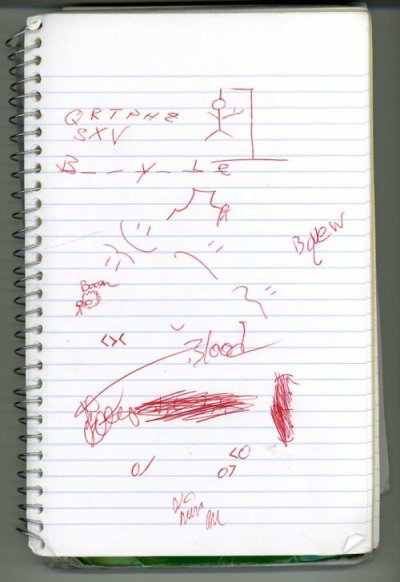
And then there’s the occasional game of hangman.

notebook page

Which morphs into drawing smiley-faces.

Which becomes drawing emoticons (which others scribble out.)

Then someone draws a picture of someone getting blown up by a hand-grenade.

And someone tries to write an onomatopoeia of the crazy noise he makes every so often.

Which somehow leads to genie jokes.

And then someone comments on my grading pen–and discovers that I grade with the blood of former students.

Bet you didn’t know that.

I don’t really share it often.

But now you know.

Students beware of taking a class by Miss Menter. :-P


Surprise!

I’m wearing jeans today. Yep, for real.

Rebekah in jeans

I wonder who’ll be more surprised: my students, my supervisor, my classmates, or the kids I’ll be picking up trash with this afternoon?

(For context, I wear jeans approximately twice a year. The last time I wore jeans, a good friend who I’d known for probably ten years said “I don’t think I’ve ever seen you wear jeans before.” Yeah, so I don’t wear jeans very often.)


Nightstand (March 2010)

I’ve done a bit more reading this month to catch up from my dismal month of February (in which I read less than a quarter of a full-size book per day. Gosh!)

Last month’s nightstand:

On my nightstand

What I actually read this month was:
(Links lead to my reviews of the book, never to a site selling you something.)

Fiction

Nonfiction

  • Don’t Waste Your Life by John Piper
    Very good book. Highly recommend. Especially for younger people.
  • Dug Down Deep by Joshua Harris
    Enjoyed this, recommended it to my new ladies small group/book discussion group. We’re going through it slowly starting last night. So I might be giving more comments on individual portions as time goes by.
  • Good Housekeeping Best Recipes 2000
    Made and modified the Caribbean Roast Chicken recipe from this a couple of times. Good stuff!
  • If Ignorance is Bliss, Why Aren’t There More Happy People?
    This is a book of quotes. I love quote books!
  • Why We Love the Church by Kevin DeYoung and Ted Kluck
    I wrote a whole series of book notes on this book–Check them out here

Juvenile

  • Children’s books AJHAR-ALIKI (43 titles)
    Including books by
    Arlene Alda and a potpourri of others
  • Benny Uncovers a Mystery by Gertrude Chandler Warner
  • Bus Station Mystery by Gertrude Chandler Warner
  • Dairy Queen by Catherine Gilbert Murdock
  • Dave at Night by Gail Carson Levine
  • The Flickering Torch Mystery by Franklin Dixon
  • The Illustrated Book of Fairy Tales by Philip and Mistry

This month’s nightstand
I don’t think I can afford to go back to the library in this next month–my nightstand for April is absolutely packed full (with a lot of non-fiction too!)

On my nightstand

Fiction

  • The Apothecary’s Daughter by Julie Klassen
    Recommended by too many bloggers to keep track of.
  • Mozart’s Sister by Nancy Moser
    Reading my way through Moser
  • Once upon a Summer by Janette Oke
    Reading my way through Oke

Nonfiction

  • Bible Babel by Kristin Swenson
    Saw this on the “new books” display at the library and thought it looked interesting.
  • **Biology: High School Review by Princeton Review
    Despite almost minoring in it, biology has never been one of my strong points. Brushing up while getting some more done on my “read every book” goal
  • The Blue Zone by Dan Buettner
    Health theory professor handed us an article about the author (published in Newsweek, I think). His stuff sounded interesting. Studying the communities around the world where people tend to live longer.
  • Five Aspects of Woman by Barbara Mouser
    A theology of femininity–I’ve read excerpts, but I’m eager to actually go through this whole Bible study. I don’t anticipate getting done anytime soon though.
  • Forgotten God by Francis Chan
    Picked up after watching a video (no longer available) called “The Big Red Tractor” on Vitamin Z. It’s all about the Holy Spirit.
  • The Girl’s Guide to Kicking Your Career into Gear
    Finishing up school soon. It’s about time to kick it into gear.
  • The Glass Castle by Jeannette Walls
    Added to TBR list on recommendation of Wayside Sacraments
  • **Home by Julie Andrews
    Picked up audio book for drive to visit my sister. Enjoyed the first disc (read by Andrews herself).
  • Male/Female Roles: Opposing Viewpoints
    I enjoy the Opposing Viewpoints collections–and since I spent some time exploring gender roles during Love Month, I thought I’d keep researching a bit more.
  • Nourishing Traditions by Sally Fallon
    Becky lent/sent me a copy of this so I could explore its claims more in depth.
  • The Power of Half by Kevin and Hannah Salwen
    Picked this up based on a review from Golden Grasses.
  • **The Ten Big Lies About America by Michael Medved
    Picked up after reading a review from Seth Heasley at Collateral Bloggage
  • The Ultimate Job Search by Richard H. Beatty
    Should be done with classes in two months. I need to get a job. Anybody know of any great jobs for RDs? How about a great place to relocate to? Currently, the world is my oyster–which is a bit intimidating.
  • **Unveiling Islam by Ergun Mehmet Caner and Emir Fethi Caner
    Unfortunately, I failed to bookmark the blogger that recommended this–but I was very impressed by the recommendation…and, so far, I’m pretty impressed with the book as well. I’ve been compiling a “Cliff’s Notes” in my journal and may well post my notes online as I get going further.
  • **Vegetables Every Day by Jack Bishop
    I’ve done a couple of recipes from this so far and am very impressed.
  • **Words to Live By by Charles Panati
    A history of the origins of phrases like “Practice what you preach” and “A friend in need is a friend indeed.”
  • **The World’s Last Night and other essays by C.S. Lewis
    Leftover from last month–I’ll have to finish this one quickly as it’s due back to the library soon!

Juvenile

  • Children’s Picture books author ALLARD-?
  • The Haunted Cabin Mystery by Gertrude Warner
    Bet you couldn’t guess that I’m trying to read the Boxcar children books :-P I’m getting to the ones I’ve never read before, being somewhat of a snob as a pre-teen and only reading the books BY Gertrude Warner (not those only CREATED BY.)
  • I, Coriander by Sally Gardner
    Read The Red Necklace on my little sister’s recommendation–and thoroughly enjoyed it (it’s a historical novel set during the French Revolution.) We’ll see about this one.
  • Inkdeath by Cordelia Funke
    Working my way through Funke. I absolutely ADORED Inkheart and Inkspell. I expect great things from this one.
  • The Melted Coins by Franklin Dixon
    Already finished Nancy Drew a couple of years ago. It’s been slower getting through the Hardy Boys. Don’t quite know why.

What's on Your Nightstand?

**The asterisks marks books I’m currently in the middle of.

Drop by 5 Minutes 4 Books to see what others are reading.