Book Notes: Paranoid Parenting (Part 3)

I’m mostly writing notes to evaluate Furedi’s arguments and add my own thoughts. If you’re interested, you can check out Part 1 and Part 2.

Chapter 3: Parents as Gods
In chapter 3, Furedi goes deeper into a concept he introduced in the previous chapter – infant determinism (also referred to by Furedi as “parental determinism”.) This idea purports that parents are uniquely responsible for all sorts of childhood and adult behavior – and that therefore parents should take a strong role in actively shaping their children’s lives (because if they don’t do it intentionally, they will be sure to mess up their children!)

“Today, parenting has been transformed into an all-purpose independent variable that seems to explain everything about an infant’s development.”

The author goes through a huge list of things that modern science blames on parenting – the terrible twos, school failure, depression, eating disorders, and more. Here’s where he starts talking a bit on my area of expertise: nutrition.

“Nutritionists claim that many parents are mistaken in the belief that a healthy diet for an adult is a healthy diet for children. It is claimed that babies and toddlers who receive normal adult fare are deprived of energy-dense food and therefore lack the right calorie intake….Parents not only have to constantly monitor the food they give to their toddlers, they also have to set the right example during meals.”

Here’s where I wonder if these are the messages parents are really receiving – because they’re certainly not the messages I’m sharing. The truth is that many people are mistaken in their beliefs about what constitutes a healthy diet, period. While extreme low-fat diets were popular, there were indeed parents who mistakenly thought that their infants and toddlers should go low-fat too – and those infants ended up with essential fatty acid deficiencies. But extremely low-fat diets actually aren’t healthy for anyone (and hopefully, no dietitians are spouting that in 2014!) – and children are actually uniquely vulnerable to nutritional deficiencies (as opposed to adults) because they’re still building their bodies (as opposed to maintaining them as adults are.) And setting a good example? Is he really complaining about that advice? It seems like common sense that if you expect your kid to eat vegetables, it helps if they see you eating vegetables too.

The disconnect between what I share as nutritional parenting advice (and really, my job is to give parenting advice) and what Furedi perceives as current nutritional parenting advice makes me wonder where else the messages researchers and educators give are transformed into paranoia.

And then I look at Furedi’s sources: Mother & Baby magazine, Prima Baby magazine, Baby magazine, Parents magazine. These magazines were purportedly quoting experts or giving advice based on research – but I’m not at all confident that journalists have the skills required to give advice based on scientific research. I see it all the time with nutrition. A new study comes out suggesting that high intake of cinnamon increases insulin sensitivity. This is interesting, but hardly something to start giving nutritional advice based upon. Yet Fitness magazine has a big feature full of cinnamon-rich recipes announcing that this is a scientific way to prevent diabetes. The advice, of course, pays no attention to the minimum dose required for response, the magnitude of the response, or the quality of the study. I suspect that much of the “scientific” parenting advice one reads in parenting magazines is similar.

But don’t blame it on the experts, this time. If you want someone to tar and feather, tar and feather the journalists who prey on parent’s fears and inappropriately translate research into guidelines.

That said, Furedi does have a good point to make: children tend to be remarkably resilient. The magnitude of these parenting effects is nowhere near as large as the popular media would have you think. My parents didn’t follow all the nutritional advice I give my clients (and I actually give them good advice :-P) – and I’m not a fatso with an eating disorder. It’s okay to relax – you don’t have to follow every new fad the parenting magazines tout in order to not mess up your child.


Narratives, Nature, and Nurture

The United States has traditionally been considered a land of opportunity. Here a man can make something of himself, regardless of his background, provided he works hard. America is the land of the self-made man. Our ancestors were persecuted peasants who fled to America and became land-owners. One of our most famous presidents was born in a log cabin. We love rags to riches stories – stories of people who through hard work, pluck, and determination made something of awful circumstances. For generations, we have told our children that they can do anything – provided they work hard enough.

Increasingly, though, a new narrative has entered into American consciousness – a new narrative that is actually quite old. According to this narrative, we are a product of our birth. Born into poverty, we are destined to live in poverty, unless some benevolent rich person brings us out. We are not the actors in our stories – others are. We are victims of the fates.

The changing narrative has had a great impact on how people perceive themselves – and on the actions they take. Those who perceive themselves as successful tend to believe that their actions have power to effect change – but they frequently feel that they obtained this power unfairly. They feel a great guilt for the accidents of birth and rearing that have made them successful – and try to assuage that guilt by becoming patrons. Those who perceive themselves as unsuccessful tend to have low self-efficacy. They believe that their actions have no effect, that they are destined for the life they have – and so the best they can do is rail against the circumstances of their lives and insist that the fortunate successful work to raise their lot.

Self-efficacy. It’s an interesting word – and an interesting concept. Self-efficacy is simply ones belief that one is able to accomplish goals. Self-efficacy is strongly linked to having an internal locus of control – that is, believing that you are the primary actor in your life (as opposed to you being one who is acted upon.)

Yet I would argue that, in general, Americans are moving toward an external locus of control. Neither the successful nor the unsuccessful consider their station to be a result of their own actions. Neither the successful nor the unsuccessful have much hope for changing themselves – they consider their own lives to be determined by their pasts. But the successful and the unsuccessful tend to have vastly different ideas about their ability to change others. If we are a product of our pasts, we cannot change ourselves – but the successful may be able to use their success to change others.

Enter nature versus nurture.

Even as I think about phrase, I realize how deterministic it is. If “nature” is all there is, if genetics are fate – then we are programmed by our genes. If “nurture” is all there is, if how we are raised is fate – then we are programmed by our parents. Either way, we’re programmed. We have no control over our own lives.

Is it any surprise, then, that the parents who consider themselves successful invest so much in trying to alter the fates of their children? This is their one chance to control something about themselves. They overparent.

On the other hand, the unsuccessful parents throw their hands up. They don’t believe they have the power to affect their children, so they do nothing. They don’t believe they have anything to invest, don’t believe it’s possible to alter the fates of their children. They fail to parent.

So we end up with opposite ends of the parenting spectrum – neither of which do children any advantages.

What if, instead of being the product of nature or nurture, children were simply themselves?

Selves, capable of writing their own stories?

What if instead of trying to write our children’s stories, we tried to teach them what makes for good stories? What if instead of consigning them to the life their circumstances gave them, we tried to give them the skills – diligence and self-discipline – that help them to rise above their circumstances?

What if we taught our children that they can be successful – provided they work hard enough?


Thankful Thursday: Plants and People

Thankful Thursday banner

Some weeks themes come easily, other weeks not so much. This week is the latter. But I am indeed thankful for plants and people.

This week I’m thankful…

…for mulberries
About a month ago, I realized how much I missed mulberries. Back when we were kids, we walked to the empty field at the end of our street and pillaged its mulberry trees regularly. I hadn’t seen a mulberry since I moved to Wichita. So, imagine my surprise when my brother and sister-in-law were in town over Memorial Day and we were doing some yardwork (pulling out a fence, digging up thistles, and reorganizing bricks and stuff from one side of the garage to the other) and discovered… a mulberry tree. In my yard. Since that point, I’ve been eating mulberries morning, noon, and night – straight from the tree (it’s the best way). I’m limited because there are only a few branches that are within arms reach and the ground’s too soft (and too muddy from digging up fence posts) to use a ladder – but mulberries ripen quickly and there’s usually a new couple dozen ripe berries within reach each time I go out.

…for spinach
I am a dismal gardener, mostly because I garden (like I do almost anything) in fits and spurts. Gardens don’t take too kindly to not being watered or weeded for long spells, and container gardens (which I had when I was renting) like it even less. But I put in a nice big raised bed last year and this year I planted it with spinach and beets and onions and tomatoes and peppers and broccoli and summer squash. And yesterday I enjoyed a lovely spinach salad grown in my own garden. It’s still early in the year and I definitely could still kill the rest – but this taste of success is bolstering my resolve that I *will* see this gardening thing out.

…for sisters
My sister-in-law (and brother) came to visit over Memorial Day weekend and insisted on being put to work. My other sister-in-law texted me on Memorial Day (after her sister had left) and asked how I was doing, said she was thinking of me. I had to reply that I was feeling a bit emotional and mopey – and we arranged a Skype date to talk, which was just the thing to lift my spirits. My sister and I had a nice long text exchange yesterday, part silliness, part seriousness. Having such wonderful sisters and sisters-in-law is a blessing that can only come from God.

…for my husband
I’ve been tired, have been barely keeping up with the housework (Remember when I lost my homemaking mojo? I’m doing a bit better but it’s still struggling.) Then I got a massive cold from a client and was pretty much out of it for three days. Daniel has fed me, made me orange juice, done dishes, done laundry, and generally babied me. I’ve given him rather a lot of worse since the day he pledged “for better or worse”, but he’s faithfully kept that vow. God has blessed me again and again with a husband who faithfully models Christ’s love for the church by loving me as his own body, regularly sacrificing his own comfort for mine, his own rights for my privilege.

…for the Vine
Frequently, I feel like a dead branch, with little life in me. I fail at so many of the good things I intend to do. I would be a dead branch, incapable of accomplishing any good thing of myself. But God has made this dead branch live, not because I conjured up life in myself, but because He has grafted me into the Vine. As I remain in Him, and He in me, He causes this dead branch to bear fruit. And whether I see fruit or not, I cling to Him and to His word. I cannot bear fruit, but cling to His promise that as I hold fast to Him, He will bear fruit in me.

Thank You, Lord, for making provision for my deadness by granting me life through Your Son. Thank you, Lord, for making provision for my barreness by providing fruit through Your work. Help me ever to abide in You.

“Abide in me, and I in you. As the branch cannot bear fruit by itself, unless it abides in the vine, neither can you, unless you abide in me. I am the vine; you are the branches. Whoever abides in me and I in him, he it is that bears much fruit, for apart from me you can do nothing. If anyone does not abide in me he is thrown away like a branch and withers; and the branches are gathered, thrown into the fire, and burned. If you abide in me, and my words abide in you, ask whatever you wish, and it will be done for you. By this my Father is glorified, that you bear much fruit and so prove to be my disciples. As the Father has loved me, so have I loved you. Abide in my love. If you keep my commandments, you will abide in my love, just as I have kept my Father’s commandments and abide in his love. These things I have spoken to you, that my joy may be in you, and that your joy may be full.”
~John 15:4-10 (ESV)


Book Notes: Paranoid Parenting by Frank Furedi (Part 2)

I’m mostly writing notes to evaluate Furedi’s arguments and add my own thoughts. If you’re interested, you can check out my introductory comments here.

Chapter 2:The Myth of the Vulnerable Child
Furedi argues that today’s children are regarded as uniquely vulnerable to outside forces (almost all of which are considered risks) and NOT resilient to manage such outside forces. As a result, parents seek to minimize all risks, not considering any potential benefits of risk. Furedi points to the modern playground as an example of the outerworking of this fear of exposing children to risk.

“It is easy to overlook the fact that the concept of children at risk is a relatively recent invention. As I argue elswewhere, this way of imagining childhood involves a redefinition both of risk and of childhood. Until recently, risks were not interpreted by definition as bad things. We used to talk about good, worthwhile risks as well as bad, foolish ones. Risks were seen as a challenging aspect of children’s lives. Today, we are so afraid of risk that we have invented the concept of children at risk. A child that is at risk requires constant vigilance and adult supervision.”

But the myth of childhood vulnerability is not limited to physical vulnerability to danger. Today’s parenting culture considers children to be emotionally and developmentally at risk, subject to what one psychologist calls “infant determinism”. Without just the right childhood circumstances, a child could be scarred for life – destined to be a psychopath or mentally ill. Yet this concept, while popular, is largely ungrounded in empirical evidence. Yes, infants in third world orphanages who are never touched or held are more likely to experience psychological difficulties – but these extreme examples do not prove that children in general are at risk of developmental and psychological issues if they are not held or watched every moment. Children are much more resilient, both physically and psychologically, than current parenting culture wants to admit.

Furedi’s playground argument hits home with me. The modern playground is so far removed from the playground of my childhood that I reflected to my husband (and to Facebook) that the modern playground seems designed to eliminate all risks, including the risk of gross motor development.

While we were dating, Daniel and I took my niece to one of the old playgrounds in my parent’s neighborhood. She was maybe 18 months and I stood a step behind her, terrified, as I let her climb the slide’s steps all by herself. I was fully aware of the risks, of the rails that were simply something for her to grab to help her climb, not something that would keep her from falling 10 or more feet to the ground if she slipped. I was aware that, if the weather were warmer, the metal of the slide could get hot and burn her. My heart was in my chest. But I value learning and independence. I think that’s important. I took the precaution of being a step behind her so she was within hands reach if she faltered. But I let her climb by herself.

Last year, a whole group of our family went to another of my parents’ old playgrounds (they have three old playgrounds within walking distance!) My sister Anna got on the merry-go-round (yes, it actually has one of those) with the Little Miss (who was now two and half) and Daniel pushed them. He went faster and faster and faster while I bit my fingernails watching them turn. I felt sure that Anna was about to throw up and feared that the Little Miss would emerge from the experience terrified of her uncle Daniel. Anna cried uncle and Daniel stopped them. They stepped off the merry-go-round and the Little Miss slowly reoriented to the world. When she found her bearings, she turned towards Daniel and demanded “Again.”

Children are resilient. Yes, risks exist – but so do opportunities that can’t be obtained without risk.

A child broke her arm after falling out of a tree. Her father contemplated banning tree-climbing. I broke my collar bone at age 2 falling out of bed. Perhaps we should also ban bed-sleeping. I say it ironically, but take a look at parenting literature and you’ll read of the advantages of toddler beds set close to the floor, maybe even with a soft mat alongside to break a child’s fall. You can add a mesh rail to your child’s bed to prevent falling entirely, but you must be careful lest your child get stuck between the bed and the rail – another risk.

All of us have stories of risks we took as children. We have stories of risky behavior that didn’t result in damage and risky behavior that did actually hurt us. Most of not only survived but thrived despite (or even because of) these experiences.

But it doesn’t stop with physical risks. We have emotionally “traumatic” experiences in our memories too. I slept in my closet on a pile of dirty clothes for weeks at a time because I got tired of having my sister tickle me in the bed we shared. One of my siblings grabbed a knife from the kitchen and threatened me with it. A drunk man got too close for comfort when I was waiting for my mom after ballet class when I was nine or ten. I experienced fear and anger as a child – but I also experienced love and safety and comradery. Today, I laugh at those “traumatic” stories and have great relationships with my siblings.

Ironically, the “traumatic” experience from my childhood that still has the power to excite me to anger is of an overprotective cop who got angry with my mother for leaving six of her children (with their eleven year old sister- me) in their wrecked van by the side of the highway while she called for help from the car of a Good Samaritan who stopped a hundred feet or less ahead of us. I still become angry when I think of someone daring to disapprove of my mom’s sensible action in the face of our accident.

So there you have it. Kids are resilient – physically and emotionally. Risks exists, but are not always bad. Parents need not be paralyzed with fear of risk – instead, they should consider which risks are truly problematic and how to wisely manage risk while maximizing childhood.


Book Review: Cotillion by Georgette Heyer

I’ve been reading and enjoying Georgette Heyer since my early teenage years, but until this month, I could not have pointed out a particular Heyer book as my favorite. I am now happy to announce that Cotillion has filled that long open spot.

The rich but notoriously tight-fisted Matthew Penicuik has summoned his four grandnephews to his country home, declaring that he intends to settle his will. Almost everyone understands what this means. Penicuik intends to settle his fortune on his ward, Miss Kitty Charing – and intends that one of his grandnephews marry her. In fact, he so intends that one of his grandnephews marry her that he makes her inheriting conditional upon this term. If she does not marry one of the four, Uncle Matthew will leave his fortune to charity, leaving Kitty penniless and his nephews without any portion of his estate.

After Uncle Matthew announces his intentions to the two of his four nephews who answered the summons, he leaves his nephews with Kitty in the drawing room. Dim-witted Lord Dolphinton, at his mother’s behest, announces to Kitty that he is an earl and therefore a desirable match. Kitty clearly sees the designs of Lady Dolphinton behind this proposal and graciously declines Dolph’s offer – much to his delight. At this, the Reverend Hugh Rattray announces his own suit. He, of course, has no desire for the money, but does not wish for Kitty to end up penniless – and since neither Freddy nor Jack have shown up to press their own suits, he shall do the honors. Kitty summarily rejects this offer too and decides to run away, so humiliating is this whole situation.

But in the course of her running away, she happens upon “Cousin Freddy” who is a bit late in coming to hear his uncle’s announcement. He received the message late and hadn’t intended to go anyway since he had no interest in his great-uncle’s fortune (and no thought that the way of obtaining it would be to marry Kitty.) Yet when Cousin Freddy ran into Cousin Jack at a club, Jack had convinced Freddy that he really ought to go. When Kitty runs into Freddy, she at first berates him for coming – she had thought better of him than to angle after her for money – and then begs him to become engaged to her once she realizes that he had no intention of offering for her.

Her would be her chance, she thought. If she were betrothed to Freddy, she could go to London to visit his mother and enjoy a month-long reprieve from her tiresome life in the country. She could at last see the town – and perhaps, well, see… But no, of course, she had no desire to see Jack. That was not at all the plan. Although…betrothed to Freddy, she could perhaps prove to Jack that she wasn’t just waiting for him to offer for her in his own sweet time.

Thus begins a delightful romp of sham engagements and secret engagements and attractions that can never turn into engagements. That said, it’s not a super-sappy romance full of long speeches and loverly looks. Instead, it’s like watching a complicated country dance, in which partners are always switching and the usual comedies of unmatched partners arise.

I highly recommend this particular Heyer title.


Rating: 5 stars
Category: Regency Romance
Synopsis: Country-bred orphaned Kitty embarks upon a month in London under the watchful eye of her faux-fiance
Recommendation: If you like romances or Heyer or comedy – or if you’ve been told you should read Heyer at some point – this is the book for you.


Book Notes: Paranoid Parenting by Frank Furedi

I found myself nodding and mm-hmming all the way through Frank Furedi’s Paranoid Parenting but was curiously unable to summarize Furedi’s arguments to my husband after I was done. That’s always a bit of a frightening prospect, because it suggests that I was reading to confirm my own biases rather than reading with a critical eye. As a result, I’ve chosen to reread the book, summarizing the author’s arguments in each chapter in order to give me opportunity to critically evaluate them. And, since blogging gives me a platform to share my thoughts, you get to peek at my notes (or skip them, if you prefer.)

Introduction
In the introduction, the author sets up the problem: In today’s world, everything is seen as threat to children and experts proclaim that there is one right way to parent properly (except that the experts disagree with one another as to what this one right way is) and that everyone who doesn’t do it their way is not only neglectful but potentially abusive – with the result that parents no longer trust their own judgment and hyper-parent lest they somehow allow their child to do or be exposed to something dangerous.

Chapter 1: Making Sense of Parental Paranoia
According to Furedi, parental paranoia is the result of three factors: an obsession with safety, a view that parental supervision is always positive, and a breakdown of adult solidarity. The first two are pretty self-explanatory, and I’m sure we can identify plenty of examples from our own experience. The third is a little different. Furedi posits that in the past, other adults were considered to be potential allies in child-rearing. Now, other adults are seen as potential threats to children, such that parents no longer trust other adults to supervise their children and other adults are fearful to interact with children lest they set off “stranger danger” alerts. The result is that parents are isolated – and children over-supervised.

The “breakdown of adult solidarity” is a new concept for me – and one that I struggle with (in a largely emotion-driven way). I am exposed to a lot of parents in my work with WIC. Most of these parents are pretty normal and, while I disagree with them on several parenting points (I am pretty opinionated when it comes to childrearing – and pretty much anything, really), I acknowledge that they are not people to be feared. I also see what is likely a disproportionate amount of truly bad parents – parents who scream at their children, who abuse their children physically, who expose their unborn babies to methamphetamine. I see the little ones who have been removed from their parents’ homes, who have marks from where their parents hit them or restrained them. I see the little ones who overeat once they get into foster care because for the first time in their life they have ready access to real food (as opposed to chips scrounged from the floor where they fell.) I would never put a child in these bad parents’ care – but I’m not worried that they’ll cause damage to a child not in their care. I don’t fear that these adults would rage at someone else’s child in a public park.

The parents I fear are… upper middle class mommies. I fear the people who jumped on Lenore Skenazy (of Free Range Kids) for letting her 9 year old ride the subway. I fear that over-protective mothers might prevent my children from experiencing a childhood. So I experience the breakdown of adult solidarity – but in the opposite direction of what the author describes. (That said, at least at present, I live in a nice lower class neighborhood where other parents are unlikely to judge me for letting my kids play in the street. It’s definitely a plus of NOT living in the suburbs! :-P)


Nightstand (May 2014)

Generally, I would take advantage of a long weekend to get my Nightstand post up and ready to go with all the bells and whistles – but my brother and sister-in-law came down to visit Daniel and I for this particular weekend and I was much too busy spending time with them to do internet stuff.

So you’re getting the little list I put together before I returned the last batch of books to the library – without expanded comments or books read since then. But something is better than nothing, right?

This month, I read:

  • The Convenient Marriage by Georgette Heyer
    An intriguing one as Heyer goes since the hero and heroine are married from the very beginning of the book. I’m enjoying working my way through my library’s collection of Heyer.
  • Ruth by Lori Copeland
    I only finished this because it was the only fiction I had out of the library. The heroine was an impulsive fool, the hero a “good man” who wasn’t a believer until the day before he married the heroine, the plot absolutely implausible. I didn’t like it at all. In fact, I’m considering just being done with Copeland – I’ve been either “meh” or “blech” on the last half dozen or so of hers that I’ve read.
  • Speaker for the Dead by Orson Scott Card
    This is the second book in the “Ender’s Game” series, and we own a copy of the first two in one volume. I loved Ender’s Game when I read it last year, and I started reading Speaker for the Dead immediately afterward – only to give up in desperation. The story was too different, the style too different. There were new characters that I didn’t know and love yet. I couldn’t do it. But when I ran out of fiction from the library this past month, I picked it up again – and absolutely loved it, devoured it. Whereas Ender’s Game is very action-packed, Speaker for the Dead is all about relationships and the inner workings of peoples’ brains. Card is a gifted writer, that’s for sure.
  • The Mysterious Benedict Society by Trenton Lee Stewart
    A re-read for our church-lady book club. I led the discusion and found it provoking all sorts of new thoughts in my own mind. Love it, love it, love it.
  • The Wolves of Willoughby Chase by Joan Aiken
    I read along with the Reading to Know Classic Book Club – and enjoyed this little Gothic tale immensely.
  • Yesterday’s Schools by Ruth Freeman
    An interesting look at the evolution of schoolhouses in America from the colonial days to the mid 20th century. The emphasis is on New York schools, as the author was apparently an educator there, but I could see resemblances to schoolhouses I’ve read described or seen in person elsewhere. It took me a while, with rather a lot of confusion to figure out that every eight pages or so was misplaced such that I had to skip a page to have a continuous paragraph and then go back to the previous page. Very odd. But I’m glad I read this itsy-bitsy little volume from my local library.
  • Paranoid Parenting by Frank Furedi
    I’m working on book notes for this one, but don’t know when they’ll be done. This was a great look at how parenting has turned into a can’t-win game – and children are losing out because of it. The subtitle is “why ignoring the experts may be best for your child” – and I agree completely, except when I’m the expert :-)
  • Betty Crocker’s Bread Machine Cookbook
    I might have only made one recipe from this book – the second one, for Buttermilk Bread. It was amazing. I made it a dozen times. I really need to get this book out again and make some more recipes to see if the rest are as good as that one.
  • The Gift of Health by Karin B. Michels and Kristine Napier
    Just another prenatal programming book. More interesting than the other two, more practical as well – but a bit too “diet-book” like for me, with two weeks worth of menus and recipes for each trimester. You have to go to the end of each chapter to see the food group recommendations that give you the option of creating your own menus within the nutritional guidelines the authors recommend.

What's on Your Nightstand?


Contemplating the Word

I was unfamiliar with the practice of Lectio Divina until I read a post from Tim Challies criticizing it.

According to Wikipedia, Lectio Divina is:

“a traditional Benedictine practice of scriptural reading, meditation and prayer intended to promote communion with God and to increase the knowledge of God’s Word. It does not treat Scripture as texts to be studied, but as the Living Word.”

This particular practice takes four phases:
1. Reading the Word (Lectio)
2. Meditating on the Word (Meditatio)
3. Praying the Word (Oratio)
4. Contemplating the Word (Contemplatio)

The second sentence of Wikipedia’s introduction to the practice makes clear the intent and focus of Lectio Divina versus other approaches to Scripture: “It does not treat Scripture as texts to be studied, but as the living Word.”

Challies’ criticism of Lectio Divina, drawn primarily from David Helms’ Expositional Preaching, comes from a strong belief that the Scriptures are texts to be studied – and that the study of Scripture should be our primary relationship with it.

I struggle.

I believe strongly in studying the Scriptures. I love inductive Bible study. I delight in asking questions of the text and using the text to answer those questions. I enjoy cross-referencing and digging deeper into the meanings of words and phrases, looking at how one writer uses a phrase and how another does. I am a fan of expositional preaching. Studying the Word is important to me.

Yet I am also something of a mystic, one who sees Scripture as the Living Word of God, capable of working with our reason but also beyond our reason. Often Scripture is poetry, except more living than any man-turned-phrase, poetry that acts as a balm for hurts reason cannot touch. It is a sword, piercing beyond the brain to the will.

Why must we approach Scripture as either/or? Why cannot we approach it as both?

I prefer to. If I had to describe my favorite approach to Scripture, it would be as a scholastic Lectio Divina

I read the word (lectio) and questions or connections come to mind. I dig into the Word to find answers to those questions or to evaluate those connections.

I meditate on the word (meditatio) and other Scriptures, related words, sometimes disparate thoughts from what seems like nowhere arise in my mind. I jot them down and then dig into the Word to evaluate connections or contrasts between the current text and the new Scriptures that came into my mind. I look at both the words of the text and the new related word that came into my mind, evaluating how the words are used similarly and differently, how the one sheds light on the other – or perhaps doesn’t. I evaluate my strange thoughts in light of the text and sometimes find that they shed light on the text or encourage me to dig deeper, while other times they seem just rabbit trails.

I pray the word (oratio), putting what I’ve learned and seen into my own words and asking God to help me internalize (through attitudes) and externalize (through actions) His living truth. Sometimes He reveals attitudes or actions that are in disobedience to His word, and I am called to repentance. Sometimes He reveals specific actions that I must do to apply His word, and I am called to put them into practice. Sometimes He directs me to go back to the word yet again to dig for something I’ve missed.

I contemplate the Word (contemplatio) as God reveals Himself the Living Word through Scripture. I worship Him, sometimes through thoughts which run through my mind, my pen, or my voice – but sometimes through simple, incomprehensible wonder.

Yes, this is my favorite approach to Scripture – I recognize it as I read through the steps of the Lectio Divina. Yet even as I write it out in my own words, I long to experience this scholastic Lectio Divina more often, more faithfully. Instead, in the busyness of the days, I settle for just reading and possibly exploring one or two questions or connections, without taking the time to meditate, to pray, to contemplate.

Challies is undoubtedly right that emphasizing mystical connection with the Word to the exclusion of empirical study of the Word is dangerous, but I am grateful that his criticism brought to my attention the four steps of the Lectio Divina and reminded me of the value of not stopping at the first step but taking the time to truly savor the Word of God – yes, in the text itself, but also in the Living Word that it proclaims.


I’m a desert dweller (almost)

Have you ever heard of a food desert?

The term refers to areas where access to fresh food is scarce.

I learned about food deserts in school and acknowledged that such places theoretically exist, where people (especially those without access to reliable transportation) have a hard time purchasing fresh foods – especially fresh fruits and vegetables.

I thought of Lincoln’s downtown, where there are few grocery stores and where many of the residents (okay, my context is almost entirely based on being a student and employee at the University of Nebraska – Lincoln) don’t have cars.

Surprisingly, when I looked at the USDAs data (check out your location here), I discover that Lincoln’s downtown is NOT a food dessert, but where I grew up IS.

This despite the fact that I spent my childhood and certainly my teenage years walking or riding my bicycle to the Walmart Supercenter or Super Saver (the most amazing grocery store EVER) that were less than 2 miles away. Huh.

Then again, the criterion for limited access in urban areas is that a large (>33%) proportion of the population is not within 1 mile of a grocery store. So I qualified. I hoofed it 1.5 and 1.8 miles respectively to Walmart or SuperSaver.

Oh, and I just forgot, there were a couple of HyVees too. One at 1.4 miles and one at 1.6 miles or so. Yep, I guess I was in a food desert. Strangely enough, I felt like I had the best access to food I’ve ever experienced in my life. Imagine that.

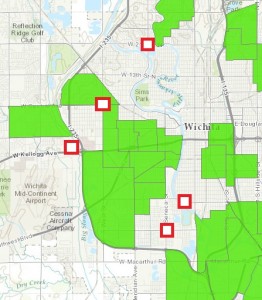
Wichita Food Deserts
I live and work towards the center of this map, right next to or on the green “food deserts”. The red squares are the supermarket complexes nearby.

Now that I’m in Wichita, I’m one street away from a food dessert.

I have one grocery store complex (Walmart Neighborhood Marketplace and Dillons) at 2 miles (an easy enough biking distance); another complex (Walmart Neighborhood Marketplace, Dillons, and ALDI) at 3.2 miles (for me, still a decent biking distance); and a third with all three stores at 3.9 miles. I struggle to come up with the store that’s within 1 mile of the majority of my census tract – but we’re still definitely not deprived.

So, I’m almost a desert dweller, officially. In reality, I’m not so sure.


Where’s baby’s bottle?

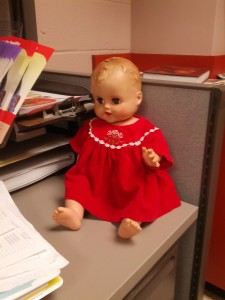
I keep a doll in my office to demonstrate breastfeeding. I keep it behind my desk because it’s really there for demo, not for children to play with. But that doesn’t stop children from wanting to play with it.

Generally, I let the children play.

One child, however, had a serious question: “Where’s this baby’s bottle?”

My breastfed baby doll

I told her that this baby didn’t have a bottle, that this baby was breastfed.

At first, mom tried to find something else in my office to take the place of a bottle. Could her daughter use the banana from the puzzle as the baby’s bottle?

She tried, but the banana just didn’t quite work.

Mommy realized that she’d just about missed a teachable moment.

“That baby doesn’t use a bottle. She gets milk from her mommy.”

Child’s eyes got wide – her mind was blown.

Milk from mommy? What a novel thought.

Small steps towards normalizing normal.