Thankful Thursday: What! All This…

My friend and I are reading The Greener Grass Conspiracy, a wonderful book on contentment that I originally picked up based on Lisa’s review. In it, author Stephen Altrogge relates a little story that Charles Spurgeon once told:

“I have heard of some good old woman in a cottage, who had nothing but a piece of bread and a little water. Lifting up her hands, she said as a blessing, ‘What! All this, and Christ too?'”

Oh, how I want my life to ring with that same spirit. The spirit that cries out that Christ is all-sufficient, and that stands in awestruck amazement at how much I have been given (no matter how small or large it might be in comparison with that of another.)

Thankful Thursday banner

This week I’m thankful for…

…family
Seeing my brother for the first time in a long time. Spending more time cuddling with my little niece. Driving and talking with my Mother. Watching movies with the whole gang. Visiting with my aunt and uncle around the fire-pit.

…friends
Spending time with Steve and Joanna and Mary around a meal. Having Ruth and Beth over for dinner after church. Sitting and chatting with Jacqueline and Jon and Cathy and Grace before the parade. A long conversation with Kathy after we were all done.

…transportation
The luxury of jumping into my car and heading out of town for a weekend. The added pleasure of hopping on my bike for a toodle about town. A comfortable seat during a commute. Books on CD I can listen to while driving.

…possessions
A lawn to mow, a mower to mow it with. A bath in which to bathe, water with which to fill it. A computer to be built, and plenty of resources for when I hit unexpected snags.

…medical care
A doctor’s office I can pop into on my way to work. The ability to make an appointment only a few days in advance. Prescription drug coverage. A chance to reduce my insurance costs by living healthfully.

…growth opportunities
The accountability of a dear friend. Theology class at church. Bible-rich expository preaching. Opportunity to serve by teaching Sunday school.

What! All this, AND CHRIST TOO?


Nightstand (August 2011)

Has August flown by or what?

I can’t believe it’s already time for another Nightstand post. Unfortunately, I just took a batch of books back to the library, so you can’t see photos of what I’ve read (except what I’ve read since Saturday or kept back for review). Fortunately, I did log my books–and I even logged them online for the time being (since my computer is still in limbo.)

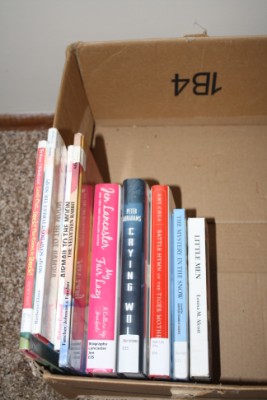
So, here’s my box of finished books followed by my list of books read:

Books read

Adult Fiction

  • Crying Wolf by Peter Abrahams
    I expected suspense based on the front cover quote from Stephen King “–something obscured by barcode–merican suspense novelist.” This didn’t turn out as suspenseful as I expected, but that was a good thing from my point of view. Instead, it was an engaging if not exactly well-told story about a poor young man, a set of rich twins, and the dangers of crying wolf.
  • The Gold Shoe by Grace Livingston Hill
    I started reading this on my way down to KC to skydive–and ended up reading the first seven chapters out loud to my traveling companions. I quoted a passage from this book in yesterday’s post
  • Duskin by Grace Livingston Hill
  • The Sacred Shore by Janette Oke and T. Davis Bunn

Adult Non-fiction

  • Battle Hymn of the Tiger Mother by Amy Chua
    Why are Chinese children (or the children of Chinese immigrants) so much more likely than Western children to be prodigies? Amy Chua says it’s because of the way Chinese parents parent. Chua begins this memoir on a soapbox–and doesn’t quite get back down as she realizes (and reveals to us in story) that Chinese mothering isn’t working with her younger daughter. I enjoyed this quite a bit-but I can understand why it was so controversial when it first came out. Chua’s Chinese parenting sounds an awful lot like child abuse to Western ears–except that these Western ears tend to register the same complaints as she against “Western parenting”, making them much more likely to consider parenting on the Chinese end of the spectrum.
  • God’s Diet by Dorothy Gault
    I reviewed this title here. Prepare for a mini-rant from this particular Registered Dietitian.
  • Dave Barry is NOT making this up by Dave Barry
  • My Fair Lazy by Jen Lancaster
    Jen Lancaster goes on a “Jenaissance”–freeing herself from the addiction of reality TV to become a “cultured woman”. I loved reading about Jen’s theatre-going experiences, pet troubles, and foot-in-mouth moments. I also loved that there was none of the conservative-bashing that seems so obligatory for memoirs these days. Jen happens to be a conservative herself, but she makes a point to leave her politics out of her writing (except inasmuch as the fact that she’s a conservative makes her even more fish-out-of-water among the hoity-toity culturata she’s now brushing shoulders with.)
  • The Most Reluctant Convert by David C. Downing
    This was a very good biography of C.S. Lewis, discussing his religious life from childhood to conversion. I wrote a mini-review in my Chronicles of Narnia Reading Challenge wrap-up post

Juvenile Non-Fiction

  • The Holocaust, Hitler, and Nazi Germany by Linda Jacobs Altman
    Not as well-organized as the other books in this series.

Juvenile Fiction

  • Little Women by Louisa May Alcott
    I had definitely forgotten a lot from when I read this as a child. I think I love this book. I quoted from it here.
  • Little Men by Louisa May Alcott
    I might love the sequel even better. There’s something about a group of almost wild children… Rainbow Valley was one of my favorites in the Anne series. Should I be surprised that I’m also in love with Little Men (or Jo’s Boys, as it has alternately been titled-Whoops, guess I was wrong on this one. Jo’s Boys is a separate book, and one that sounds rather more sensational than the wholesome Little‘s.)?
  • The Mystery in the Snow created by Gertrude Chandler Warner

Juvenile First Readers

  • Bones and the Math Test Mystery by David A. Adler

Children’s Picture Books

  • To & Fro, Fast & Slow by Durga Bernhard
  • The Girl in the Castle inside the Museum by Kate Bernheimer
  • The Tortoise and the Hare Race Again by Dan Bernstein
  • The Curious Demise of Contrary Cat by Lynne Berry
  • Are You Going to Be Good? by Cari Best
  • Easy as Pie by Cari Best
  • Goose’s story by Cari Best
  • Last Licks by Cari Best
  • Sally Jean the Bicycle Queen by Cari Best
  • What’s so Bad about Being an Only Child? by Cari Best
  • Three Cheers for Catherine the Great by Cari Best
  • Shrinking Violet by Cari Best
  • Montezuma’s Revenge by Cari Best
  • Wolf Song by Mary Bevis
  • The Artist by John Bianchi
  • Welcome back to Pokeweed Public School by John Bianchi
  • Spring Break at Pokeweed Public School by John Bianchi
  • The Velveteen Rabbit by Margery Williams Bianco
  • The People with Five Fingers by John Bierhorst
  • Turkey Bowl by Phil Bildner
  • Twenty-One Elephants by Phil Bildner
  • A Regular Flood of Mishap by Tom Birdseye
  • Airmail to the Moon by Tom Birdseye
  • Soap! Soap! Don’t forget the soap! by Tom Birdseye
  • Look Out Jack! The Giant is Back! by Tom Birdseye

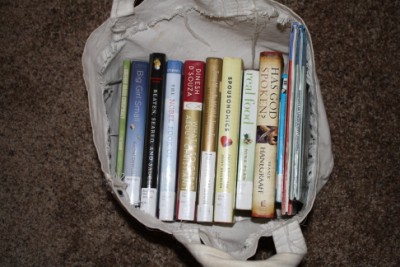
In addition to the books I’ve finished this last month, I have a number in progress (currently in a tote for easy travel!)

Books in progress

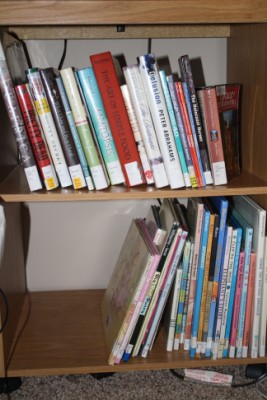
And I was unable to resist the lure of more books when I went to the library on Saturday, so I am almost certainly going to (once again) have to return books unread when I make my next trip down to the library in three weeks.

Books in the wings

Don’t forget to drop by 5 Minutes 4 Books to see what others are reading this month!

What's on Your Nightstand?


WiW: What a waste

From Grace Livingston Hill’s The Gold Shoe (published in 1930):

Then, one day, there arrived a delivery car from one of the big florist’s establishments in the city…

“Mercy!” said Hesba, “what a waste!”

“A waste?” said Marget starting back sharply from her first sweet breath of them with a hurt look in her eyes.

“Yes, sending all these here, with just us two. Not even a party or a funeral! Mercy! Do you know what those yellow roses cost, those with the yard long stems? I priced them the other day, just for curiosity, and they are seventeen dollars a dozen! Just think of that! I say that’s wicked! Think of the heathen!”

“The heathen?” said Margret puzzled. “What about the heathen?”

“Why, think what that might do for them!”

“What would it do for them?” asked Marget burying her face in the mass of lilacs, and wishing she might keep it there awhile and not listen to the grilling of Hesba’s questions.

“What would it do? Why feed them, and send them to school, and put decent clothes on their back, and teach them to be respectable citizens in the world.”

“Is that all?” asked Marget with her eyes half closed, looking at the flowers dreamily.

All? What more do you want?” asked Hesba indignantly. “Isn’t that about all one needs in life?”

“I was thinking that you might be saying it would send the knowledge of the Lord Jesus to them,” said Marget, lifting a stately lily and gazing into its golden heart.

“Oh, that! Of course, that goes too. But they have to live you know. They have to have food and clothes.”

“You think that comes first?” said Marget…

It’s a story that’s been going back at least a century–well meaning religious folk interested in social justice.

Caring for the poor. Providing food and clothes and education.

Upset with the extravagance of comfortable lives.

Nothing wrong with that.

Every Christian should be interested in caring for the poor. Every Christian should consider providing food and clothing and education. Every Christian should consider whether they are using their money wisely or squandering it on comfort.

But Marget and Hesba illustrate two completely different views of wealth and ministry.

While Hesba rages at the extravagance of a gift of costly flowers, Marget fully enjoys the gift she has been given.

While Hesba concerns herself with the physical needs of people, Marget recognizes their greatest need-their need for Christ Himself.

About 15 years ago, Charles Sheldon’s then 100 year old book In His Steps reawakened the question “What would Jesus do?”

Christians and non-Christians alike asked themselves what Jesus would do and sought to follow in the steps of the man from Galilee-the man who was famous for healing, teaching, and serving.

In more recent years, the church has turned more and more towards social justice issues–and much of it appropriately. They have heard the call of Christ to lay down their lives for others. And this is good.

But self-denial is not the gospel.

Even should we follow Christ to the cross for the sake of others,
our eulogies might still proclaim “What a waste!”

Our deaths would profit the world nothing–except that by our dying we proclaim Christ crucified and resurrected.

My crucifixion cannot save the world. My death to self cannot save the world. My giving up flowers and food so that others can have food and education cannot save the world.

I cannot merely follow in His steps in that I give of myself as He gave of Himself.
To do so would only be a waste.

In order for my following to not be wasted, I must give Him just as He gave Himself.


The Week in WordsDon’t forget to take a look at Barbara H’s meme “The Week in Words”, where bloggers collect quotes they’ve read throughout the week.


Book Review: “God’s Diet” by Dorothy Gault

Dorothy Gault has a plan to take the complexity out of diet planning. Her diet includes no counting, no nutrition panel reading, no exchanges, no dozens of rules to remember.

In fact, there’s only one rule: “If God didn’t make it, don’t eat it.”

On the surface, God’s Diet is simple, straightforward, easy. Until you start asking the big question: What hasn’t God made?

Theologically speaking, it’s hard to come up with something God hasn’t made. I can only think of one: evil. And the idea of eating evil is pretty ridiculous, if you ask me.

So what does Gault mean when she talks about what God did or didn’t make?

Turns out, what God didn’t make is flour and sugar. (Who’d have thought?) So what’s off limits is anything with flour and sugar in it. Anything else, you can eat whole hog.

At least, that’s how Gault makes it sound, though she later backtracks to say that high-fat, high-sodium, high “legal”-sugar foods should be eaten in moderation.

This diet rubbed me wrong in several ways.

The first thing I didn’t like about it was that it violated one of my most sacred food rules: Food is not a moral issue.

There’s no such thing as a “good food” and a “bad food”. Food is morally neutral (sort of like money–you know the verse about the love of money being the root of all kinds of evils?) Turning food into a moral issue binds one to a law we have been set free from in Christ. It creates condemnation where no condemnation need be and false self-righteousness where righteousness is not.

Gault speaks in direct opposition to this “food rule” of mine.

“When we eat something sinful, we need to know that it is sinful. Once again, if God didn’t make it, it must be sinful.”

Errnt. Strike one.

Secondly, the theology in this book is terrible. Gault can’t decide whether she’s a creationist or an evolutionist, constantly switching between the two depending on which provides better “support” for her diet.

She really makes no case for why God didn’t make flour and sugar-and completely ignores the many instances in which bread is made by or commanded by God.

God commanded the eating of unleavened bread, manna was used to prepare bread (with no indication of it being wrong). Jesus multiplied loaves and taught His disciples to pray “Give us this day our daily bread.” What’s more, Jesus said that He Himself was bread from heaven, and commanded His disciples to take and eat the bread that symbolized His body. If flour is indeed sinful, would Jesus have done this? Would He have told His disciples to pray: “Give us this day our daily sinfulness…and lead us not into temptation”? Would Jesus have said “I am the sinfulness from heaven”? Would Jesus have commanded His disciples “Take and sin…do this in remembrance of Me?”

Clearly this diet has everything to do with ideology and nothing at all to do with Christianity, despite the author’s references to God and the garden of Eden.

Errnt. Strike two.

Finally, Gault’s vilification of flour, specifically, has little if any scientific support.

Gault claims that flour is bad for us because it has been processed; while unprocessed grain is good for us because it is in the form in which God made it. She uses a child eating corn and ending up with drawers full of corn as an example of how corn in it’s natural state is fundamentally different from corn flour (also known as cornmeal).

In its natural state, Gault tells us, grain is indigestible. In its processed state (when ground as flour), it is digestible and therefore bad.

Come again?

Since when is something being digestible a bad thing? And even if it is, Gault mistakes visibility with reality.

The truth is that just because Gault cannot see the corn kernels in the poop after eating cornmeal does not mean that the cornmeal was fully digested.

The same fiber that is indigestible in corn is still indigestible in cornmeal. It’s just ground so you can’t see it when it comes out in the feces.

Now it’s true that some forms of processing do make chemical changes to food products–but the making of flour is not one of them. The only difference between whole grain flour and the grain itself is the size of the particles. The only difference between how the two are digested is time We don’t have to chew the flour as long, don’t have to mechanically churn it in our stomachs as long–but the starch is the same starch and the fiber the same fiber.

There is no evidence that whole grain flour and unprocessed whole grains are fundamentally different.

Errnt. Strike three.

She’s out, and so is this diet.


Rating: 0 stars
Category: Diet
Synopsis:Gault proposes a “simple” but nutritionally and theologically unsound diet based on one rule: “If God didn’t make it, don’t eat it.”
Recommendation: Don’t read it. Don’t believe it. Don’t promote this sort of thinking. It’s wrong.

Safely Falling

I was completely out of control, but I was attached to one who knew what was going on and who was in control.

The air roared past my ears as we free-fell towards the ground.

My mind strained to remember my instructor’s directions, even though I could no longer hear his voice.

Soaring above the clouds

Arch my back, kick my bottom, hands hanging on to my harness chicken wing fashion.

Content that I’d followed instructions, I could enjoy the ride.

Exhilaration.

Free-falling.

Amazing.

He pulled the chute, the free-fall ended far too soon. I wanted it to last forever.

Soaring through the clouds

Now he guided my hands into the chute’s handles, asked me if my harness was comfortable. Everything was fine.

He told me he would be loosening the connections that held us. I’d drop a bit lower, so inches would separate our bodies.

Now, here, I felt a glimmer of fear. I knew it would be safe, I knew I’d still be attached. But it wouldn’t be the same. Once he’d lowered me, I wouldn’t be able to feel his presence. Would I be able to make it without that sure sensory feedback reminding me that I was safe?

I would choose to trust, I told myself–and so I did.

Flying, closer up

I relaxed as the distance grew between us.

I was still safe, still connected, still hearing his voice. He was still guiding the chute.

He asked me if I wanted to do anything fancy–circles, loop-de-loops, or the like. “Or would you rather just hang out?”

It was hard to push the words from my lungs: “I’d rather just hang out.”

“That’s okay,” he told me, “we’ll just hang out.”

And so we did, arms outstretched, hands in the chute’s handles. We hung there, suspended between sky and earth, observing the scenery below as we softly drifted along.

My head started spinning. I willed it to stop. I was enjoying this too much to be sick.

I wanted to see.

Preparing for landing

I told my instructor that I was getting dizzy. He encouraged me to breathe deeply, said he’d go gently.

I breathed, my eyes taking in everything I saw.

Beside me, Joanna and her instructor were doing crazy moves.

I smiled and breathed and wished I could be flying forever, and never.


Burning coals on my head

I am the world’s worst neighbor.

I let my grass go so long I had to use my hedge-clippers to get the crab grass short enough to mow.

No joke.

So when my neighbor starts his lawn mower when I’ve decided to at last tackle the front yard, I’m feeling serious guilt.

I see him glance over at my old-fashioned mower taking its hundred passes.

He’s done with his front yard and moves on to his back.

He’s mowing a little extra, taking a few feet out of my backyard.

Instead of returning my negligence, he’s showing me kindness.

My hair’s almost on fire.

Darn it all. Now I feel obligated to mow the BACK YARD too.

I haven’t even attempted that since the Fourth of July.

“Beloved, never avenge yourselves, but leave it to the wrath of God, for it is written, “Vengeance is mine, I will repay, says the Lord.” To the contrary, “if your enemy is hungry, feed him; if he is thirsty, give him something to drink; for by so doing you will heap burning coals on his head.”
~Romans 12:19-20 (ESV)


WiW: Real (Musings from the Velveteen Rabbit)

The Week in Words

“What is real?” asked the Rabbit one day, when they were lying side by side near the nursery fender, before Nana came to tidy the room. “Does it mean having things that buzz inside you and a stick-out handle?”

Real. Meaningful. Authentic. Significant.

Things I want to be.

Things I want my life to be.

But what is real?

Is it having all the bells and whistles? Is it being the very latest and greatest?

“Real isn’t how you are made,” said the Skin Horse. “It’s a thing that happens to you. When a child loves you for a long, long time, not just to play with, but REALLY loves you, then you become Real.”

No, real is not about the gee-gaws and do-dads. It’s not about externals.

The best job, the biggest house, the nicest car.

Those things aren’t what makes life meaningful, real, significant.

What makes me real is the One who loves me.

“Does it happen all at once, like being wound up,” he asked, “or bit by bit?”

“It doesn’t happen all at once,” said the Skin Horse. “You become. It takes a long time…. Generally by the time you are Real, most of your hair has been loved off, and your eyes drop out and you get loose in the joints and very shabby.”

Real doesn’t happen in a day.

Authenticity. Meaningfulness.

A flash in the pan, here and then gone might be exciting, but it’s not real.

Real takes time. It takes work.

It’s faithful presence. It’s being used. It’s giving pieces of yourself away. It’s being with people in the tough times and in the joyous times and in every time in between.

“The Rabbit sighed. He thought it would be a long time before this magic called Real happened to him. He longed to become Real, to know what it felt like; and yet the idea of growing shabby and losing his eyes and whiskers was rather sad. He wished that he could become it without these uncomfortable things happening to him.”

What I would like to have the end result without the middle.

To be effective without having to get up every morning and go to work. To make a difference without having to get involved in people’s messes. To be authentic without having to expose my own messes. To be holy without having to fight against my flesh.

Oh that Real could be achieved in one glorious battle instead of through this tedious, painful process called sanctification.

The process of becoming real is boring.

Yet boring is the life to which God has called most of us.

“Scripture also calls us to embrace the mundane and ordinary as holy and beautiful: ‘… aspire to live quietly, and to mind your own affairs, and to work with your hands’ (1 Thessalonians 4:11).”
~Andrew Byers, in We Need Boring Christians

And in the boring, we become REAL.

Meaningful.

Authentic.

Significant.

*****All quotes except the last taken from Margery Williams Bianco’s The Velveteen Rabbit*****


Don’t forget to take a look at Barbara H’s meme “The Week in Words”, where bloggers collect quotes they’ve read throughout the week.


On Bibles that aren’t translations (Choosing a Bible, Part 2c)

Now that you understand formal vs functional equivalence, have heard my best argument for functional equivalence, and have discovered my personal bias for formal equivalence…

you’re ready for a bunny trail.

Right?

Of course right.

The categories that I’ve deliberately left out of my discussion of methods of translations are the one-man translation and the paraphrase.

The One-Man Translation

The most famous of one-man translations (perhaps the only one popularly available?) is Eugene Peterson’s The Message.

The Message is a translation, in that it was translated from the original languages (Greek, Hebrew, and Aramaic) by a scholar in those languages (Peterson). But it differs from most other translations in two important ways.

First The Message goes a step further than functional equivalence in trying to make the “tone” of the text closer to the original. This is called “idiomatic” translation. When we take into account the fact that the New Testament was written in Koine (or common) Greek rather than the more formal classical Greek, this mode of translation makes sense. The New Testament (at least) was written in the vernacular, not in the language of the elite but in the language of the common man–street language. The Message approximates this effect. This is great in one respect and not-so-great in another. Remember that the further we get from a word-for-word translation, the more opportunity there is for interpretation to be included in the translation. So The Message can contain a lot of interpretation.

The other distinct way in which The Message differs from other translations is that it is a translation undertaken by one man. While most Bible translation is done by a relatively large group of scholars, The Message was translated by just one scholar. This means that unlike other translations, The Message is prone to reflect the linguistic and theological strengths and weaknesses of its one translator. Where other translations have a system of checks and balances to correct for linguistic weaknesses and theological slants, a one-man translation does not.

Due to the high probability that The Message and other one-man translations (if they exist) contain personal interpretation, I do not believe that they are a good choice for personal study. The Message can be a useful tool, and is definitely an interesting read, but it should not be one’s primary “Bible”.

The Paraphrase

The second category of Bible that I haven’t yet discussed is the paraphrase. Paraphrases are, well…

How exactly does one describe a paraphrase?

A paraphrase is what you get when someone puts the Bible into their own words. Unlike with translations, where scholars work from the original languages and translate the original language into a modern language, paraphrases generally take an English translation as their starting point.

As a result, the paraphrase is VERY prone to interpretation, and lacks the scholarship that goes into creating a functionally-equivalent translation. Translators of a functional-equivalence Bible go to great pains to ensure that the way they are translating reflects the best scholarship on what the original audience would have understood from individual words, phrases, and pericopes. Paraphrasers have no such scholarship underlining their word and phrase choices. They are simply rephrasing the English Bible as they understand it–not attempting to translate it as it should have been or would have been understood by its original audience.

The primary example of a paraphrase is The Living Bible (not to be confused with the New Living Translation, which is truly a translation in the functional-equivalence camp).

My opinion toward paraphrases is similar to my opinion on the one-man translation. They can be interesting to read, but they should never be used as your primary “Bible”.

When choosing a Bible, much better to read the words of God than the words of man. Choose a translation (not a one-man translation or a paraphrase.)


A Case for Functional Equivalence (Choosing a Bible, Part 2b)

Being a cerebral sort with a high reading level and general affinity for both grammar and poetry, I gravitate towards translations that use formal equivalence. Many in my family do the same, for similar reasons (we’re rather a nerdy family with quite a few high “T” people.)

When my dad switched from the formal equivalent NASB to the functional equivalent TNIV, it sent shockwaves through the family. We would never have guessed, Dad being the most “T” of us all.

But Dad had a compelling case to make for his switch. He had been convinced after reading Gordon Fee’s How to Read the Bible for all it’s worth that the vocabulary and syntax of formal equivalence is a stumbling block that stands in the way of clear evangelistic presentation of the gospel. Apparently, Fee argues that believers who use formal equivalence for their daily reading, study, and preaching–even if they paraphrase Scripture–will still tend to use the same awkward language style in their presentation of the gospel, alienating their a-religious audience in the process.

This seems a bit far-fetched to someone who has grown up speaking of the “Grace of God” and “fear of God”, who is used to thinking of some people or things as “Bless-ed”, and who understands the word “begotten.” But to the average a-religious individual, those figures or speech and ways of expressing oneself are as foreign as if someone had come to me speaking in the Thees and Thous and sinneths of the KJV. I can understand the language of the KJV, but it is certainly not my language of fluency–and the use of thees and thous and sinneths in a message would distract me from the message. In the same way, these ways of speaking which I find so familiar are unfamiliar and distracting to the a-religious.

It’s a compelling argument-probably the most compelling I’ve ever heard–for the use of functional equivalence. Certainly, I can see the utility of a translation using functional equivalence for a seeker’s study or for a new believer’s personal devotional life. The idea that we speak what we read also makes a case for why mature believers might want to read and memorize from translations that use functional equivalence.

I haven’t switched to functional equivalence myself, but hearing my dad’s argument has forced me to rethink my evaluation of other people’s translational choices.

I am inclined to ascribe laziness to users of functional equivalence. This argument reminds me that their motivation might actually be love.

I say scholarship leads me to use formal equivalence. This argument reminds me that my motivation may actually be pride.