Christianity Distilled

In The Factastic Book of 1001 Lists, the first page of the section of world beliefs includes four lists: “The Five Pillar of Islam”, “Jewish Rules and Rituals”, “The Five K’s of Sikhism”, and “Noble Truths of Buddhism.”

My eyes quickly jumped over these headings, searching for the one that would seek to distill Christianity into a list four or five points long.

I never found that list.

The Factastic Book of 1001 Lists didn’t have it–and as I considered why, I realized that the reason was simple.

Christianity cannot be distilled into a list.

Not a list of principles or a list of rituals or a list of rules.

No, the author of this book would be quite wrong to distill Christianity into a list. After all, I learned in grammar that lists should contain more than one item.

And Christianity is distilled, not into a list of items, but into One Word:

Jesus

The Word through Whom the world was made.

The Word for Whom the world was made.

The Word Who gives light to every man.

The Word Whose death offers life to every man.

The Word at Whose name every knee bows and every tongue confesses.

Jesus

In one Word, the meaning of all of life.

We have no five pillars, but we have one foundation: Jesus

We have no rules or rituals, but we have one ruler and priest: Jesus

We have no five K’s, but we have one King: Jesus

We have no four noble truths. We have only One: Jesus

“I am the way, the truth, and the life. No one comes to the Father except through Me.”
~John 14:6


Hearing History

I live within minutes of my “home” office, but I drive around five hours a week to consult with my other two facilities.

This gives me plenty of time to listen–

and since I decided to be ambitious and include audio works that are an independent work of art in my “read every book” goal, it gives me a chance to breeze through Eiseley’s compact disc collection.

I’m almost done with the Christian music section–and I’ve made decent headway in classical and jazz. With trepidation, I’ve checked out a few rock and roll CDs.

But when I was trolling the library during my last visit, I happened upon a set of discs that fascinated me greatly.

The Words and Music of World War II.

“Cool.” I thought, and threw it in my basket.

If only I’d known.

As it was, I didn’t open the case or bother to look at it further until several weeks later when I’d just finished my current CD and was ready for another for my commute.

I happened upon this title and popped it in to hear something spectacular.

An air raid siren sounds.

A crackling radio voice informs me that Pearl Harbor has been attacked.

Music fills my car, forties swing reminding me to remember Pearl Harbor.

President Roosevelt begins his iconic address “a date which will live in infamy…suddenly and deliberately attacked…”

Forties swing takes me away again.

Back and forth it goes, a narrator describing the events of the war–then a song from that era. A radio reporter tells of flying over Germany with a group of bombers–then music. Announcers tell British parents exactly what items their children should carry in the hand luggage they take to school the day they will be evacuated to the country to escape the air raids. Another song fills the airwaves.

Two full discs, a drive to and fro. Music and memories, sad and sweet, crazy and comical.

It was a much different look at the war than the picture I’d been reading from inside Germany. This was the home front. America. Great Britain.

This started much later, only after Germany had invaded Poland and Great Britain declared war, making it an official “World” War.

But it was a necessary look. A reminder of how others’ lives, so far away, were affected or not affected by what was occurring in Europe and the Pacific.

And it was fun–swinging, rollicking tunes. Sad, sentimental songs. Hilarious bits like “Atom and Evil”.

Hearing History, almost like living history–a tiny piece of what life was like then.


Nazi History: Some Cliff’s Notes

Some people figure that the internet makes books obsolete.

Why buy a book, why spend money and space on a paper copy of something when you can find it all online anyway?

Encyclopedias, once the hallmark of a well-educated home, have all but disappeared as wikipedia and online subscription “encyclopedias” rush to take their place.

For my part, I won’t be throwing away my books any time soon.

‘Cause while the internet is great for looking stuff up quickly or following rabbit trails endlessly, books are still best for immersing yourself in a topic.

Like when Bodie Thoene’s Zion Covenant series turned me into a fan of history.

I suddenly wanted to learn everything I could about World War II and the events leading up to it.

That’s a rather vague topic for the internet to handle.

Instead, I turned to my (not-so-local-anymore) library.

As per my M.O., I headed to the children’s section first for my Cliff’s Notes.

What I found was three excellent resources for immersing myself in World War II (particularly in the events leading up to World War II): The Rise of the Nazis by Charles Freeman, The Nazis by William W. Lace, and Hitler Youth: Growing Up in Hitler’s Shadow by Susan Campbell Bartoletti.

Nazi History books

The Rise of the Nazis begins its coverage with the opening of a new session of the Reichstag, this time with Adolf Hitler as the chancellor of Germany. Having described the crux of German history as it relates to the Nazi party, Freeman moves back in time to the events that led up to that fateful moment: the Versailles treaty and it’s crippling demands on Germany, Hitler’s educational and military background, the early life of the German Socialist Worker’s Party that would become the Nazis, Hitler’s entrance to the party and rapid domination of its politics, the failed coup staged by the Nazis, and the imprisonment during which Hitler wrote his Mein Kampf.

By the last chapter, Freeman is ready to move past the opening scene. He quickly describes how Hitler, once appointed as chancellor, took over the presidency and ultimately, the country.

This story ends, as promised, just as the Nazi party reaches its political pinnacle: at the declaration of Adolf Hitler as Germany’s Fuhrer (supreme leader).

William W. Lace’s The Nazis covers this same material, but with a different emphasis. While The Rise of the Nazis focuses on how the party and Hitler came into power, The Nazis (a book in the Holocaust Library) focuses on the Nazis’ attitude towards the Jews and how the Nazi takeover of Germany affected the Jews.

The events leading up to Hitler’s takeover of the German government take up about two-thirds of the book, while the final third rushes quickly through the high (or perhaps low?) points of the War in Europe, how the war ended, and what the results of the Nuremberg trials were.

Unlike The Rise of the Nazis, which is simply an informative book, The Nazis introduces a question for the reader: What were the moral or spiritual causes that allowed Nazism’s blatant evil to run rampant in Germany–and how can such an evil never be allowed to rise again?

In this sense, The Nazis is an ideological story. Every event is told in such a way as to inspire horror and repugnance in the eyes of the reader. (Not that one should not be horrified by the acts of the Nazi party…) The goal of this book is to impress upon its readers the necessity of never again allowing evil to reign as it did in Nazi Germany. (Which isn’t a bad goal, but it’s a goal beyond just information nevertheless.)

Hitler Youth: Growing Up in Hitler’s Shadow takes a completely different approach to the Nazis than the previous two books.

While The Rise of the Nazis informs the reader and The Nazis convinces the reader, Hitler Youth enjoins the reader to empathize–this time not with the Jews against whom the Nazis rage was focused, but with the children who joined the Nazi party, the children who couldn’t join because they were racially “unfit”, the children who spoke out against the Nazi party.

Hitler Youth describes the incredible pull of the scout-like community the Hitler Youth movement created, the heady sense of power its organization imparted to youth, the voluntary-and-then-compulsory character of participation.

Telling the true stories of specific, individual children–Germans, Jews, girls, boys, loyal Nazis, and subversive anti-propagandists–Hitler Youth describes the double tragedy of Hitler’s methods.

In raising up a children’s army, he destroyed both the children that he lured through adventure and false loyalty and the rest of the world through those children.

This was an intensely moving book.

All in all, I am glad to have had a look at the Nazi party through the very different viewpoints of each of these books.

Certainly, there is still much that I do not know (especially since these barely glanced on the war itself–or the Holocaust “proper”)–but I feel that these three books gave me a good introduction to some of the historical and moral dilemmas that surround World War II.

I’m heading back to my library on Saturday, and I’m ready for the big guns now. It’s time to start looking for adult histories.

Sorry internet, you’re just not cutting it for this newly-minted history lover.

In Praise of Historical Fiction

It may shock some of my readers, who are inclined to think highly of me (whether I deserve it or not), but I am not a fan of history.

I never have been.

While I looked with fascination at the fashions of bygone eras, was interested in olden modes of speech or transportation, and often envied historical skills in handiwork, I cared nothing for all the names and dates and circumstances and conflicts that make up the study of history.

I occasionally feigned interest in history so as to take interest in my brother (an avid history buff). But frankly? I didn’t understand the hoopla.

Oh, I played lip service to the value of history. You know, the whole “Those who do not learn from history are doomed to repeat it” and “if I have seen further it is only by standing on the shoulders of giants” and all that.

But really, I’ve never been a fan of history.

At least, not until a few months ago when I picked up a copy of Bodie Thoene’s Vienna Prelude.

There I read of Adolf Hitler’s “peaceful” annexation of Austria, of Herman Goring and Winston Churchill, of the SA, the SS, and the Gestapo.

I continued reading and learned of Kristallnacht, of Nazi concentration camps, of the traitorous appeasement prize Britain awarded Nazi Germany by handing over Czechoslovakia. I learned of the narrow passage connecting Poland to the sea–and separating Germany from Germany. I learned of the pogroms and of the falsehood fabricated to justify the invasion of Poland.

I started to wonder what was true and what was fiction, so involved was I in the story unfolding in novel after novel.

I no longer cared only about the protagonists. I started to care about the whole story–the story behind and below and around the one created in the imagination of the author.

I became a fan of history.

Now I begin my journey into history, fueled by the fiction of an author who cares about fact.

My life, my outlook has been indelibly changed.

Such is the power of good historical fiction.


WiW: The Blessed Life

The Week in Words

Augustine, in the tenth book of his Confessions, goes into great detail of the pull that temporal things hold for him–beautiful sights, lovely sounds, pleasant odors, the pursuit of knowledge, the enjoyment of food.

He speaks of his quest for asceticism in order to better love God–and of the corresponding pull of his flesh for the lusts of the flesh, the lusts of the eye, the pride of life.

I don’t know that I agree that Augustine’s asceticism is necessary for the full pursuit of God–I’m not sure that it’s necessary to eschew all earthly pleasures in order to chase after the pleasures found in God.

Yet, in this one point, I am fully in agreement with Augustine: Christ Himself is the Treasure, the Pleasure for Whom it is worth forsaking all else.

“…to those who freely worship You, You are Yourself their joy. And even this is the blessed life: to rejoice before You, in You, because of You; even this and none other. As for those who think there is another life, they are chasing after another joy, and not a true one.”
~St. Augustine Confessions

I pray that every beauty that comes before my eyes would cause my eyes to long for the sight of the One whom I, not seeing, believe, and rejoice in hope. (John 20:29, Romans 5:1-2)

I pray that every lovely strain that meets my ear would cause my ears to burn for the One whose words are life. (John 6:63,68; Luke 24:31)

I pray that every tantalizing scent that wafts beneath my nostrils would cause my nostrils to yearn for the fragrance of the life that is found in Christ. (2 Corinthians 2:14-15)

I pray that every sweet taste my tongue savors would lead me to better taste and savor the God who is good. (Psalm 34:8)

I pray that every comfortable touch that my body feels would make my body long for the comfort of my eternal Lover’s embrace. (2 Corinthians 1:3-5)

I pray that every delightful bit of knowledge that enters my mind would cause my mind to long for knowledge of the One who is Wisdom and in whom is found all wisdom. (I Corinthians 1:24, 30)

For He, He is a treasure above all else. He is the Pleasure beyond all the pleasures the world can offer. He is the Joy beyond every fleeting joy this world delivers.

May I find Him–and in finding Him, find all.

“Again, the kingdom of heaven is like treasure hidden in a field, which a man found and hid; and for joy over it he goes and sells all that he has and buys that field.”
~Matthew 13:42

Don’t forget to take a look at Barbara H’s meme “The Week in Words”, where bloggers collect quotes they’ve read throughout the week.


Flashback: Physical Education

We were homeschooled, remember, and we were relatively active kids–but “PE” did not rank high on the list of educational priorities. In fact, there was really only one year that I remember us having a formal “P.E.” program.

Flashback Friday buttonToday Linda asks… Was physical fitness a focus in school when you were growing up? Did you have P.E. in elementary school or just recess? Was recess organized games or just free playtime?…

It was the year 1990.

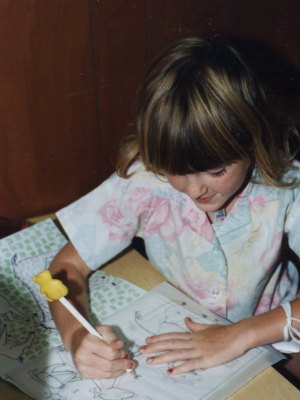
Anna was six, a first grader.

Anna doing school

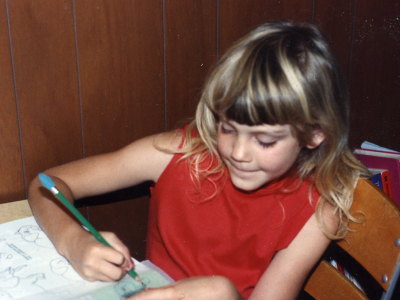
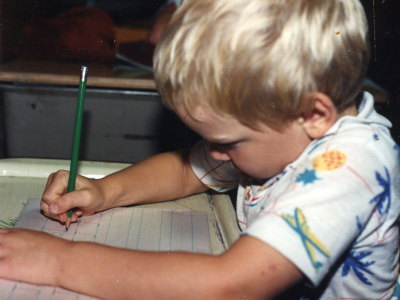
I was five, a kindergartener.

Rebekah doing school

Joshua was three, a preschooler.

Josh doing school

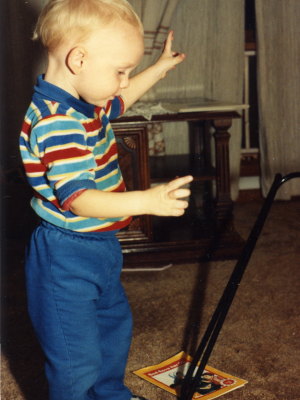
Daniel was 18 months-ish, a toddler.

Dan looking cute

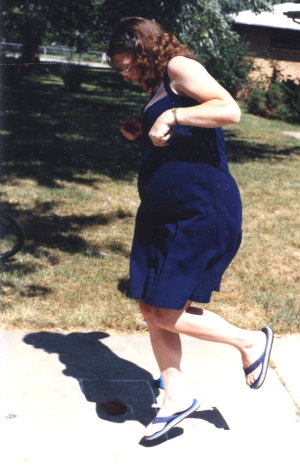
Mom was 8 months pregnant with John.

Mom teaching us to play hopscotch

She taught us how to play hopscotch.


Read other memories about P.E. at Mocha with Linda’s Flashback Friday Meme


Thankful Thursday: Things that Didn’t Happen

Often we are thankful for things that do happen–and complain over things that don’t. I know I do.

But sometimes, it’s worthwhile to stop and think about all the things that haven’t happened–and be thankful for those.

This week, I’m thankful…

…that when my eyes suddenly itched and filled with tears and I could no longer see, I did not wreck my car. (I was able to turn to a side street where I parked for five minutes until I could see again to return home.)

My eyes

My eyes once they’d calmed down–and I had gotten safely home.

…that I did not have a resident inexplicably lose 35 lbs in 6 weeks.

…that I did not slip on the ice on my way into work

…that I have not received the wrath I was due.

Thankful Thursday banner

I’m also thankful for some things that DID/WILL happen…

…that I had a song of worship in my heart as I started work

…that I somehow had a restful day of labor

…that I received a letter from my brother in the mailbox

…that I have a concert to look forward to this evening

…that I have obtained an inheritance in Christ Jesus (Eph 1:11)


I love Columbus, NE

The weather forecast was predicting half a foot or so of snow in Grand Island yesterday afternoon–and when I called one of my Grand Island facilities at 7 yesterday morning, the dietary manager said she had little for me to look at.

Not relishing the thought of getting stuck in Grand Island overnight, I elected to stay in Columbus and run some errands–and then work from home on some menu stuff (that I have a hard time doing in the office where there are interruptions galore.)

My first order of business was errands.

Errands. I don’t really relish them, but these ones were somewhat important.

I turn old next week, so it was time for me to get a new driver’s license–and probably time for my license to reflect my new dwelling place as well.

Furthermore, just over two years ago, my car (Jack) was rear-ended and I had to buy a new car (Luci). Which means that registration is due this month. And it’s probably about time that my license plates reflect my new dwelling place.

What’s more, Nebraska generally holds primary elections in May–and though I’m not quite sure whether we’ll have any of note this year, I make it a point to vote in every election. Except that my voter’s registration says that I live in Lincoln, which is definitely no longer the case. It’s time my voter’s registration reflected my new dwelling place.

Thankfully, all three errands could be completed in one place–the Platte County Courthouse.

I have to say that I was a bit leery of becoming an official “10 County” resident (mostly because 10 County drivers lack the get-up-and-go of Lincoln drivers)–but my experience at the Platte County Courthouse largely assuaged my fears.

It was there that I discovered that I love Columbus, NE.

Why do I love Columbus, NE?

First, because when I went to get my car registration taken care of, the lady at the desk assumed that I had specialty plates since my current license plates started with “RFS” instead of the ubiquitous number designating the county (Platte County is “10 County”, as mentioned above.)

I had to explain that no, those plates weren’t specialty plates. They were LANCASTER COUNTY plates. (The three largest counties in Nebraska–Douglas, Lancaster, and Sarpy–have enough people that they need the extra leeway allowed by the 26 letters over the 10 numbers, so they use a three letter/three number combo instead of the “County number-dash-four digit code” that the rest of the counties use.)

Then it came time for ME to get an education on getting a license plate in Platte County.

The gal at the desk asked me what I’d like as my leading letter.

“Leading letter?” I was thoroughly confused.

“How about ‘R’ for your first name, since we don’t have ‘M’?”

“Okay,” I responded, mystified.

It was then that she handed me a looseleaf notebook turned to a page with two columns of handwritten numbers.

R000
R001
R002
R003

“Pick your plates. If a number’s crossed out or has a name beside it, it’s not available.”

And so, while she entered my information into her computer system, I picked out my license plate number and wrote my name beside it.

10-R717

The lady checked what I’d written and marched off to get me my plates.

10-R717

Yes, I love Columbus, NE.

The rest of my errands weren’t quite as interesting (or unexpected)…except for my moment at the DMV where the attendant snapped a picture of me grinning my head off.

They don’t let you smile for Driver’s License photos in Lincoln. In Lincoln, they insist that you look sober.

I have to say…I love Columbus, NE.


Actors on a Stage

Hypocrite.

The word has come to mean someone who says one thing and does another–or, even more commonly, one who holds others to a standard that he himself does not live up to.

But that isn’t what hypocrite always meant.

According to the Zondervan Pictorial Bible Dictionary (edited by Merrill C. Tenney), the word hypocrite in the New Testament comes from the Greek hypokrinomai: to act a part in a play.

Being a hypocrite doesn’t mean saying one thing and doing another. It means acting one way and being another.

An awareness of the true meaning of hypocrite draws Jesus’ indictment of the Pharisees in Matthew 23 into sharp relief.

“But woe to you, scribes and Pharisees, hypocrites! For you shut up the kingdom of heaven against men; for you neither go in yourselves, nor do you allow those who are entering to go in.”
~Matthew 23:13

The scribes and Pharisees made themselves out to be arbiters of the kingdom of heaven, claiming by their rules to determine who goes in and out. Yet for all their playacting, they had no entry into the kingdom themselves.

“Woe to you, scribes and Pharisees, hypocrites! For you travel land and sea to win one proselyte, and when he is won, you make him twice as much a son of hell as yourselves.”
~Matthew 23:15

The scribes and Pharisees went around making converts, proselytizing Gentiles that they might become “sons of Abraham.” Yet they themselves were not sons of Abraham but sons of hell (cf. John 8:39, Romans 4:11-12).

“Woe to you, scribes and Pharisees, hypocrites! For you pay tithe of mint and anise and cumin, and have neglected the weightier matters of the law: justice and mercy and faith. These you ought to have done, without leaving the others undone.”
~Matthew 23:23

The scribes and Pharisees made great show of their attention to the law, but really they had no regard for the law. Their tithes were only playacting, a pretense.

“Woe to you, scribes and Pharisees, hypocrites! For you cleanse the outside of the cup and dish, but inside they are full of extortion and self-indulgence.”
~Matthew 23:25

The scribes and Pharisees had elaborate rituals for ceremonial cleansing–and worked diligently to never be declared “unclean.” Yet their cleaning was like a young child polishing the outside of a cup full of mud–nothing more than dress-up.

“Woe to you, scribes and Pharisees, hypocrites! For you are like whitewashed tombs which indeed appear beautiful outwardly, but inside are full of dead men’s bones and all uncleanness. Even so you also outwardly appear righteous to men, but inside you are full of hypocrisy and lawlessness.”
~Matthew 23:27-28

The scribes and Pharisees took great care to be seen as righteous. They got into character every morning. But this was a role they played, not character they possessed. Really, they were playactors who despised God’s righteousness.

“Woe to you, scribes and Pharisees, hypocrites! Because you build the tombs of the prophets and adorn the monuments of the righteous and say, “If we had lived in the days of our fathers, we would not have been partakers with them in the blood of the prophets.'”
~Matthew 23:29-30

The scribes and Pharisees made a show of mourning at the graves of the righteous, saying that they would never have rejected those righteous ones as their fathers did. Yet this was only an act, for the Righteous One stood before them and they rejected Him–even sending Him to the cross.

Actors on a stage.

Pretending to be righteous, to be devout, to be sons of God.

It’s only a play-act, a charade, hiding who they really were.

Lawless, revelation-rejecting sons of the devil.

Only when the costume is torn asunder, when the charade ceases, can they be seen for what they are.

Only when the costume is left behind, when the players break from their lines, can they be transformed into what they had earlier only pretended to be.

Leave behind the ACT.
Leave behind the bravado that makes you think you are strong.
Leave behind the baubles that makes you think you are rich.
Leave behind the costume that makes you think you are clothed.
Stand exposed as wretched, miserable, poor, blind, and naked.
Buy gold and become rich.
Buy white garments and be clothed.
Get eye salve that you may see.
Come to Jesus, and BE.

“Because you say, ‘I am rich, have become wealthy, and have need of nothing’—and do not know that you are wretched, miserable, poor, blind, and naked— I counsel you to buy from Me gold refined in the fire, that you may be rich; and white garments, that you may be clothed, that the shame of your nakedness may not be revealed; and anoint your eyes with eye salve, that you may see. ”
~Revelation 3:17-18


WiW: Outsourcing humanity

The Week in Words

“Peter Suderman…argues that…’it’s no longer terribly efficient to use our brains to store information.’ Memory, he says, should now function like a simple index, pointing us to places on the Web where we can locate the information we need at the moment we need it….
Don Tapscott, the technology writer, puts it more bluntly. Now that we can look up anything ‘with a click on Google,’ he says, ‘memorizing long passages or historical facts’ is obsolete. Memorization is ‘a waste of time.'”
~Nicholas Carr The Shallows

Memorization is a waste of time, Tapscott suggests.

I understand where Tapscott is coming from.

If memorization is merely a means by which information is stored for future recall, information can be stored much more easily, with much less work, online.

Why memorize sports stats if I can just look them up online whenever I need them? Why memorize the dates of friend’s birthdays when Facebook can remind me on the day?

“[Clive Thompson] suggest that ‘by offloading data onto silicon, we free our own gray matter for more germanely ‘human’ tasks like brainstorming and daydreaming.'”
~Nicholas Carr The Shallows

It’s a nice idea. Let the computers do the dreary work of memorizing. Let’s stick to the parts that make humans unique. The stuff that can’t be outsourced.

Thompson lists brainstorming and daydreaming as more “germanely” (fittingly, appropriately) human tasks than the task of memory.

In a way, he’s right.

We can outsource “memory” (the storage of facts) to computers–but we cannot outsource brainstorming or daydreaming.

As such, brainstorming and daydreaming are more germanely human than memory.

But he fails to mention what I think is an even more germanely human task–the task of thinking.

Humans are unique among created beings in that they have a mind in addition to just a brain.

Humans can think. They can sort through stored information. They can make new connections between information. They can discover new applications of information. And they can be transformed as they think through information.

You can memorize without thinking. Computers do that.

But I don’t know that you can think without memory.

Thinking. It’s an integral part of the Imago Dei.

And memory is an integral part of thinking.

That’s why I disagree with the above commentators.

We can’t outsource memory–because if we do so, we lessen our ability to think. And in doing so, we lose an essential part of what it means to be human.

That’s one thing we can’t outsource.

Don’t forget to take a look at Barbara H’s meme “The Week in Words”, where bloggers collect quotes they’ve read throughout the week.