Nightstand (April 2010)

It’s time again to report the contents of our Nightstands, a la 5 Minutes 4 Books. I was hoping to be able to link up before I left for my interview–but I s’pose 6 am is a little early to expect a post to be up by. So enjoy browsing my books and check out 5M4B to see more Nightstand posts.

Last month’s nightstand:

On my nightstand

What I actually read this month was:
(Links lead to my reviews of the book, never to a site selling you something.)

Fiction

  • The Apothecary’s Daughter by Julie Klassen
  • Divine and Human (and other stories) by Leo Tolstoy
    I haven’t read many short stories since my anthology days in middle school–but this collection of short stories by Tolstoy definitely piqued my interest. Like I noted when I reviewed Resurrection, Tolstoy’s characters are fantastic and the interactions between them often complex–but Tolstoy tends to moralize and certain of the stories can be heavy-handed in their conviction that socialism is the appropriate application of Christ’s words. Now that I’ve read a collection of Tolstoy’s works from after his conversion to Christ and embrace of pacifism and socialism, maybe I’ll have to read some of his earlier, better known works. Anybody got suggestions for my next Tolstoy read?
  • Mozart’s Sister by Nancy Moser
  • Once upon a Summer by Janette Oke

Nonfiction

  • Bible Babel by Kristin Swenson
  • Biology: High School Review by Princeton Review
  • The Blue Zone by Daniel Buettner
  • The Glass Castle by Jeannette Walls
  • Home by Julie Andrews.
  • Male/Female Roles: Opposing Viewpoints
  • The Power of Half by Kevin and Hannah Salwen
  • The Ten Big Lies About America by Michael Medved
  • Unveiling Islam by Ergun Mehmet Caner and Emir Fethi Caner
    I also wrote extensive notes on this title as I read it.
  • Vegetables Every Day by Jack Bishop
    I made several recipes from this book and was quite pleased with the results. I modified a recipe for honey glazed parsnips and liked it so much that I posted my modified version. I’ll probably be checking this one out of the library again–it has TONS of vegetable recipes, most of which can be easily modified as needed. This is a book worth having.
  • Words to Live By by Charles Panati
  • The World’s Last Night and other essays by C.S. Lewis
  • A Year of Blind Dates by Megan Carson

Juvenile

  • Catch-up Children’s Picture Books ALBOROUGH-ALIKI (11 titles) including:
  • Children’s Picture books author ALLARD-ANDERSEN (68 titles) including:
  • The Haunted Cabin Mystery by Gertrude Chandler Warner
  • I, Coriander by Sally Gardner
  • Inkdeath by Cordelia Funke
    It took me several chapters to get hooked into Inkheart. I slipped easily back into that world with Inkspell. And Inkdeath absolutely captivated me. This is a rare trilogy that improves with every tale.
  • The Melted Coins by Franklin Dixon

This month’s nightstand
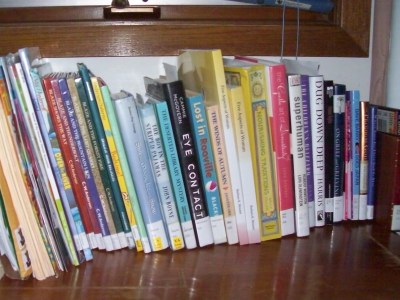
On my nightstand

Fiction

  • Eye Contact by Cammie McGovern
    Added to my TBR list after reading a review by Framed and Booked
  • Lost in Rooville by Ray Blackston
  • Washington’s Lady by Nancy Moser
  • Where Love is, There God is also by Leo Tolstoy
    I’m dancing around reading the big two: Anna Karenina and War and Peace. I think my library has one more collection of short stories that I can procrastinate with before I start in on the two that still manage to majorly intimidate me (despite the fact that I enjoyed Resurrection–which is almost as long as Anna Karenina–a great deal.)
  • The Winds of Autumn by Janette Oke

Nonfiction

  • The Children’s Blizzard by David Laskin
    Added to my TBR list based on somebody’s review–but unfortunately this was before I started saving the locations of all the reviews that got added to my TBR list.
  • Dave Barry Does Japan by Dave Barry
  • Five Aspects of Woman by Barbara Mouser
    Didn’t end up starting this one last month–I had so many other books to read, not to mention going to school and teaching. I plan on starting on this as soon as I’m done with Forgotten God
  • **Forgotten God by Francis Chan
    So far, I’m loving this book about the Holy Spirit. Check out my notes on the first few chapters here.
  • The Gentle Art of Domesticity by Jane Brocket
    I’ve picked up this blogger’s book before and enjoyed perusing it–but didn’t have time to finish it before I sent it back to the library. Maybe this time I’ll get all the way through it.
  • **Get Married: what women can do to help it happen by Candace Watters
    I read about this when Carrie reviewed it last fall–and then essentially forgot about it. Something or another reminded me of it while I was blog-hopping a week or two back and I figured I’d ILL it. It’s a slightly different perspective than the “If God wants you to marry, He’ll land someone in your lap” perspective so common in the Christian world today. So far, it’s quite interesting.
  • Human Rights: Opposing Viewpoints
    After reading on that human rights treatise disguised as a children’s book, I figured I might look a little deeper at how folk define “human rights”.
  • Life’s Instructions for Wisdom, Success, and Happiness
    A quote book. I probably like them just a little too much.
  • Nourishing Traditions by Sally Fallon
    Another title I’ve barely had a chance to look at this month. Since I’ll likely be just working on thesis this summer (not working or going to school else-wise), I might have a bit of extra time to peruse this cookbook with its extensive nutritional/ideological sidebars.
  • **The Occasional Vegetarian by Karen Lee
    Vegetarian recipes for people who aren’t necessarily anti-meat, but who just want to go meatless more often. I’ve made one recipe already–it was pretty good but a little too fussy for everyday use. I hope to make a few more recipes before I have to take this title back to the library.
  • **On Grief and Grieving by Elizabeth Kubler-Ross and David Kessler
    I read the first few chapters of this book after my mom recommended looking into the stages of grief. I found the discussion of stages of grieving very helpful. However, since I’m not dealing with grief from a death, which the book is primarily geared towards, I’m not sure if I plan to finish the rest. For now, it may have served its purpose.
  • The Prodigal God by Timothy Keller
    Another one on the TBR list that I can’t pinpoint the source of.
  • Superhuman by Robert Winston and Lori Oliwenstein
    It seems to be a book about how our bodies fight disease–and about modern medical technology. It seems especially interesting to me since my brother is in biological systems engineering and works quite a bit with biomedical appliances and the like (currently, he’s doing some research with adult stem cells.)

Juvenile

  • Children’s Picture Books author ANDERSON-?
  • The Boy in the Striped Pajamas by John Boyne
  • The Deserted Library Mystery created by Gertrude Chandler Warner
  • The Shortwave Mystery by Franklin Dixon
  • Sun and Moon, Ice and Snow by Jessica Day George

What's on Your Nightstand?

**The asterisks marks books I’m currently in the middle of.

Drop by 5 Minutes 4 Books to see what others are reading.


Book Review: “Home” by Julie Andrews

I’m not a huge audiobook fan–but I’m even less of a long-drive-on-my-own fan. So when I was planning on visiting my sister during Spring Break, I figured I’d pick up an audiobook to occupy me on the drive up and down. After browsing the library’s collection for what seemed like forever, finding little that interested me, I finally settled on Julie Andrew’s Home read by the author herself.

It turned out I didn’t listen to it on the way up to my sister’s–I was too worked up about other things and needed that couple of hours to pray. I did start the discs on my way back home. And since it’s now springtime when I riding places (on my bicycle) rather than driving, I’ve been listening to Home in my car for weeks now. When you’re listening in fifteen minute chunks or less, it takes an awful long time to get through a book–especially when those listening times are pretty infrequent.

The first few chapters of this title weren’t that interesting to me. Andrews starts her story with a short biography of her parents and then reports her life chronologically. She goes into quite a bit of detail that is frankly boring. Only the melodious qualities of Andrews’ voice kept me listening.

Once Andrews got her first Broadway gig, singing the part of Eliza Doolittle in My Fair Lady, the content suddenly picked up and I started sitting in my garage to finish a chapter after a jaunt around the town. Julie speaks of the people she met, the plays and shows she did, the places she lived, and the experience of traveling back and forth from England to America.

The story at this point probably appealed to me the most because of my long-time infatuation with My Fair Lady. I loved hearing about the antics Rex Harrison pulled on set and the difficulties Andrews had learning a Cockney accent. I enjoyed the behind-the-scenes stories, the differences between the Broadway and the London shows, and the struggles of maintaining a voice during a 7-show-a-week Broadway run. Likewise, I enjoyed Andrews’ reminisces about working with Richard Burton in Camelot.

I wonder if I would be more inclined to recommend this book if I had read it rather than listening to it. Since silent reading is much faster than reading outloud, I probably could have easily skimmed through Andrews’ early life and gotten right to the exciting bits of her stage career instead of being bogged down with hours of girlhood anecdotes that seem to have little meaning in the overall framework of the story.

As it is, I can only give this lukewarm ratings. Andrews’ (physical) voice is always beautiful and her stage career is fascinating–but I couldn’t care about the lukewarm facts and anecdotes Andrews shared from her childhood. It was as if Andrews’ (authorly) voice abruptly shifted halfway through the title, from being a dispassionate historian of her childhood to being a refined but slightly gossipy actress reminiscing about old times. If the book had been cut in half, telling only the story of Andrews’ Broadway days, I would have been much more delighted.


Rating: 2 Stars
Category: Memoir
Synopsis: Julie Andrews reminisces about her life from birth through her Broadway career immediately prior to starring in the Walt Disney film Mary Poppins
Recommendation: If this book had been split in half and only the second half published, it would have been a much stronger book and worthy of my recommendation. As it is, it’s a take-it-or-leave-it title.


The Holy Spirit terrifies me

Notes on Francis Chan’s
Forgotten God
Chapter 2: What are you afraid of?

Chan’s first question made me think. His second question no less, but in a completely different way. To answer the first question, I had to dig deep into Scripture. To answer the second, I have had to plumb the depths of my own soul.

Chan’s second questions is: “What are you afraid of?”

It’s not an easy question to answer, for fear can be a subtle captor, binding one with chains so light they almost seem not to exist except for the inability to move.

I’m afraid I’ll lose things I value if I surrender my life to the Holy Spirit. I have known many who have given up houses, jobs, comfort, and possessions in order to follow the Holy Spirit’s leading to the mission field. I have known some who have lost friendships, even family, over differences in doctrine regarding the Holy Spirit. I, too, have experienced loss as a result of my beliefs regarding the Holy Spirit.

I am afraid of surrendering, of letting the Holy Spirit be my guide rather than setting my own agenda. What if He leads me where I don’t want to go? What if He leads me to take up my cross? What if He leads me to leave father and mother, career and family, dreams and aspirations? What if His plan for my life is different than my own?

I am afraid of the heresy I have seen in experientially-based charismatic movements. I have seen those who have latched on to the prosperity gospel, making God into little more than a cosmic gift giver. I have seen those who have replaced Scripture with prophecy, “words from God”, and ecstatic experiences. I have seen how this folly has borne destruction in my friends and peers, leading them away from God, from true doctrine, and from holy character.

I am afraid that saying “Yes” to the Spirit is turning off my brain. I have seen many for whom that is true. Convinced of the wisdom of following “the Spirit”, they throw all logic and thought to the wind. They act in ridiculous ways, following half-baked schemes with more enthusiasm than wisdom–and then wonder when the results aren’t what they expected.

Ultimately, I have two fears–both very valid but very different.

The first fear is the fear of having to die to self in order to let the Spirit reign. This fear is completely founded. As Chan says,

“The truth is that the Spirit of the living God is guaranteed to ask you to go somewhere or do something you wouldn’t normally want or choose to do. The Spirit will lead you to the way of the cross, as He led Jesus to the cross, and that is definitely not a safe or pretty or comfortable place to be….The Holy Spirit does not seek to hurt us, but He does seek to make us Christlike, and this can be painful.”

There is no doubt about it: surrender to the Holy Spirit means dying to self, but it also means experiencing the greatest joy–knowing Christ and being conformed into His image.

The second fear is a fear of being experience-based rather than truth-based, and being led to error thereby. This fear is based on experience–on seeing many who have been led into error in their emphasis on the charismatic gifts. But the fruits I saw were not the fruits of the Spirit. They were the fruits of an immature faith, of believers who were tossed to and fro by every wind and wave of doctrine, not testing the spirits to see that they are from God.

This second fear need not be an issue, so long as I am truly led by the Spirit–because the Spirit does not lead into error but into truth. The Spirit does not lead into debauchery but into self-control. I must not equate the fleshy outcome of some charismatic indulgence with the actual activity of the Holy Spirit. The Holy Spirit is not the author of confusion, error, and sin. He is the author of discernment, truth, and righteousness.

I tremble in fear as I approach the throne of God to ask that His Holy Spirit take control of my life. I beg Him that I might know His love–and that His love would drive away my fear of relinquishing control. I beg Him that He might lead me in all truth–and that my path would be kept far from the error of experientialism. My knees knock and I fall in terror. Lord, I don’t want to relinquish control. I don’t want to die to self. I don’t want to lose my life. But I want to be led by Your Spirit. I want to see and know You. I want to experience the power of the Holy Spirit. So despite my fear, I surrender. Holy Spirit, have Your way in me.

(See more notes on Forgotten God here.)


Recap (April 18-24)

On bekahcubed

Book Reviews:

On the web

Books for the TBR list:

  • Cutting for Stone by Abraham Verghese
    A novel about a missionary nun-nurse who gets pregnant (by her doctor?). Set in Ethopia and narrated by one of the nun-nurse’s twin sons, this book sounds like an intriguing story.
  • Living Dead Girl by Elizabeth Scott
    A young adult novel about a kidnapped girl who has been abused at the hands of her captor for 7 years. Sounds brutal.
  • The Memory Keeper’s Daughter by Kim Edwards
    A doctor delivers his own twins and discovers that one has Down syndrome. He commits one to a nurse to deliver to an institution–but the nurse instead takes the daughter with Down syndrome and raises her as her own.
  • Stitches: A Memoir by David Small
    I don’t really understand the appeal of graphic novels. But this is not a graphic novel but a graphic memoir, telling the story of Small’s childhood and the surgery that left him mute. Interesting.

Projects to try:

  • My friend Kayla is working on a project. She’s doing a new thing every day–which is a cool project in its own right. But this week, one of her new things was folding little money shirts. These are absolutely awesome. I think maybe I’ll put it on my list for when I decide to try a new thing every day!

Thought-provoking posts:

  • Jon Acuff on worrying about the little things:

    “Like a college student who on the night before a final finds a million reasons to clean their dorm room instead of studying, we clean our metaphorical rooms. We avoid writing the big paper and wrestling with grace by worrying about makeup and dancing and a million little other things that make our faith seem really little and manageable.

    But grace cannot be managed.”

  • Tim Challies asks: Is error in doctrine always sin? A thought provoking post on difference is doctrine and the role of conscience.

Videos worth seeing:

  • My sister gives a tour of our neighborhood–after running away from the guy at the front door.

The Undeniable Activity of the Spirit

Notes on Francis Chan’s
Forgotten God
Chapter 1: I’ve got Jesus. Why do I need the Spirit?

In the first chapter of Forgotten God Chan encourages his readers to ask themselves a seemingly simple question:

“When was the last time I undeniably saw the Holy Spirit at work in or around me?”

It seems simple but for the difficult corollary question: How can I incontrovertibly identify the Spirit’s working? How can I be sure that what I see is the Spirit at work?

Acts 2 gives an example of the undeniable activity of the Holy Spirit. The disciples are filled with the Holy Spirit. They start speaking in tongues. They’ve got tongues of fire sitting on them. Wind is rushing through the house they’re in. This is undeniably the action of the Holy Spirit.

But if you asked me the last time I saw something like that, I’d have to say…Never. I’ve never heard a rushing wind through a house. I’ve never seen tongues of fire resting on people’s heads. I’ve heard people speak in tongues–but then I’ve also heard people babble in imaginary languages. So I don’t know that I can claim that as an undeniable act of the Holy Spirit.

I’ve known people who would exclaim after a particularly emotional church service that “the Spirit was sure moving tonight.” But how do we know that? I’ve seen people emotionally moved by political speeches–but that doesn’t mean the Spirit was moving.

I’ve known people who identified “goosebumps” moments as the working of the Spirit. But I get goosebumps when it’s cold and shivers up my spine when I see a cool scene in a movie. That doesn’t mean the Spirit is at work.

So what is an undeniable act of the Holy Spirit? What does the Holy Spirit do that only the Holy Spirit does–so that when I see it, I can clearly identify the activity of the Holy Spirit?

A quick word study of “Spirit” in the New Testament highlights a few main activities of the Spirit.

Scripture is clear that the Spirit is active in salvation. He washes, justifies, and sanctifies the believer (I Cor 6:11, II Thess 2:13, Titus 3:5, I Pet 1:2). He grants access to the Father (Eph 2:18). He frees us from the law of sin and death (Rom 8:2). He gives life (John 6:63, II Cor 3:6).

The Spirit gives the believer assurance of salvation. It is in the Spirit that we cry out “Abba, Father” (Rom 8:16, Gal 4:6). The Spirit is given as a guarantee (II Cor 5:5, Eph 1:13-14). At salvation, we are sealed with the Holy Spirit (Eph 1:13-14, Eph 4:30).

The Spirit of God is intimately involved in sanctification of the believer. It is by the Spirit that the believer puts to death the deeds of the body (Rom 8:13). When one walks in the Spirit, he no longer fulfills the lust of the flesh (Gal 5:16). The Spirit produces fruit of godly character in the believer: love, joy, peace, longsuffering, kindness, goodness, faithfulness, gentleness, self-control, righteousness, and truth (Gal 5:22-23, Eph 5:9). The Holy Spirit transforms the believer into the image of Christ (II Cor 3:18).

The Holy Spirit gives understanding of the things of God. He teaches and brings to remembrance the things that Jesus said (John 14:26). He speaks what He hears from Jesus (John 16:13-15). In Him, the mystery of Christ is revealed (Eph 3:5). Indeed, Scripture says that no one can understand the things of God except by the Spirit of God (I Cor 2:10-12)

The Holy Spirit is a witness to God and enables believers to be witnesses. Jesus said that when the Spirit comes, He will testify of Christ (John 15:26). He promised that when the Spirit comes, the disciples would receive power and be witnesses to Christ (Acts 1:8). When the early church was filled with the Spirit, they testified boldly of Christ (Acts 4:31, 5:32; 18:5). John repeats that the Spirit of God witnesses (I John 5:6-8), and expands it to say that we can test the spirits to know if a spirit is the Spirit of God by whether or not the spirit confesses that Jesus Christ has come in the flesh (I John 4:1-3).

The Holy Spirit additionally enables tongues, prophesy, and a variety of other gifts (Acts 2:4, 10:45-46, 11:28, 19:6, 21:4; Romans 12:7-12). The Holy Spirit gives the believer hope and comfort (Acts 9:31, Rom 15:13, Gal 5:5). The Holy Spirit gives direction (Acts 8:29, 10:19, 13:2, 16:6-7, 20:28).

Ultimately, the Holy Spirit enables the believer to say that Jesus is Lord. I Corinthians 12:3 states that there is one thing that the Spirit and only the Spirit can do. No one can do this thing without the Holy Spirit’s enabling.

“Therefore I make known to you that no one speaking by the Spirit of God calls Jesus accursed, and no one can say that Jesus is Lord except by the Holy Spirit.” (I Cor 12:3)

So how can I know undeniably that the Holy Spirit is at work? I know if the word of God is being boldly proclaimed, if people are being saved, if the saints have assurance of salvation, if there is understanding of the Scriptures, if believers are being freed from the power of sin and are walking in godly character, if believers walk with a clear sense of direction, if believers have hope, if believers are walking in the gifts of the Spirit.

Ultimately, if the Holy Spirit is at work, the Lordship of Christ will be both proclaimed and demonstrated through the lives of believers.

In the Bible study Experiencing God, Henry Blackaby talks of things that only God can do. The aforementioned list is a list of things that only God, working through the Spirit, can do.

So tell me, does your life show evidence of the Holy Spirit at work? Does your church show evidence of the Holy Spirit’s work? Or does your life indicate that you are quenching the Spirit (I Thess 5:19)–not allowing Him access to do His thing?

When I answer that question, I have to say–yes, the Spirit is alive in me. My life does show some evidence of the Holy Spirit’s work. I have assurance of salvation. I have hope in Him. These are things only God can accomplish in me. But am I experiencing the full activity of the Holy Spirit? No. I do not have boldness as a witness of Christ. There are many areas in which I have not, by the Spirit, put to death the works of the flesh. My attitudes and actions only occasionally reflect Christ-like character.

Yet the Spirit of God dwells inside of me. That is true. I do not need to be “filled with the Spirit” as if He was not already inside me. I was sealed with the Holy Spirit at salvation. That’s a done deal. But, maybe, as Chan suggests, I have “forgotten” or ignored the Holy Spirit. Instead of walking according to the Spirit, I have walked according to the flesh–and in doing so, I have reaped of the flesh.

Like Chan, I have to say:

“…I am tired of living in a way that looks exactly like people who do not have the Holy Spirit of God living in them. I want to consistently live with an awareness of His strength. I want to be different today from what I was yesterday as the fruit of the Spirit becomes more manifest in me. I want to live so that I am truly submitted to the Spirit’s leading on a daily basis. Christ said that it is better for us that the Spirit came, and I want to live like I know that is true. I don’t want to keep crawling [like a caterpillar] when I have the ability to fly [as a butterfly, a new creation, alive by the Spirit].”

(See more notes on Forgotten God here.)


The Reluctant Instructor

Wei Ming was one of my student employees when I was managing at Harper Dining Services. He was there when I started and there when I left. I believe he graduated the same semester I began my internship. In general, he was a quiet but conscientious employee.

Fast forward a year. I arrived in my statistics lab to discover that the TA was none other than my old employee Wei Ming. I wondered if it might be odd–being under a student I was once over. But my fears were unfounded. Wei Ming has turned out to be a knowledgeable and articulate teacher.

Our professor was gone today and will be gone on Monday, so Wei Ming is teaching the class. He confessed in lab on Wednesday that he was not looking forward to teaching. My thoughts on hearing that were somewhat different–and rightly so. Under today’s reluctant instructor, I understood the subject material better than I have in weeks.


Thankful Thursday: Peace

Thankful Thursday banner

Today, I’m thankful…

really, I am.

Truth be told, I’m more tired than thankful.

It’s been a whirlwind week, and the busyness will get worse before it gets better.

One particular big decision (not a decision I must make, or even a decision regarding me–but a big decision others must make concerning a friend) weighs upon my heart.

I’m clinging to the word: “Be anxious for nothing, but in everything by prayer and supplication, with thanksgiving, let your requests be made known to God; and the peace of God, which surpasses all understanding, will guard your hearts and minds in Christ Jesus.” (Philippians 4:6-7)

And so I choose not to be anxious.

I choose to lift my requests to God.

I choose to be thankful.

And His peace, beyond my understanding, sets a guard over my heart and my mind.

His will will be done.

And for that, I am thankful.


My Muslim Friend

I’ve got a Muslim classmate–actually, I’m sure that I have several Muslim classmates. But I have one particular Muslim classmate with whom I converse on occasion.

I’m not sure how we met or started talking. But somehow, we did. And since our paths often lie in the same direction, we walk together and talk every so often.

The thing is, I’m acutely aware that he is a man and I a woman. And I’m not sure where propriety draws a line. I know enough of Muslim culture to know not to initiate friendship with a Muslim man. I haven’t done that. But what about when a Muslim man initiates friendship with a single, non-Muslim woman? That’s where the tricky part comes in.

What culture does Muhammad (I’ll call him that here, for it is his name, even though I call him by another name in “real life”) belong to, and which culture’s rules should I follow in responding to him? He is Libyan by birth, he studied in Malaysia, and now he is here in the US pursuing an advanced degree.

Do I treat him as just a fellow grad student? Do I treat him as an international student (whatever that might look like)? Or do I treat him as a Muslim man?

Most of you probably know that I don’t believe in “best friendships” with guys. I don’t think that kind of heart intimacy is appropriate for a platonic male-female relationship. So I have no intention of taking this friendship to a heart level.

The “problem” is that I want for Muhammad to know Christ–just as I want all of my friends to know Christ. But sharing Christ with a Muslim man is different than sharing Christ with a non-Muslim man. I don’t know if I’m equal to the task. I don’t know if I should be.

So for now, I pray that I would walk in wisdom. I pray that the Holy Spirit would guide me to not act or speak out of turn–and to know when and if it is appropriate to speak. Most of all, I pray that God would give Muhammad male Christian friends who would be bold to share the gospel with him.

Will you join me in praying?


A Balanced Life (More of Him, Less of Me)

Notes on Francis Chan’s
Forgotten God
Introduction

Variety. Balance. Moderation.

Buzzwords for healthy eating. Buzzwords for healthy living.

Try lots of different things. Have them in proportion. Don’t have too much of anything.

I’m by no means perfect, but this is how I try to live–finding a balance between the hundreds of things that attract my interest, trying to moderate my affections and attentions.

I find this spilling over into my spiritual life, where I’m constantly trying to find a balance–between holiness and grace, between spirit and truth, between orthodoxy and relevance.

But this is where I go wrong–and where Chan’s words hit me:

“When we are referring to God, balance is a huge mistake. God is not just one thing we add to the mix called life. He wants an invitation from us to permeate everything and every part of us. In the same way, seeking a “healthy balance” of the Holy Spirit assumes that there are some who have too much Holy Spirit and others who have too little. I have yet to meet anyone with too much Holy Spirit. Granted, I’ve met many who talk about Him too much, but none who are actually overfilled with His presence.

When it comes to God, I don’t need variety. Deuteronomy 4:35 says “…the Lord Himself is God, there is none other beside Him.”

When it comes to God, I don’t need balance. I don not need to walk a fine line between which character attribute I emphasize and which I de-emphasize. I need to emphasize them all.

When it comes to God, I don’t need moderation. I need everything.

When it comes to God, I need to see Him entirely, experience Him completely, and cling to Him wholeheartedly.

The imbalances I see in those who emphasize holiness to the exclusion of grace or spirit to the exclusion of truth are not solved by running a balancing act between the two. They are solved by emphasizing God to the exclusion of all else.

Imbalances come when I try to pick and choose between radicalism and stagnation–when instead, I should be choosing God.

Imbalances come when I, a human, try to balance God instead of recognizing that God needs no balancing. I need God. Period.

It is not possible to have too much of God. Imbalances occur not when I have too much of God (or even to much of a specific one of God’s attributes). Imbalances come because there is too much me.

My goal in life, then, should be like John the Baptist’s: that He would increase and that I would decrease. My goal should be to have all that He is, to embrace Him fully, to let Him take over my life.

It is not possible to have too much of God.

Lord, I repent of placing myself in Your place, trying to be the judge weighing You on my balance. I see now that the opposite should be true. You are the judge, the arbiter of right and wrong, of balance and imbalance. You are all that is good–and I have only to embrace all of You for my life to be balanced. I repent of picking and choosing which parts of You to embrace. I repent of trying to choose how much of Your control I’d allow. And today I choose to desire all of You. I want Your exclusive reign over every part of my life. I offer my life to You. Take it–until all that remains is You.

(See more notes on Forgotten God here.)


Music Moves Me

With a long day (22 hours on 4 hours of sleep) on Saturday and a wedding early Sunday afternoon, I elected to not attend church Sunday morning. My hostess in the Master’s College dorms had invited me to chapel on Monday morning, so I knew I’d still have a chance to worship with a body of believers this week.

I was excited to be there, to worship with these college students. I was supremely grateful to Kim for inviting me. It wasn’t until I got into the gymnasium and took my seat next to Kim in the aisle about halfway down that I started to get nervous.

It was then that I suddenly realized that I had no idea how these people conducted their musical worship. I know a wee bit about Master’s college’s theology–after all, John MacArthur is the president of the school. I know MacArthur’s theology to be quite conservative, and dogmatic on certain issues that I consider secondary issues (ones over which true believers can and do disagree). It made me wonder whether this conservatism would carry over into musical worship.

Because my worship style… Well…

Music moves me.

And I don’t just mean emotionally.

That I know of, I have never been able to keep my body still when music is going. Try as I may to keep myself still, my body sways, my feet tap, my arms begin flowing.

In my church, with its very open worship-style, this isn’t really a problem. “That’s just Rebekah,” the congregation says of the girl with the long hair who’s almost dancing in the front row. But then again, my church is fine with people actually dancing–the jump up and down and twirl in circles kind of dancing.

But what happens when I enter a more conservative congregation?

Usually, I know in advance that I’m entering a more conservative congregation, and I have a pew in front of me that I can grasp to stabilize myself–to keep my body from giving me away.

Here, my hostess has selected the row with a big break between it and the one in front of it–a horizontal aisle for people to cross back and forth. What’s more, she’s given me the aisle seat. This is the seat I’d normally choose, the seat I’d desire if I knew the church had no problem with my worship style. Aisle seats mean I have plenty of room to simply worship, without worrying that my unconscious movement would run into anyone.

Except that I have no desire to place a stumbling block in anyone’s way by allowing myself such freedom in worship here.

For the first song, I tightly grasp my hands together in front of me, trying to focus on the lyrics, trying to focus on God–but mostly just focusing on keeping myself still.

When a member of the worship band half raises his hand towards the end of the first song, I breathe a sigh of relief. This expression of worship is allowed.

I begin to see some students with hands half raised, so I allow myself that freedom.

Now some have their hands fully raised in the air. I relax a bit more.

They begin the song “Before the Throne of God Above”.

My heart is overwhelmed with thankfulness for the
“great High Priest whose name is love
Who ever lives and pleads for me.”

I forget myself and simply worship.

I want to honor God by honoring His body. I also want to honor God by fixing my attention on Him alone in worship. The difficulty is when fixing my attention on Him might be a distraction for others seeking to do the same.

So I continue to walk this line.

Because music moves me.