
The Brothers Grimm: Hansel and Gretel

The tale of Hansel and Gretel is one of the more familiar of the Grimm’s Fairy Tales.

Prior to actually reading the tale, I knew that the children were left in the woods, couldn’t follow their trail of breadcrumbs home, discovered a gingerbread house occupied by a witch who intended to eat them, and ended up locking the witch in her own oven.

What I didn’t know was the level of detail found in the original story (or stories). The children were left in the woods at the urging of their mother (stepmother?) who feared there wasn’t enough for the whole family to eat. The children found their way home by way of dropped moonstones. The first time they were left in the woods, Hansel tricked the witch into thinking he wasn’t gaining weight by giving her the same old animal bone to feel when she came to check his finger for fatness. After they were free of the witch, the children were carried across a pond by a kind duck (what?) They arrived home at last to find their mother (stepmother?) dead.

It was fun to see how different translators and retellers tell this story, and how different illustrators illustrate it. It is certainly a dark tale – but each version has its bright moments.

Hansel and Gretel illustrated by Sybille Schenker, text edited by Martin West

Visually, this book is gorgeous. You can recognize it by its black cover sewn together with orange thread. The illustrations are typically black and white with stark contrasts – but with great depth thanks to a multitude of vellum overlays layering page upon page upon page. The illustrations are beautiful, but creepy. The text is fairly detailed, but translational choices emphasized the relationship between brother and sister – and decreased the forboding nature of their abandonment by having the stepmother (as opposed to the mother) doing the convincing and then the actual abandoning (the father is apparently there, but it is stepmom who marches the children into the woods and tells them that their father and she will return for them – which, of course, doesn’t happen.)

Hansel and Gretel illustrated by Paul O. Zelinsky, retold by Rika Lesser
This book received the Caldecott Honor in 1985 (it’s as old as me!) for Zelinsky’s beautiful illustrations. I wish I knew enough about art history to be able to place them in some artistic school – but I’ve seen paintings in this style in museums. They are perfectly suited to the tale and to the historical setting of the tale. The story is told well, with lots of dialogue between characters. Interestingly, about half of the book addresses the period before the children found the gingerbread house.

Hansel and Gretel retold by Neil Gaiman, illustrated by Lorenzo Mattotti
A relatively wordy version for slightly older children, this retelling increases the spook factor rather than playing it down. Trees claw at the children in a forboding manner; the old woman (never named as a witch) tells the children that she hopes their arrival heralds the coming of meat to her kitchen again. The additions to the story fleshed it out but didn’t feel contrived or moralistic like some of the other versions (that I didn’t like so much.) Mattotti’s illustrations are stark, black and white with lots of tangled branches and the occasional eye poking out. The people are the clearest of all the forms, but even they are merely black outlines against a white splash of light. The illustrations and story alternate with each double page spread, making this a better choice for reading to oneself than for reading aloud (since you can’t look at the pictures while someone else is reading.)

The Cookie House by Margaret Hillert, illustrated by Kinuko Craft
This is unique among the retellings because it is a first reader, with just 59 words. The text primarily consists of Hansel and Gretel’s thoughts as the events of the tale occur: “Mother is not here. Father is not here. I do not like this.” This leaves the illustrations to tell the story – which they do quite well. As with all first readers, this is a book best read by a child (since it doesn’t have the rich text that makes parental read-alouds so beneficial) – but it really is a nice version of the Grimms’ story. I can certainly see a child reading it to her parent and then having dialogue about what was happening in the pictures (to flesh out the story).

Hansel and Gretel illustrated by Susan Jeffers, retold by Amy Ehrlich
A straightforward retelling of the story – with one new-to-me detail: a white bird led the children to the witch’s gingerbread cottage. The stepmother is often referred to as “the woman”, helping to make the betrayal a little less personal. Illustrator Susan Jeffers has two different illustration styles (it seems to me). The woodland pictures are in great detail, with individual leaves on the trees and lots of lovely wildlife. The indoor pictures and those prominently featuring people seem to be almost in the style of American Country Crafts (you know, the kind from the ’80s and ’90s, round faced dolls with peat moss hair and painted on cheek circles?) This wasn’t a bad picture book, but it’s not my favorite either.

Nibble, Nibble Mousekin retold and illustrated by John Walsh Anglund
A quite wordy version with lots of text on each page and a fair bit of extraneous description. This one has Hansel fill his pockets with stones on the mere suspicion of his stepmother’s wickedness, without having overheard her plan (in fact, she never shares the plan with the father – thereby freeing him from the guilt of weakness.) Furthermore, the stepmother runs away rather than dies, leaving the children and their father to enjoy each other in the end. The illustrations alternated between color and black and white on every other two-page spread. The children remind me of Precious Moments dolls – but the rest of the illustration is different enough that it’s only a passing reminder. I generally prefer the more faithful retellings found above.

Hansel and Gretel retold and illustrated by James Marshall

The retelling was neither bad nor spectacular – but the cartoon-like illustrations didn’t really suit my fancy. My library also had a video version of this, in which the illustrations are lightly animated (the stepmother is always munching something). While the generally very story-book like manner was appealing (that is, a narrator read the story while each page was shown on screen versus the flash-from-one-scene-to-another-very-quickly nature of typical cartoons), I still wasn’t impressed with the storytelling or the illustrations.

Hansel and Gretel retold by Cynthia Rylant, pictures by Jen Corace
Generally speaking, the retellings of “Hansel and Gretel” have been faithful to the extent that my commentary has focused on omissions or on illustrations. This retelling is an exception, for while the illustrations are interesting, what stands out is what Rylant has chosen to ADD to the story – explanations. She explains the stepmother’s selfishness, explains the father’s weakness, and explains the moral she wants children to derive from the story.

“It has been said that guardian spirits watch over and protect small children, and that may be so. But there are also stories of children who find the courage to protect themselves.”

“Perhaps this is when guardian spirits finally intervene, when small children have already been so brave.”

I would much prefer that retellers keep to the story and let parents and children talk about what the story means. In this case, I am all for children being brave – but I want my children to know the bravery that comes from complete reliance on the Holy Spirit, who intervenes when we can do nothing, granting us supernaturally a spirit of “power and of love and of a sound mind”.

So this is one retelling I don’t recommend.

Book Review: Devil’s Cub by Georgette Heyer

Unlike a majority of Georgette Heyer’s romances, Devil’s Cub is not set in Regency England. Instead, it is set about 30 years before, prior to the French Revolution.

Like Georgette Heyer’s other romances, though, Devil’s Cub includes a supercilious man who is an expert shot, a couple foolish male foils, a rather silly and romance-headed girl, a sensible female, and several other major players. As is usual, it took me a couple of chapters to get the characters straight in my mind – but once they were fixed, I was transfixed.

Murder in the first chapter. Female squabbling in the second. A love interest in the third. High-stakes cards in the fourth. Before the book was out, there was mistaken identity, abduction, and an elopement (or was it two elopements?). Just the sort of thing to get one’s mind off the laundry and the dishes.

I enjoyed this book, as I usually do Heyer’s romances. I did find a few bits jarring – a groom starts off the book taking the Lord’s name in vain (there are usually quite a few “damn’s” in Heyer’s books, but this seemed out of place compared to what I’m used to), and the different time setting meant the terminology and attire were a little different (requiring me to work a bit more than usual to understand what the characters were saying and wearing.)

It was also plain to see that this was a sequel – that Heyer had previously written the story of the parents of the “Devil’s Cub”. While the story was plenty enjoyable without knowing the back story, there were frequent allusions to the parents’ story that would probably have been more enjoyable had I read These Old Shades prior to reading Devil’s Cub.

In all, I was glad I read this – but it probably wouldn’t be my recommendation for a first foray into Heyer.


Rating: 3 stars
Category: Historical romance
Synopsis: Straight-laced Mary Challoner attempts to save her sister from the clutches of the notorious “Devil’s Cub” – and ends up embroiled in scandal herself.
Recommendation: Fellow fans of Heyer will enjoy this one – but it’s not the best intro to Heyer’s writing.


The Brothers Grimm: Introduction

I have long loved fairy tales as I knew them – generally from popular saccharine representations in children’s picture books and (of course) Disney movies. Later on, I came to love young adult fairy tale novelizations such as those by Jessica Day George and Robin McKinley. But, apart from my childhood reading and re-reading of Anderson’s Fairy Tales, I haven’t read many original fairy tales.

Since I am familiar with Hans Christian Anderson’s original tales, I’ve selected a less familiar collection of originals for this month’s Reading to Know Book ClubGrimms’ Fairy Tales (link to Wikipedia).

Grimms’ Fairy Tales include 200 separate tales – familiar tales such as Rapunzel, Hansel and Gretel, and Little Red Riding Hood, but also much less familiar ones. Since the volumes are rather large, I don’t expect that many of us will read them in their entirety (I’m going to try but to give myself plenty of grace if I don’t end up doing so!). So this challenge will be to read one or more of the Grimm brothers’ original fairy tales and to write about them so we all can learn a bit more about the tales behind the children’s storybook versions.

As I mentioned on my nightstand post, I’m planning on reading:

  • Grimm’s Complete Fairy Tales 1993 edition published by Barnes and Noble Books
  • As many picture book versions of the Grimm Brothers’ fairy tales as my library owns
  • Whatever else strikes my fancy related to the Brothers Grimm (Tirzah Mae and I have been enjoying listening to a recording of Hansel Humperdink’s Hansel und Gretel, a German opera based on the Grimm fairy tale “Hansel and Gretel”)

I’ve already started reading a number of different picture book versions and will have frequent updates throughout the month on the best (and worst) versions I’ve seen – and commentary on the stories.

Anybody wanna read along with us?


One child, fewer theories

A little over a year ago, I wrote up a post declaring my “side” on the many different parenting decisions for the first year. To quote my introduction, this was so “I can look back years from now and shake my head at how naive and idealistic I was back before I had children.”

Well, now that I’ve had one go-round at the first year, it’s time to see what I’ve done and what I think NOW.

The first days:

I didn’t have a lot of choice about what went on during the first days – between the c-section and Tirzah Mae’s NICU stay, things were mostly done by protocol. I still hold by my theories – but we just didn’t have the opportunity for delayed cord clamping or skin-to-skin this time around (nor did the hospital ask me prior to giving Tirzah Mae her eye drops – even so, while *I* and my midwife know that Tirzah Mae wasn’t going to get chlamydia or gonnorrhea from me, I understand why the hospitals don’t just take a woman’s word for it.)

Diapering

As soon as Tirzah Mae ran out of the one bag of preemie diapers I bought for her when she came home from the hospital, we switched to prefolds and have been using them ever since. We’ve been gifted with covers that we use most of the time (although I have used plastic pants too). We used snappies a lot until Tirzah Mae got diaper rash and I started leaving the cover off around the house – then the pins hold things on much better.

Feeding

Breast or bottle?
I still hate that question. Tirzah Mae has received breastmilk exclusively – initially via a tube into her stomach, then from a bottle, and finally at the breast. Initially, she just got one breastfeeding a day and the rest from a bottle – but we switched around Christmastime (her due date) to breastfeeding ’round the clock with a bottle only before bed for her Vitamin D and iron supplement.

Scheduled feedings or “on demand”?
The hospital enforced scheduled feedings every 3 hours – and it absolutely broke my heart. Even as a preemie, Tirzah Mae gave very clear hunger cues – cues that said she wanted to eat every 2 to 2.5 hours. Once I brought her home, I fed her whenever she gave cues (and continue to do so.) I continue to believe this is nutritionally the best approach to infant feeding (and can be quite doable, especially for a stay-at-home mom).

Vitamin D or no?
Tirzah Mae got drops in her evening bottle until the expressed breastmilk from her hospitalization ran out (sometime in August) At that point, we were going outdoors daily (and I skipped the sunscreen unless we were going to be out longer than 15-20 minutes.) Now that it’s getting cold and we’re not out as much, it’s probably time to start them up again (this time, she doesn’t need them mixed with anything to not spit them out.)

Nursing cover, blanket, or nothing at all?
Still don’t use any hidey devices

Introducing solids?
Adjusting for age made this one difficult. My “no sooner than six months” – is that for corrected or calendar age? Tirzah Mae started eating sometime right around 6 months by the calendar – because she refused to let me eat in peace.

First foods?
The only baby food I’ve purchased is baby oatmeal, which Tirzah Mae ate three servings of. Then she ate table food – we ground it with a handheld baby food mill for about two weeks and she’s been eating it straight from the table (mashed or diced and now in chunks) ever since. I did not introduce one food at a time as originally intended – and I don’t think I ever will.

Weaning from the breast?
Still going strong and no end in sight.

Weaning from the bottle?
I ended up using one, but only infrequently after the first few months – she hasn’t gotten one since the breastmilk from the NICU ran out, and she’s never missed it.

Pacifier?
The NICU never asked, they just started her on one. I’d ask them not to if I were in the situation again – but it didn’t hurt us. She gave it up on her own sometime around six months and we haven’t used it since (even if I’ve tried a couple times in desperation :-P)

Potential allergens?
I’ve been pretty consistent with this one – Tirzah Mae gets the same foods we eat except for honey (until tomorrow!) I have given her bits of cow’s milk with meals over the past month (earlier than the one year I mentioned earlier), but it’s been pretty minimal amounts (and therefore unlikely to damage her kidneys, which is the real concern with early intro of cow’s milk.

Sleep

I REALLY underestimated what my own sleep deprivation would induce me to do in this area!

Cosleeping?
Never in our bed, I said. Ha. That did NOT happen. But we weaned her from our bed and into her crib sometime between 4 and 6 months.

Back or front?
Yep, back to sleep saves babies’ lives – but I never managed to keep Tirzah Mae asleep on her back (until summertime – and then she wanted to be on her back. So weird.

Nursing to sleep?
We still do – and I don’t wake her back up to brush. We brush and do our fluoride drops during the day.

Rocking to sleep?
While I occasionally wish I could just put Tirzah Mae down and have her fall asleep by herself, I generally enjoy our bedtime routine (which, yes, includes breastfeeding and rocking to sleep)

Swaddling?
I didn’t want to rely on this and we haven’t. It was helpful before her due date, but not so much after.

Sleep training/Crying it out?
I still believe sleep training is not for newborns (you’re unlikely to find someone who has actually studied infant sleep who thinks you should.) But I also believe sleep training can be a very loving thing to do. I really will publish that “Loving by Sleep Training” post one of these days – suffice to say that I used a modified version of sleep training on two different occasions and did so because it was the only way I could love my daughter in those circumstances.

Miscellany

Babywearing?
Tummy Time?
Car seats?
I stand by what I said – and I’ve stood by it pretty well this year.

Church nursery?
The NICU really encouraged us to avoid the church nursery until Tirzah Mae was a year old. I held off until I started teaching Sunday School and now she’s in there during Sunday School and my Bible study. She’s with Daniel and I during services. We’ve had two or three colds in the two months since she’s been in the nursery. I think I’m pretty pro keeping little ones with me unless they’re really keeping me from being able to participate (which Tirzah Mae would at this point, with teaching Sunday School and participating in Bible Study.)

So, when theory turns to action, I’m a little more realistic, but I’m still an idealogue. Bring on the next baby (so I can change my mind on more)!


Read Aloud Thursday (October 2015)

While we’ve started reading some paper-page picture books together, this month we happened to like a selection of board books best.

For reading together, that is.

If Tirzah Mae’s reading to herself, she prefers to turn paper pages – just like the pages she sees her mama reading as mama reads to herself :-)

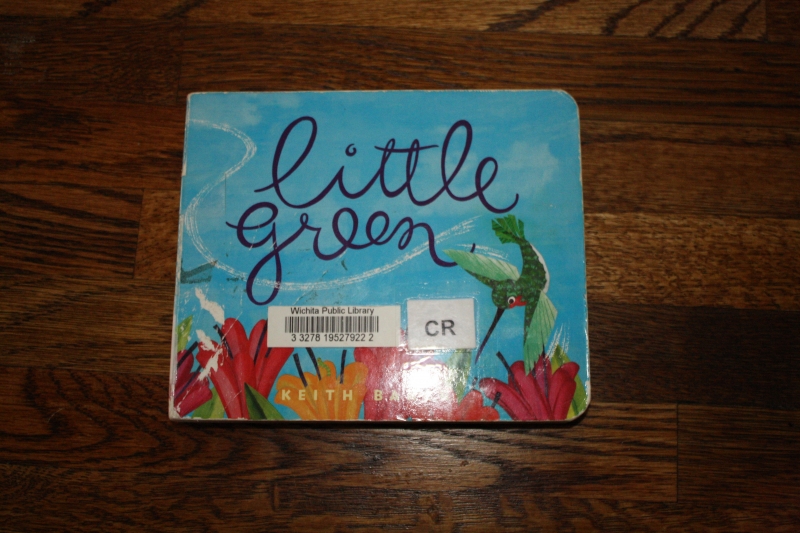
Little Green by Keith Baker

Little Green by Keith Baker

A fortuitous find in the library’s board book baskets, Keith Baker’s Little Green has a little boy painting as a little green hummingbird flits this way and that outside his window. There are lots of motion words and lots of words describing the little bird’s path: zigging, zagging, coming, going, stopping, starting, going in curliques. The colorful illustrations are fun to peruse, and the faint white path of the little bird is fun to follow with one’s finger. Tirzah Mae and I enjoyed all the “-ing” words piled on top of one another, the illustrations that lend themselves well to action, and the bright colors which lighten the already-starting-to-get-dark-too-early days.

Freight Train by Donald Crews

Freight Train by Donald Crews

This little board book was recommended by the authors of Baby Read-Aloud Basics for Tirzah Mae’s “babbler” stage – and we are sure glad it was.

The freight train is rainbow-colored, starting (at the end, which was weird) with a red caboose and working its way to a purple boxcar right before the black tender and steam engine. We learn the names of a variety of different train cars – and then the train starts moving. We see the rainbow colors blur into one another as the train goes past cities and over trestles and…

This is a very simple book, but elegant – and fully deserving of the Caldecott Honor it received in 1979.

Boats Go by Steve Light

Boats Go by Steve Light

This atypically-sized board book was probably Tirzah Mae’s and my favorite book this month. Each two-page spread contains a boat – and how it goes (that is, what sound it makes). It starts with the fireboat “Whee whee. Whee-whee. Whee-whee.” and ends with a gondola, which sings “O sole mio” :-) The author does a terrific job of writing the onomatapoeia so that a mother (who doesn’t feel particularly confident about replicating the sounds cold) can read them with a reasonable facsimile of the real deal. The illustrations are varied and beautiful, with lots of bright colors (I really enjoyed how the water was represented differently in almost all of the pictures, which I believe were painted with watercolor.)

Of course, moms who don’t want to simply make boat noises have plenty to talk about here. There are tugboats and cruise ships and submarines (a yellow one, which always causes this mama to burst out into unscripted song) to talk about, and even more.

I highly recommend this particular book.

Check out what other families are reading aloud at Read Aloud Thursday at Hope is the Word.


The Time for Forming Affections

I am a teacher at heart.

I love to transmit information, ideas, skills.

I like to think deeply, like to communicate deep thoughts.

Which is why I was nervous when I was asked to teach Sunday School to second graders a few years back.

I love to teach, not to do worksheets with kids. I like deep doctrine, hearty theology, difficult passages. How could I do that with second graders? (I learned, somewhat)

This is why I was nervous when I was placed in a 3-year-old classroom this year.

I love to teach, not to babysit. How could I do that with 3-year-olds? (I’m learning)

It’s also why I’m kinda tentative with my own daughter.

Everyone tells new parents that it’s hard to mess up parenting a baby. You change them, you feed them, you love them.

But I love to TEACH. How can I teach my baby?

Mostly, I think of how I’ll teach her one day when I actually can.

And then I started noticing Tirzah Mae going over to the pile of books, pulling one out and babbling to herself as she leafed through the pages. She likes when I read the board books to her – but she prefers books with regular pages when she’s reading to herself. After all, that’s what her mama reads to HERSELF.

And then I started noticing Tirzah Mae grabbing a pen (my Zebra pens!) and holding them ever so carefully between thumb and forefinger, running the point along whatever surface is handy.

And then I started noticing Tirzah Mae perking up whenever music came on, waving her hands and singing along.

And I realized that now may not be the time for teaching Tirzah Mae to read or write or sing. It may not be the time for imparting information or attaining to skills. But it is the time for forming affections.

When I spend every spare moment (when my hands aren’t otherwise occupied) with my nose in a book, I teach Tirzah Mae that books are valuable and worth reading. When I spend my mornings writing as I do Bible study and as I jot down a note on what I’m reading or make a grocery list, I teach Tirzah Mae that writing is a valuable skill and worth learning. When I sing a song, turn on a CD, dance to music (in my own home and elsewhere), I teach Tirzah Mae that music is valuable and to be enjoyed.

She likely doesn’t understand the Bible stories I read to her every night before bed. She probably doesn’t get the deep theological truths in the hymns we sing as she falls asleep. She doesn’t know what the words in the Bible I read every morning mean.

But now is the time for forming affections. So even if I’m not lecturing, not explaining some truth. Even if she’s not internalizing the Bible passages or their meanings, she’s learning. She’s learning that the word of God is precious. That the truths found in hymns are beautiful. That they are important.

I don’t see outward signs yet, like I do with reading and writing and music; but I can continue modeling Christian discipline for my daughter and can do it with ever-renewed vigor when I am reminded that now is the time for forming affections.


Book Review: It Sucked and Then I Cried by Heather B. Armstrong

Just to show how un-blog-savvy I am, I had no idea who Heather B. Armstrong was until I read a news article (by chance) about how famous people were leaving social media. Armstrong was cited as an example. Apparently, she was fired from a job for talking unfavorably about her workplace on her blog – and then became a wildly successful “mommy blogger.”

Even having read this article, I had completely forgotten who Armstrong was by the time I picked up her book (maybe a week later?) because it was in a Dewey Decimal section I was working my way through (306.8743 – mostly memoirs or sociological treatments of motherhood). It wasn’t until I saw “creator of Dooce.com” under her name that I remembered the article I’d read.

So I entered this memoir of motherhood with few preconceptions.

First impressions: Heather Armstrong is NOT A MORMON. This is the defining feature of her life. Every page of this memoir screams out her insistence that she is NOT A MORMON any longer. Even if her family is all Mormon and she lives in Utah and she went to BYU. She is NOT A MORMON any longer. Lest anyone start thinking she’s a Mormon mommy blogger and uncool, she must remind them that she drinks alcohol (NOT A MORMON!), listens to cool bands at cigarette-smoke-filled bars (where all the other people in Salt Lake City who are NOT A MORMON! are), curses like a sailor (NOT A MORMON!), and doesn’t wear holy underwear (NOT A MORMON!)

Hearing Armstrong declare (implicitly and explicitly) that she is NOT A MORMON! was exhausting. I wanted her to tell me something about who she was that would make me like her. Does she have interests, beliefs, passions, personality traits of her own? I couldn’t tell. It seemed like she only stood against, never for. Yes, plenty a memoirist drinks, goes to live concerts in bars, curses, and dresses immodestly – and sometimes I still manage to like them. But in order for me to like an alcohol-obsessed, rock-concert-going, cussing, immodest memoirist, they have to tell me something real about themselves – about who they ARE, not just who they AREN’T. I wasn’t a fan.

And then there was Armstrong’s tendency towards hyperbole. She just positively eats up her baby – slathers her with butter and jam and eats her up. And motherhood is absolutely the most awful thing ever and she throws things at her husband when he walks in the door from work because he’s done something other than try to entertain a baby all day and how dare he get her pregnant in the first place. Motherhood is awful, awful, awful, she says (and then goes off on eating her baby again.)

The thing is, nothing she was describing about her own situation sounded that awful to me. Her baby smiled at her at one month. Her baby slept through the night (12 hours!) at three months. My baby didn’t smile at me until three months and still hasn’t slept twelve hours. Armstrong complained about naptimes and how they have to be just right and blah-blah-blah-blah. My baby gave up napping the same time she started sleeping eight hours (about 3 weeks ago). But you don’t see me whining and complaining that it sucks and then I cried. Yes, I probably complain more than I ought – but I also recognize that this is how life with a baby goes, so sometimes I stop my whining and just do what needs to be done.

So, imagine my surprise when I discovered somewhere around month six of Baby Armstrong’s life that Armstrong has actually been clinically depressed all this time and is now checking herself into a psychiatric hospital because she’s afraid her husband will leave her if she doesn’t get a grip on things!

What? She’s not just a whiner? Something is actually wrong with her? See, I assumed that all the awfulness of her really-not-very-awful experience caring for a new baby was hyperbole to balance out all that hyperbole about sweet-smelling baby whose smiles seem straight from heaven-that-I-don’t-believe-in and who I eat up every day with a side of caramel sauce.

Maybe that’s saying more about me than about her. But I think maybe it also says something about her writing. She couldn’t tell her story well enough that I could figure out that she was experiencing something more than just what every mother experiences?

So, yeah. I wasn’t a fan.


Rating: 1 star
Category: Memoir of motherhood
Synopsis: Armstrong is NOT A MORMON. Turns out, she’s not just a crazy hyperbolist who whines more than is necessary. She’s actually suffering from rather severe postpartum depression and anxiety. Bummer she couldn’t have somehow communicated that to the reader before she commits herself to a psychiatric hospital.
Recommendation: Nothing redeeming in this one. Skip it.


Thankful Thursday: Looking Back

Yesterday, Facebook reminded me that it’s been one year since the urine test at my midwife’s office confirmed that I had preeclampsia. I was 30 weeks and 5 days pregnant.

You can read about my initial reactions here.

After a brief moment of grieving over the homebirth I knew this ruled out, I made Matt Redman’s song “10,000 Reasons” my prayer and my resolve.

“Whatever may pass and whatever lies before me
Let me be singing when the evening comes:

Bless the Lord, O my soul,
O my soul, worship His holy name
Sing like never before, O my soul
Worship His holy name”

I didn’t know what all would come to pass.

Hospitalization. Monitors. IVs. Throwing up in front of my husband and the nurses, unable to even move my arms to keep my hair out of the way. And that was just the first day (a year ago tomorrow).

Topping two hundred pounds. Having a “bottom number” blood pressure reading that would be bad if it was the “top number”. Pneumonia. Fluid restriction. Liver shutting down. Not being able to see color for six weeks.

Labor induction. Uncontrollable shaking. So swollen I couldn’t see. A c-section.

Two hours before I could touch my baby, a half dozen before I could hold her. Twenty-six days before I could take her home.

Her first taste of breastmilk came from a bottle. It was mixed with formula. Her first latch wasn’t at my breast, it was at a nipple shield. Only one breastfeeding session a day for that first month.

Three months before her first smile. Eleven months before she’d sleep more than three hours consistently.

It’s been a hard year. A very, very hard year.

But one year past the official declaration of preeclampsia, another song by Matt Redman springs into my heart and from my mouth as tears roll down my cheeks.

“Standing on this mountaintop
Looking just how far we’ve come
Knowing that for every step
You were with us

Kneeling on this battle ground
Seeing just how much You’ve done
Knowing every victory
Was Your power in us

Scars and struggles on the way
But with joy our hearts can say
Yes, our hearts can say

Never once did we ever walk alone
Never once did you leave us on our own
You are faithful, God, You are faithful
You are faithful, God, You are faithful”

Thank you, God, for your faithful presence, for your enduring grace, for Tirzah Mae and I alive today – on this day one year out.


The Difference Thanks Makes

As we get close to November and start thinking towards Thanksgiving (and before the 30-Day Thankfulness Challenges start popping up on Facebook), I’ve been noticing thankfulness in daily life.

Now, I usually think of thankfulness in terms of thankfulness to God – and generally get frustrated when the focus is on thankfulness towards other people (don’t even get me started on what I think of how “the pilgrims gave thanks to the Indians on the first thanksgiving.”)

And thankfulness to God is essential. He is, after all, the source of every good gift (See James 1:17).

But being thankful to God doesn’t preclude thankfulness to others. In fact, I think thanking God should naturally flow out into thanking others. As I become aware of God’s gifts, I become aware of how he uses others as gifts in my life. That’s when I can give thanks, like Paul did in Romans 16:3-4: “Greet Prisca and Aquila, my fellow workers in Christ Jesus, who risked their necks for my life, to whom not only I give thanks but all the churches of the Gentiles give thanks as well.”

Recognizing that God never commands being thankful to anyone other than Himself, I still think that thankfulness to others can be a powerful part of the Christian life. Why?

Because even if we aren’t commanded to be thankful to others, we are commanded to encourage one another (See 1 Thessalonians 5:11, 14). And thankfulness is hugely encouraging.

Because even if we aren’t commanded to be thankful to others, we are commanded to love one another (See John 13:34-35, Romans 12:10, Ephesians 5:2 and others). And thankfulness is nothing if not loving.

The best example I can think of for thankfulness to others (and how it encourages and demonstrates love) is my husband.

I cook dinner for us almost every evening, and it almost never fails that sometime, in the course of the meal or the evening, Daniel will thank me for making dinner.

When I make a phone call or post a letter or run an errand for Daniel, he makes sure to thank me – verbally, in a text, in an email.

I sometimes often get discouraged with my housekeeping abilities or my time-management skills or a dozen other real or perceived faults. And almost always, Daniel’s response is thanks.

“Thank you for taking care of our daughter all day.”

“Thank you for doing dishes.”

“Thank you for folding the laundry.”

“Thank you for growing us tomatoes.”

“Thank you for listening to me.”

It’s not big things that he’s thanking me for. If I chose, I could brush off his thanks with a “no problem.” And those things aren’t a problem (usually). But that’s not the point.

The point is that when he thanks me, I feel encouraged. I feel strengthened. I feel loved.

That is the difference thanks makes.

And it challenges me to do the same for others.


Recap (2015/10/17)

It’s been a while since I posted a Recap – which means there’s a lot to share, but it also means I’m going a little less detailed and just hitting the highlights (in the interest of time :-P).

In the living room:

  • My little brother is in Nebraska for about a month between military postings, so Daniel and I and Tirzah Mae made another quick trip up to Lincoln to spend time with him (we haven’t seen him since another little brother’s wedding almost 2 years ago.) That was pretty great.
  • Tirzah Mae has started “helping” with laundry, pulling the laundry out of the basket and either mouthing it or putting it on the floor. After a few days worth of frustration at having to refold my laundry multiple times, I arrived at a solution. Tirzah Mae stands at the basket of unfolded laundry and hands me one article at a time (“Thank you, Tirzah Mae”). I fold the item and then place it somewhere out of reach (often on the other side of a barricade of my body and the basket.) She hands me another article and we continue until the laundry is done. Then I try to keep her occupied until I can get all the folded laundry gathered and put away!

In the kitchen:

  • I just took Melissa D’Arabian’s Ten Dollar Dinners back to the library, but not before we ate her yummy recipes for a couple of weeks straight (well, apart from some standard household staples). You should check out my review, linked above, if you haven’t already.
  • We picked up our half a pig when we took our vacation at the beginning of last month, which means we’ve been enjoying pork chops and ground pork and BACON!
  • I am so excited that it’s fall and I can start making crockpot soup for every meal. And soon, I’ll be able to put a casserole in the oven without feeling like I’m in an inferno. Which reminds me. It totally belongs in the “on-the-land” section, but we just purchased and picked up a double convection wall oven today. I’m dreaming of having EVERYONE over for turkey dinner. Thanksgiving at my house next year, peoples.

In the nursery:

  • Tirzah Mae is standing now, generally for 5 second intervals but occasionally for as long as 30 seconds or a minute
  • Tirzah Mae is sleeping now. From 8 or 9 at night to 5 or 6 in the morning. Her mother feels like she’s been granted a second chance at life.
  • I had been worried about Tirzah Mae’s language development because she wasn’t babbling as of her nine month appointment, but I’m not worried anymore. Our daughter clearly has no problem hearing and replicating all sorts of consonants. If we called Daniel “dad”, she’d have said her first word; but since he’s papa, she’s still just babbling :-)
  • For years, I’ve been telling moms about the “picky phase” children enter from one year to eighteen months. It’s ’cause nutrient needs decrease quite a bit, making children able to be more selective. And now, I’ve had a chance to see it firsthand. Tirzah Mae went from eating three or four cups worth of watermelon at a sitting to eating maybe a tablespoon or two worth of food. It’s a good thing I know better, ’cause if I didn’t, I’m sure that would freak me out.

In the craft room:

  • I’ve made up an autumn smelly blend for use in a candle-lit simmer pot – and I like it quite a lot. It’s 2 drops cedarwood essential oil, 1 drop clove bud essential oil, 1 drop cinnamon bark essential oil, and 2 drops of tangerine essential oil. Mix with water in your simmer pot and light that candle. Yummy!
  • I also have a Christmas craft book just about due to return to the library, so I had to get started on the project I wanted to do with it – a Nativity scene with a stable and manger made from twigs. I selected appropriate twigs from our more-than-ample pile of brush and have cut them to size, but haven’t yet assembled them into said stable and manger. But since the book has to go back this next week, I’m gonna have to get cracking!

In the garden:

  • Tomatoes keep trickling in – just slow enough that I can use them before they go bad.
  • I’m subbing homegrown hot peppers for all sorts of things, since my hots went crazy while my bells…not so much
  • Everything else is torn out – and plans are simmering for next year’s garden

On the land:

  • We have framing!
  • We have that fancy upstairs school room!
  • We have a roof!
  • We have windows and doors!
  • We have plumbing!
  • We have electrical! (Although it isn’t live yet.)
  • I just bought kitchen appliances!