C.S. Lewis to Bloggers

In his masterful turn-the-world-upside-down book The Screwtape Letters, C.S. Lewis has his diabolical character Screwtape write the following:

“It remains to consider how we can retrieve this disaster. The great thing is to prevent his doing anything. As long as he does not convert [his conviction and subsequent remorse] into action, it does not matter how much he thinks about this new repentance. Let the little brute wallow in it. Let him, if he has any bent that way, write a book about it; that is often an excellent way of sterilising the seeds which the Enemy plants in a human soul. Let him do anything but act.”

I felt the sting as I read.

But will I convert the conviction of the Lord into obedience?

“But be doers of the word, and not hearers only, deceiving yourselves. For if anyone is a hearer of the word and not a doer, he is like a man who looks intently at his natural face in a mirror. For he looks at himself and goes away and at once forgets what he was like. But the one who looks into the perfect law, the law of liberty, and perseveres, being no hearer who forgets but a doer who acts, he will be blessed in his doing.”

~James 1:22-25 (ESV)


Legalism and Lawlessness

Suppose you were six years old and your parents had just given you some new boundaries for riding your bike.

You could ride from one next door neighbor’s driveway to the other next door neighbor’s driveway – a distance spanning approximately two yard widths.

Elated to learn your new boundaries, you hop and your bike and ride as fast as you can to the far edge of your next door neighbor’s driveway – and sit there looking at the next driveway down until your mother calls you in for dinner.

Ridiculous, right?

So what about this one?

Given the same boundaries, you reason that if you get on your bike and start riding down the sidewalk you might not be able to stop and turn in time to avoid outriding your boundaries. So you get on your bike and sit in the center of your own driveway until your mother calls you in for dinner.

Equally ridiculous.

When I was six (or whatever age I was) and those were my boundaries, I’ll tell you what I did. I got on my bike and rode from one driveway to another and back again. Over and over and over again until my mother called me in for dinner.

I trusted that my mother meant what she said when she gave me those boundaries. I trusted that meant I wouldn’t go wrong as long as I was inside them – and that something would go wrong if I was outside them. And so I fully enjoyed life within those boundaries (except the times when I didn’t – because even six-year-old me was a sinner, who sometimes thought life was better outside her boundaries – but that’s neither here nor there as this example goes).

The above scenarios are what I think of when I see Christians who don’t seem to know how to get together without drinking alcohol. They’re what I think of when I see Christians who want to forbid anyone from drinking alcohol lest they cross the line from drinking to drunk.

The above scenarios are what I think of when I see Christians who only listen to secular music. They’re what I think of when I see Christians who get upset because any other Christian is listening to secular music.

My little scenarios are simplistic, I know.

A wise little girl would recognize that she needs a certain amount of space in which to turn – so she leaves herself that space when approaching the boundary. And a wise Christian recognizes that if she has a personal or family history of alcoholism, she may need to abstain.

A loving little girl might recognize that her three-year-old brother has more constricted boundaries than she – so she might choose to play with her brother inside his own boundaries rather than pushing on to play where she legitimately may.

But it seems to me that, so long as I am neither going against my own conscience nor offending my brother, God is glorified when I fully enjoy everything within the boundaries – neither confining myself to the fence nor to the point farthest from the fence.


A Taste of Sore Throat Relief

Our family has had colds this week, which means mama has been pushing lots of fluids and encouraging lots of rest. I hate colds like these, ones where you’re exhausted but can’t sleep thanks to the postnasal drip and where your throat feels like it’s on fire from the aforementioned drip.

With colds like these, you have to pull out the big guns for sore throat relief. That is, if by “big guns” you mean standard-variety home remedies.

As I was contemplating my options for sore throat relief, I realized that the spectrum of relief includes all five of the basic tastes.

Say what?

While we typically refer to the “taste” of something as being whatever gives it its characteristic flavor, this is an incorrect understanding of taste. Taste is one of our senses, experienced through the “taste buds” located on our tongues. There are just five basic “tastes”: Bitter, Salty, Sour, Sweet, and Umami.

And it just so happens that you can try a sore throat remedy in every taste.

Bitter: Baking Soda Gargle

The Technique:
Add 1/2 tsp baking soda to 1 cup warm water. Gargle in throat and then spit out.

Why does it taste bitter?
Baking soda (chemical name: sodium bicarbonate) is basic (with a pH above 7) and basic compounds taste bitter.

The Claim:
Bicarbonate kills bacteria and other bad bugs that colonize your throat.

Evidence:
Tenuous. This is a commonly recommended home remedy – and if it provides you relief, great. It’s cheap and not likely to be dangerous. On the other hand, it’s unlikely that it’s actually killing anything bad. Any relief is probably from having warm water on your throat. Sorry.

Salty: Salt Water Gargle

The Technique:
Add 1/2 tsp salt to 1 cup warm water. Gargle in throat and then spit out. This technique is often combined with the above (1/2 tsp salt, 1/2 tsp baking soda to 1 cup water).

Why does it taste salty?
‘Cause it’s salt (chemical name: sodium chloride) and salt tastes salty :-)

The Claim:
Salt kills the bacteria and other bad bugs that colonize your throat.

Evidence:
Also tenuous. See the evidence for the “bitter” solution.

Sour: Lemon or Orange Juice

The Technique:
Mix a little lemon juice (with or without honey) into warm water and drink. Or just have some orange juice.

Why does it taste sour?
Citrus fruits contain citric acid – and acids give foods a characteristicly sour taste.

The Claim:
Vitamin C in lemon or orange juice stops cold viruses in their tracks, either by killing the virus or by boosting your immune system so it can kill the virus.

Evidence:
While many super-smart people have posited the above claim, scientific study has failed to support this claim. The relief you experience when you drink lemon water or orange juice is more likely thanks to the soothing effect of the water itself (numbing when cold, relaxing when warm). The water also helps by loosening secretions so you don’t get stuffed up (and since stuffiness promotes things like sinus infections and uncomfortable headaches, the water can help you avoid some of those complications.)

Sweet: Honey

The Technique:
Eat honey from a spoon, or add it to your warm lemon water or tea.

Why does it taste sweet?
Honey is primarily made up of the simple sugars glucose and fructose (the same two sugars that are linked together to form table sugar). Both sugars taste sweet – fructose is a little sweeter than table sugar, glucose is a little less sweet than table sugar.

The Claim:
Honey keeps you from coughing, which keeps the sore throat from getting worse. Also, if your sore throat is caused by allergies, locally grown honey will contain pollen proteins that will desensitize you to common allergens.

Evidence:
The anti-cough properties of honey are borne out by moderately good quality research studies. So if your sore throat is because you’ve been coughing a lot, honey will help it out. If you put your honey in water, especially warm water such as if you were making a warm lemon water or tea concoction, you’ll get even more benefit because the water will loosen any secretions so they can flow into your digestive system instead of hanging out in your throat to get coughed up. The allergy thing? I wish it were true, but there isn’t any clinical evidence to suggest that it is – and its theory is also tenuous since most of the things people are allergic to are wind-pollinated rather than bee-pollinated, so the honey is unlikely to contain the offending allergens.

Umami: Chicken Noodle Soup

The Technique:
Make chicken noodle soup (or have grandma make it for you :-P) Eat and enjoy.

Why does it taste umami – or, hey wait, what on earth is umami?
I’m so glad you asked! Umami is a meaty or brothy taste that we experience when we eat meat or broth (I know, right?) It is caused by the amino acid glutamate, which is found in most meats, mushrooms, and in that ubiquitous Chinese food additive monosodium glutamate. Chicken – and chicken broth – contains glutamate and therefore tastes umami

The Claim:
Chicken noodle soup fixes a sore throat because Grandma said so.

Evidence:
The majority of the benefit of chicken noodle soup is probably psychosomatic – most of us include chicken noodle soup in the “comfort food” category. But even if it isn’t a comfort food for you, it’s a warm water-filled food – which means it loosens up those secretions and it soothes your throat on its way down.


My preferred sore-throat treatment is warm water with lemon and honey, not so much because it confers medical benefits (although the anti-cough properties of the honey are sometimes welcome), but because it tastes great and it makes sure I’m getting that much needed water while I’m battling a cold. (Tirzah Mae gets breastmilk – the ultimate wonder-drug. Honey could contain botulism spores that a baby’s immature immune system can’t shed, resulting in life-threatening respiratory illness, so never give honey to a baby under age 1.)

Do you have a favorite sore throat remedy?

The Abridged Screwtape, part 1

Foreword from the editors

In the short years since its publication, Screwtape’s correspondence with his nephew has become something of a classic. Part training manual, part cautionary tale, it regularly tops the novice demon’s recommended reading list.

Unfortunately, with the human population growth explosion being such as it is, young demons are being pressed into service earlier and earlier with less and less opportunity to read even such short works as this. A great need exists for concise training materials that can be quickly read by novice demons overtaxed by the strain of managing multiple patients.

To this end, we, the editors, have put together this all new abridge collection of Screwtape. We hope it serves Our Father Below well.

Letter 1: Avoid reasoning and science

“The trouble about argument is that it moves the whole struggle onto the Enemy’s own ground. He can argue too; whereas in really practical propoganda of the kind I am suggesting He has been shown for centuries to be greatly the inferior of Our Father Below.”

“…the best of all is to let him read no science but to give him a grand general idea that he knows it all and that everything he happens to have picked up in casual talk and reading is ‘the results of modern investigation.'”

Letter 2: Keep him disillusioned with the church

“All you then have to do is to keep out of his mind the question ‘If I, being what I am, can consider that I am in some sense a Christian, why should the different vices of those people in the next pew prove that their religion is mere hypocrisy and convention?”

Letter 3: Promote little annoyances and disharmonies within the home

“Let him assume that she knows how annoying it is and does it to annoy – if you know your job he will not notice the immense improbability of the assumption. And, of course, never let him suspect that he has tones and looks which similarly annoy her.”

Letter 4: Keep him from praying

“Whenever they are attending to the Enemy Himself we are defeated, but there are ways of preventing them from doing so. The simplest is to turn their gaze away from Him towards themselves.

Letter 5: Do not rejoice overmuch in times of war, for the Enemy uses war to his own purpose

“Consider too what undesirable deaths occur in wartime. Men are killed in places where they knew they might be killed and to which they go, if they are at all of the Enemy’s party, prepared.”

Letter 6: Teach him to be anxious and to focus on his feelings

“[The Enemy] wants men to be concerned with what they do; our business is to keep them thinking about what will happen to them.”

Letter 7: Encourage extremes or keep people complacent, depending on the age

“All extremes except extreme devotion to the Enemy are to be encouraged. Not always, of course, but at this period. Some ages our lukewarm and complacent, and then it is our business to soothe them yet faster asleep. Other ages, of which the present is one, are unbalanced and prone to faction, and it is our business to inflame them.”


I’ve been reading (and haven’t yet finished) C.S. Lewis’s The Screwtape Letters with the Reading to Know Classics bookclub. Thanks Barbara for choosing this month’s read. Follow the links to find out what other readers are saying about the Letters.


God of Judgment, God of Grace

“In the Old Testament, God reveals himself as a God of Judgment. In the New Testament, God reveals himself as a God of Grace.”

If I had a dollar for every time I’d heard a well-intentioned Christian say something to that effect…

But wait.

I’m pretty sure I’ve said something to that effect.

The problem is, it’s wrong.

Or, at least, it’s incomplete.

God does indeed reveal himself as a God of Grace in the New Testament. But that doesn’t mean He fails to reveal himself as a God of Judgment.

God does indeed reveal himself as a God of Judgment in the Old Testament. But that doesn’t mean He fails to reveal himself as a God of Grace.

I’ve been thrilled to be teaching the Old Testament to three-year-olds in Sunday School this year. It’s great. I love the Old Testament. I love teaching the Old Testament.

And what’s struck me about the Old Testament this time around is that I haven’t yet seen an example of God’s judgment without His Mercy.

When Adam and Eve ate the poisonous fruit, God’s judgment on them meant death and banishment from the garden. Yet in God’s mercy, He promised a Savior and the ultimate destruction of their enemy the snake.

When Cain killed Abel, God’s judgment on Cain meant an end to his livelihood and a lifetime of wandering. Yet in God’s mercy, He set a mark on Cain to protect him from his greatest fear – that whoever found him would kill him.

When the people were so wicked that God could stand it no longer, God’s judgment on the world meant a flood that destroyed all people but eight. Yet in God’s mercy, He preserved eight – and promised to never again destroy the earth in that way (despite man’s evil continuing to provoke His anger.)

When humanity set themselves against God and sought to build a tower to display their own glory, God’s judgment meant confusing their language and their plans. Yet their punishment was God’s mercy, giving them a second opportunity to be obedient – to fill the earth and subdue it.

When Sodom and Gomorrah committed great atrocities before God, God’s judgment meant raining down fire and brimstone on them. Yet in God’s mercy, He let Abraham haggle with him over the fate of the city, promising to save the cities if even ten righteous men could be found. But even when ten righteous could not be found, God’s mercy saved the family of the one righteous man.

The New Testament really only requires one proof text – but it’s the proof text around which every other text hangs. God’s mercy meant pardoning sinful rebels. But his judgment meant pronouncing a death sentence on His Son.

God’s grace meant imputing His Son’s righteousness to wretches. His judgment meant nailing His Son to the cross for the wretches’ sin.

If you think that the Old Testament tells only of God’s judgment, read again.

If you think that the New Testament tells only of God’s grace, read again.

For wherever God reveals Himself, He reveals Himself as the Judge and the Justifier – the awful and the merciful.

“But now the righteousness of God has been manifested apart from the law, although the Law and the Prophets bear witness to it— the righteousness of God through faith in Jesus Christ for all who believe. For there is no distinction: for all have sinned and fall short of the glory of God, and are justified by his grace as a gift, through the redemption that is in Christ Jesus, whom God put forward as a propitiation by his blood, to be received by faith. This was to show God’s righteousness, because in his divine forbearance he had passed over former sins. It was to show his righteousness at the present time, so that he might be just and the justifier of the one who has faith in Jesus.
~Romans 3:22-26 (ESV)


Book Review: The Child in the Family by Maria Montessori

Over the years, I’ve read my share of books about homeschooling, looking forward to the day when I’d be doing history timelines with my elementary students, science experiments with my middle schoolers, and higher maths with my high schoolers. But, then… what do you know? I don’t have any of those. I have a baby. And before she’ll be a high schooler or a middle schooler or even an elementary schooler – she’ll be a preschooler.

Which is why I resolved to pick up something on early childhood education on one of my recent library trips.

And who better than Maria Montessori, right? She’s a universally recognized early childhood educator.

I started with The Child in the Family because we’ll be training our children in our family (not in a school setting) – and because I guessed that this would be about very early childhood, even infancy. And… I was right!

The Child in the Family is highly theoretical.

Montessori begins by stating that children are the last repressed class of humans – practically slaves to their parents, who exercise god-like power over them. She argues that while adults tend to think of children as blank slates, ready to be made after their parents’ image, children are in fact living spirits ready to begin to make their physical selves in their own likeness.

Montessori’s method, then, is all about giving children the freedom to raise themselves, to learn as they desire, to mold themselves as they like.

Montessori’s child is some sort of idealized angel, innately aware of both morality and of his own dignity. When the child sees injustice, he bristles. When his dignity is wounded, his spirit is crushed. As such, adults should tread lightly, recognizing their great potential for injuring this otherwise perfect being.

Does this sound melodramatic? I thought so too.

Montessori seems fully aware of one half of the human condition: Imago Dei. But imago Dei is only one half of the equation. Original sin means the child is not only a spiritual being made in God’s image, but also spiritually dead, bent toward evil.

Montessori’s only-half-right-theory means that her practice is only-partially-helpful. In this volume, Montessori mentions a few practical ways by which a parent or other adult can avoid offending the child. The first is to be patient with a child’s curiosity (a child isn’t being dirty or naughty when he picks up a fallen leaf from the sidewalk). The second is to, for lack of a better phrase, allow the child to be a grown-up. Montessori encourages the use of real miniature glasses and plates and silverware, rather than having unbreakable “child-friendly” dishes. She encourages the use of child-sized furniture that the child can move around (and discourages the use of rubber caps to keep the movement of said furniture from making noise.) She encourages the use of child-sized cleaning equipment so a child can sweep her own floor and dust her own furniture.

In general, I’m okay with those practices. I don’t think I’m anywhere near as dogmatic on the child-sized-but-real stuff – but certainly Tirzah Mae has no interest in using a plastic baby spoon, eschewing it in favor of real flatware (child-sized flatware for her is on it’s way, since she can’t exactly fit the real flatware in her mouth!)

The second to last chapter speaks of the Montessori teacher and how she uses “various stimuli to awaken a sense of security in the child.” She is all about making her educational material attractive to the child so that the child will initiate learning activity. Once the child has initiated the activity, she is careful not to interrupt either with praise or correction (I really appreciate this idea – I often see moms completely disrupt their child’s purposeful play by inserting themselves into the play.) Unfortunately, that is the extent of the discussion of Montessori’s pedagogical methods in this book. I certainly hope she elaborates more in other books – since this proposed role for the teacher seems much more interesting to me than the silly theories about a child’s innate goodness promoted by this particular book.


Rating: 2 stars
Category: Early Childhood Education
Synopsis: Montessori propounds her theory that children are innately good and should be allowed freedom to mold themselves as they like.
Recommendation: Lots of ridiculous theory, very little of practical use. Skip it.


Vacation (Part 2): Thai and Travel and Porch Swings

September 6: Day 2

Sunday morning, Daniel dropped me off at church early to prepare the “opening” activity centers for the three year old Sunday School. We were learning about Noah, so I had a sticky wall rainbow and, by now, I can’t remember what else. Oh, but it’s coming back – pairs of animals to match and blocks to build an ark with.

Daniel went back home to take care of our guests and to get Tirzah Mae ready for the service.

After church, we went out to the land, where we inspected the then-current state of construction – at that point, the walls had been poured but the forms not yet removed. Timothy and I tramped around the perimeter so Tim could see our land more fully.

Our family at the hole

Our family in front of “the hole”

From there, we went out for Thai at Chiang Mai Thai (Oh my, so much going out to eat this vacation already!) As is our custom, we served Tirzah Mae from our own plates – in this case Green and Yellow curries. The older woman who served us kept exclaiming about “The baby!” “Eating Thai curry!” After expressing her astonishment to us, I heard her in the kitchen, expressing her astonishment there as well :-)

Once home, Daniel and Joanna and Tim watched the very bloody The Untouchables, about the attempt to put away Chicago mob-boss Al Capone. I squawked around like a chicken with my head cut off, doing endless loads of laundry and attempting to get us packed for our trip to Lincoln.

When the movie was done, we “scared up” breakfast for dinner – caramel apple oven French toast I’d prepared earlier, as well as bacon and sausage and kiwi and whatever else I could find in the fridge that needed to be used up.

Then, all four of us adults got busy getting the packing done and the house cleaned up so we could leave for Lincoln at a decent hour the next day!

September 7: Day 3

After the usual scurry of last minute preparations for a trip, we took off – Daniel and I and Tirzah Mae in our gold Trailblazer, Tim and Joanna and their baby-on-the-inside in their blue Trailblazer (one of the fun parts of having a large family is occasionally accidentally matching!)

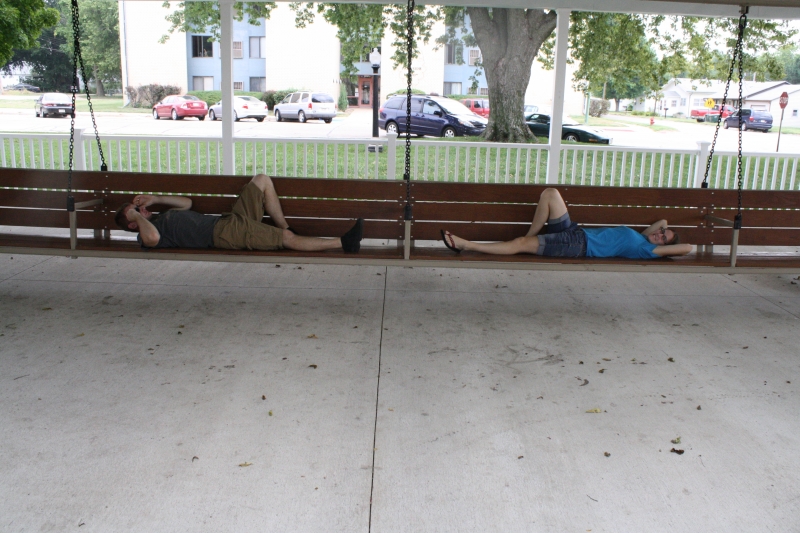
Tim and Joanna on the world's largest porch swing

Tim and Joanna on the World’s Largest Porch Swing

We stopped at the world’s largest porch swing in Hebron, NE where we took pictures and then took Tirzah Mae over to the playground. Tirzah Mae enjoyed her first swing ride (that is, she enjoyed a swing for the first time, not that she rode one for the first time.) She also went down a slide for the first time.

Aunt Joanna helps Tirzah Mae get acquainted with the swing

Aunt Joanna helps Tirzah Mae get acquainted with the swing

Once we were done in Hebron, we wished Tim and Joanna good-bye and headed on toward my parents’ home in Lincoln.


Grace to Know Your Limits

This week was our first week back to fall Bible studies, having been gone for the first two weeks since they officially began.

I was leaving Tirzah Mae in the nursery, which meant doing all those things that must be done for other people to take care of her – stuff diapers so the nursery workers don’t have to figure out prefolds, fill a sippy cup with water and a dish with precut grapes since the nursery workers can’t breastfeed her, put her in clean clothing so I don’t look like the worst mom in the world…

It hadn’t been a terrible night – wakings at midnight and 4, but ones where I’d quickly fallen back asleep after feeding and settling Tirzah Mae.

When I got home from Bible study and had my list of usual morning tasks still to complete, I decided I’d forgo my afternoon nap.

Eat lunch. Switch laundry, hang laundry, fold laundry and put it away. My eyes started feeling heavy, my temples started to throb. But I still had to rinse diapers, give the toilet a quick scrub, and get the mail before I could start on my afternoon tasks.

“Grace to know your limits,” I thought – and began composing the blog post in my head (and then on the back of an envelope.)

Now I must learn the wisdom to work within my limits.

(Which is why I must now stop writing and get to taking that nap!)


Read Aloud Thursday (September 2015)

Tirzah Mae and I continue to read board books – I’ve gotten another dozen or so by Sandra Boynton out of the library (since we’ve enjoyed several of hers in the past) and I picked up a couple of new-to-me authors from the library on my last visit as well. But we’ve also branched out, rather accidentally (on my part), into regular picture books.

I’ve generally been inclined to think that regular picture books are outside of our abilities, mostly because Tirzah Mae is majorly into oral exploration and because it’s hard enough to keep her from ripping board books. But when Alice gave some recommendations on our last Read Aloud Thursday post, I dutifully requested them from my library, not realizing until I picked them up that they’re normal picture books!

I tried (unsuccessfully) to read one to Tirzah Mae as we both laid on the floor. And then we went on vacation, taking the board books and leaving the picture books. But when we got back and I was casting about for things to do at the kitchen table while Tirzah Mae kept on eating second breakfast (I’m thinking she must be going through a growth spurt – she can steadily eat for an hour, consuming maybe two cups of food over that period.) Anyway, I was looking for things to do when I noticed Clip-Clop by Nicola Smee on the bookshelf. I got it out and read it and… what do you know? It worked wonderfully.

This Month’s Favorite Regular Picture Book:
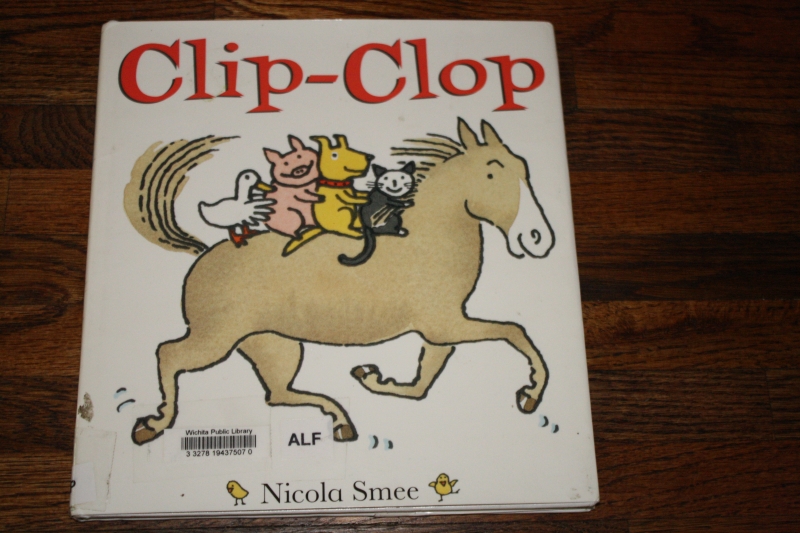
Clip-Clop by Nicola Smee

Clip-Clop

A cat asks a horse for a ride, which the horse gladly gives – then a dog asks for a ride. Before long, there are four different animals on horse’s back, begging Mr. Horse to go faster and faster. When Mr. Horse finally stops, the animals fly off into a haystack. Mr. Horse is a little worried, but the four voices crying out “Again!” reassure him. It’s a delightful tale with wonderful rhythm. We’ve read it now three or four times, laughing and thoroughly enjoying it each time.

This Month’s Favorite Board Book:
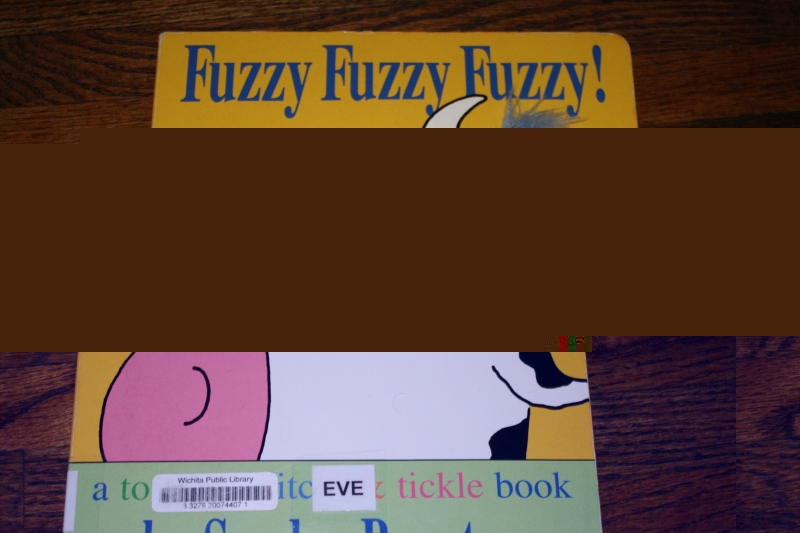
Fuzzy, fuzzy, fuzzy by Sandra Boynton

Fuzzy, Fuzzy, Fuzzy!

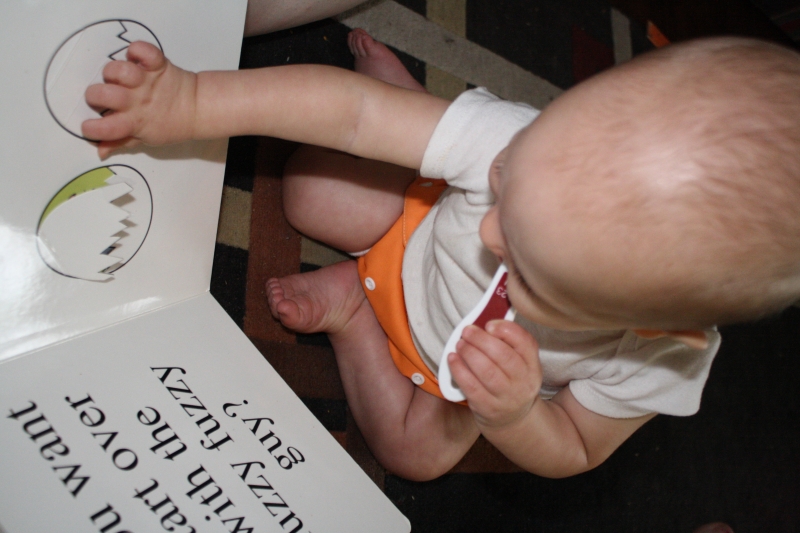
A touch-and-feel book with simple language, this one captivated Tirzah Mae and she won’t let it go. There’s a “fuzzy, fuzzy, fuzzy” cow’s nose, a “rough, rough, rough” dog’s paw, and an “incredibly soft” duck’s belly. Tirzah Mae delighted in touching the different textures. But what she liked most of all were the lift-the-flap eggs at the end. The book asks “Do you want to start over with the fuzzy fuzzy guy?” Depending on which flap you lift, the little chicks inside answer either “Yes” or “No”. Tirzah Mae thinks these are hilarious. So much so, that all we need to do to send her into paroxysms of laughter is to say “Yes” and then “No” in the voices we generally do when we’re reading. So, so funny. She likes this so much we’re buying it for her (I think I’m going to call it a birthday gift.)

Tirzah Mae lifts the flaps

This Month’s Favorite New Author:
Leo Lionni

Leo Lionni’s What?, Where?, and When? feature torn-paper mice illustrations demonstrating different words. In Where?, the copy asks “Can you guess where the mice are?” before showing them “Up high” in a tree, “Popping out” of a shoe, etc. When? asks “When does it snow?”, leaving reader or listener to respond “in the winter”. What? asks readers to guess what the things on the pages are. Readers once again have to supply the noun, while the text of the book supplies little comments like “Do you see what I see?” as the mice peek out from behind a giant set of eyeglasses. Even if I weren’t planning on reading every book in my library, I’d still be picking up whatever else I can by the author on my next library trip.

Check out what other families are reading aloud at Read Aloud Thursday at Hope is the Word.