Praying for a Meaningless Life

Daniel and I have a friend who grew up in the faith but has since abandoned it.

Our friend tried Christianity and it didn’t work–or so our friend says.

Since the day I heard of our friend’s lack of faith, I have had one prayer:

Make his life meaningless.

Our friend is young and energetic. He can do whatever he wants. He is free to explore the world, to enjoy every pleasure it has to offer.

I have one prayer:

Make his life pleasureless.

I pray that he would ever have a longing unfulfilled, that he would always come to the end of a pursuit empty, that his wanderings would never satisfy his wanderlust.

I pray that his travels would end like the Preacher’s and that he would come to the same conclusion.

“Vanity of vanities, says the Preacher; all is vanity.”
~Ecclesiastes 12:8

I pray that all of life would seem worthless, meaningless, joyless–until one day our friend would come to the end of himself and discover that meaning, worth, and joy can only be found in doing precisely what he was made to do: in bringing glory to God.

“The end of the matter; all has been heard. Fear God and keep his commandments, for this is the whole duty of man.”
~Ecclesiastes 12:13

Every day, I pray this prayer…

and I am reminded that I too sometimes need a meaningless life

I too need to feel the gnawing ache whenever my heart is not fixed on Christ.

May I never find meaning, purpose, or pleasure apart from Him.

Wedding Whens and Wheres, Part 2

In my previous post about wedding whens and wheres, I realize that I missed two parts. The time of day for our wedding and the place for our reception.

I don’t think determining the time of day for our wedding was particularly difficult for us. I grew up attending my aunts’ and uncles’ wedding (my mom was the second married of 12 children and I attended the weddings of at least 7 aunts and uncles during my childhood years)–and our family pattern was an early afternoon wedding with a reception immediately following in the church fellowship hall. Daytime weddings are traditional for our family.

Furthermore, as a college student and after, I’d attended many an evening wedding and mused at how worn out the bride and groom must be when they finally reach their honeymoon (or overnight) location. I was NOT eager to have my first night with my groom be one of exhausted irritability.

We chose a 1:30 wedding with a (short) reception immediately following.

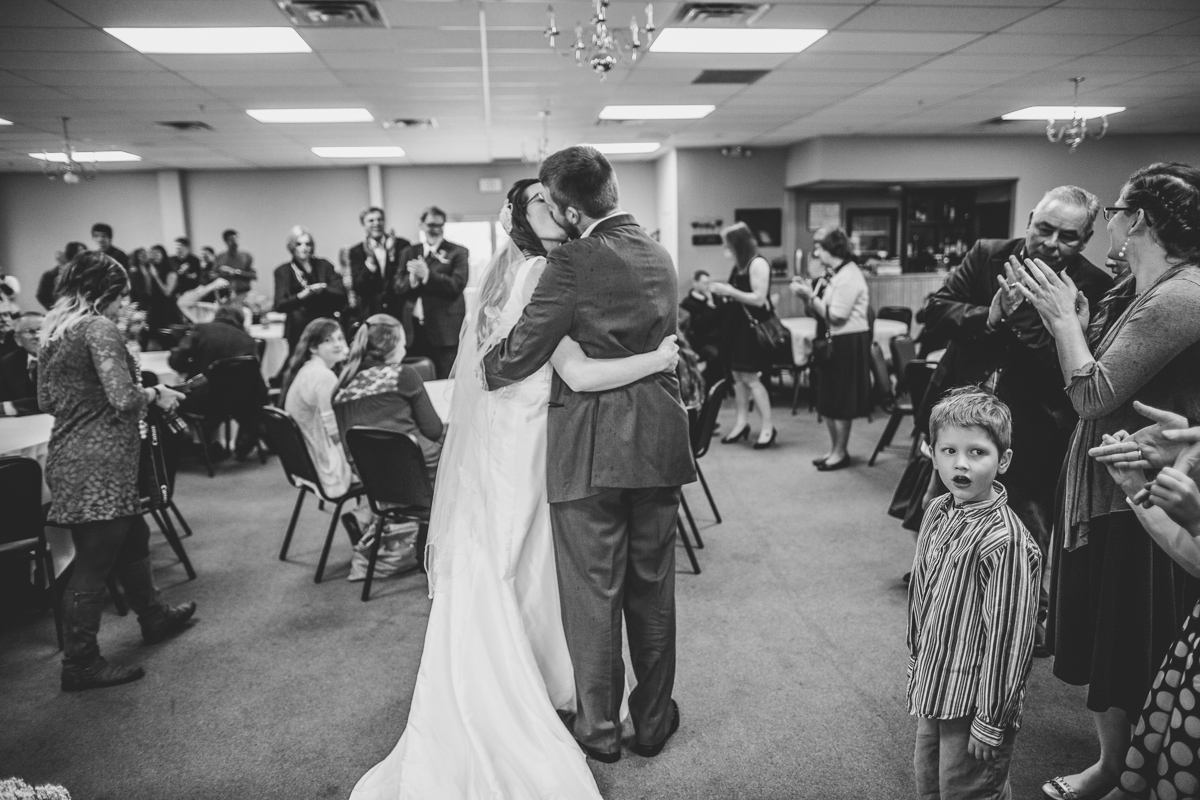
20130309_RebekahDaniel_342

Lincoln Meadows was fairly nondescript–and we didn’t do much to fancy it up, just flowers on the tables. But it fit everyone and let us cater ourselves–which was pretty much what I was looking for.

Once we had our ceremony site in place, we had to choose a site for our wedding reception. We couldn’t have it in the church fellowship hall, since the hall can only comfortably seat maybe 80 people. Variable weather in Nebraska in March meant outdoors wasn’t an option–so we had to find ourselves a reception hall.

We had some definite constraints:

  • The hall had to be available on March 9
  • The hall had to seat at least two hundred people
  • The hall had to have space for two hundred people to PARK (since our wedding was on the same day that Lincoln was hosting Nebraska’s Boys State basketball tournament)
  • The hall had to let us self-cater or, at the very least, allow us to bring in an outside caterer (because I’m uber-cheap)

I did internet searches for places, called for availability, and was left with exactly two potential places–one of which seemed definitely the better pick.

Since I wasn’t in Lincoln, I phoned the hall to figure out logistics and then sent my mom down to scope out the hall and reserve it.

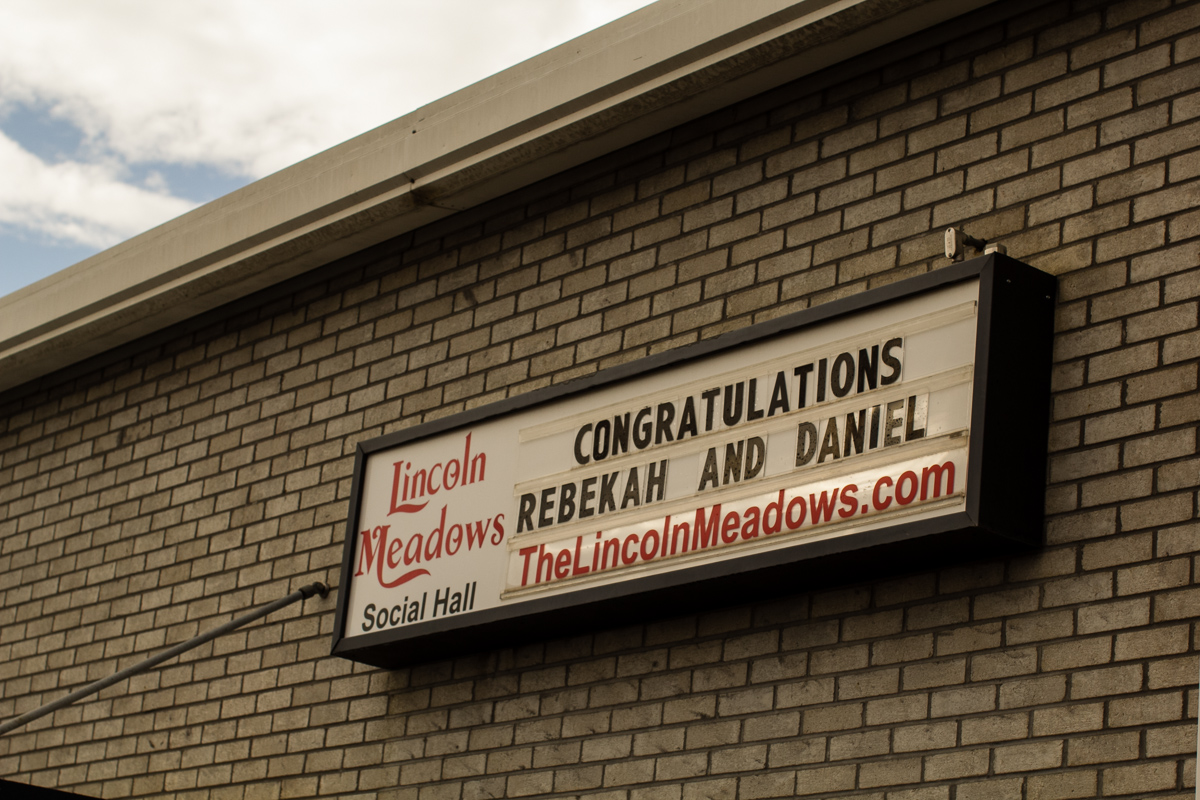
Sign on the Reception Hall

When my mom went to the hall the morning of our wedding, the sign still bore the names of the previous couple. She contacted the hall, and by the time we got there the names had been changed

And that was that.

What: Wedding
When: 1:30 pm Saturday March 9, 2013
Where: Lincoln Christian Fellowship and Lincoln Meadows Social Hall

I made it down to Lincoln one weekend and my mom took me out to the place to peek in the windows–but otherwise, the first time I saw our reception location was when I arrived there to decorate the day before the wedding.

Despite all that, it turned out great. The only downside had nothing at all to do with the reception site and everything to do with my own lack of preparation.

I had mentioned the need for some sort of sound system in conversations with my folks but hadn’t followed up on it or made definite arrangements to have a microphone and speakers so our host could direct the reception activities more easily.

20130309_RebekahDaniel_423

Daniel’s best man toasts us near the bar. (I tried to see if they’d let us go completely without a bar, but that wasn’t an option. So a bartender was there but we didn’t really advertise that it was available–which meant they maybe made a half dozen sales, max. Eh :-P)

WICBits: Contaminated Food Risk Code

Nutrition Risk Factor:
Consuming potentially contaminated foods

What it means:
Consuming potentially contaminated foods includes

  • consumption of cold hot dogs, lunch meat, or deli meat
  • consuming tuna or salmon more than two times a week
  • consuming raw milk or soft cheeses made with unpasteurized milks
  • consuming sprouts

Why it’s a risk:

  • Tuna or salmon may contain mercury, which is toxic in sufficient amounts
  • Cold hot dogs, lunch meats, or deli meats may contain listeria, which can cause miscarriage or fetal abnormalities when consumed by pregnant women or can cause brain or blood infections when consumed by children under the age of 12
  • Raw milk and soft cheeses made with unpasteurized milk may also contain listeria
  • Sprouts put pregnant women and young children at risk for Salmonella or e-coli infections, which can be even more dangerous for these populations because of their weakened immune systems

What I might educate/counsel regarding:

  • Eat fish, including tuna and salmon, but no more than twice a week
  • Heat hot dogs, lunch meat, ham, and other deli meats to steaming before eating. This can be done in the microwave, on the stovetop (just fry both sides of lunch meat in a skillet, no need to add fat), or can be done by making a grilled sandwich. At the sub store, ask to have your meat toasted in their little oven thing.
  • Purchase pasteurized milk and soft cheeses (feta, Brie, blue, queso fresco, queso blanco, etc.) made with pasteurized milk
  • Avoid sprouts during pregnancy and don’t serve to children. If you must have them, heat them to steaming before eating.

Generally, the most surprising information for my clients is that deli meats carry a risk of listeria. Clients know to heat hot dogs, but are shocked to learn that cold deli meats and lunch meats carry the same risks.

Occasionally, I’ll have parents say they’ve been eating cold deli meats for forever, or been feeding their children cold deli meats for forever and haven’t had a problem. I ate cold deli meats as a child and never got listeriosis. Truth is, listeriosis is relatively uncommon–but when someone with a weakened immune system gets it (for example, a child, a pregnant woman, or an elderly person), it can have devastating effects. So, even though the event we’re trying to avoid is rare, we still recommend heating. It’s not THAT hard, and if it does keep you from Listeria, it makes a big difference.


Nightstand (July 2013)

Someday, I’m going to get used to how moving and marriage has changed my reading habits and my reading volume–but for now, I end up a little depressed every time I write up my Nightstand post when I realize just how little I’ve read.

And then I get a little depressed that I’m boring you again with my laments of how little reading I’ve done.

Sorry.

Maybe I’ll have a better blurb next month.

For now, I’m busy retiling my kitchen floor, leaving me with little time for recreational reading. So, without further ado…my Nightstand.

This month, I read:

  • The Layman’s Bible Commentary: Judges, Ruth, 1 Samuel, 2 Samuel by Eric C. Rust
    The commentator has little regard for Biblical authority and undermines the doctrines of inspiration and inerrancy on almost every page. I do not recommend this commentary. See my full review for examples.
  • Unbroken by Laura Hillenbrand
    If you didn’t read this back in 2011-2012 when all the other Nightstand-ers were raving about it, you should definitely go out and get yourself a copy and start reading now. This is a fantastic true story set primarily during World War II. Read my full review for a mostly-incoherent fan-splat.
  • The 5:30 Challenge: 5 ingredients, 30 minutes, dinner on the table by Jeanne Besser
    I cooked up four or five recipes for this book and really enjoyed them. Perhaps my only complaint is that some of the ingredients were “specialty” type ingredients that I don’t normally keep on hand. Otherwise, both the concept and the execution are great.
  • Clifford’s Manners by Norman Bridwell

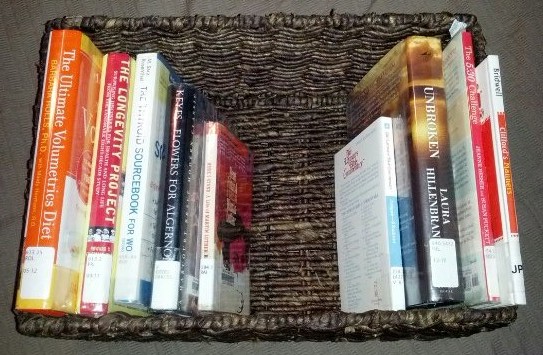
What's on My Nightstand

Continuing from Last Month:

  • Bondage of the Will by Martin Luther
  • The Thyroid Sourcebook for Women by Sara Rosenthal

New Additions this Month:

  • Flowers for Algernon by Daniel Keyes
  • Here I Stand: A Life of Martin Luther by Roland Bainton
  • The Longevity Project by Friedman and Martin
  • The Ultimate Volumetrics Diet by Barbara Rolls

Don’t forget to drop by 5 Minutes 4 Books to see what others are reading this month!

What's on Your Nightstand?


WICbits: What does a WIC appointment look like?

When a WIC applicant walks into our doors, they’ll be asked to sign in at a book in the lobby and then wait for the first available staff person to check them in.

Check-in includes verifying eligibility by evaluating proof of identity, proof of residency, and proof of household income. The check-in staff will tell the applicant about the WIC program, including their rights and responsibilities as a WIC participant. Check-in staff will also assess the applicant’s use of other programs and will make referrals as necessary.

Once the client has been checked in, they will wait for the medical data staff who will weigh and measure them and do a finger-stick for hemoglobin.

Next, the client will see a professional (either an Registered Dietitian or a Registered Nurse), who will assign risk codes based on a diet questionnaire and interview, will provide appropriate education and assist the client in setting goals for improvement, and will tailor and print checks for the food package. Professionals also provide referrals as needed.

In Kansas at least, most WIC clients (that is, children from 1-5) are re-certified every 6 months–which means they have to go through the entire process including verifying eligibility again. In between recertification visits (about once every 3 months), clients have to come in for at least one nutrition education meeting.

Low risk clients have an option of completing an online educational module or reading an educational poster in our facility for their nutrition education meeting. High risk clients (for example, obese children or women with a low Hgb) have to see a dietitian for their nutrition education meeting.

My job, then, is to evaluate clients using a combination of questionnaire and interview, assess their risk factors, certify them for WIC, counsel them regarding their risks and give them the needed education to make changes, and assist them in setting goals for themselves and/or their children.

I love it.

I spend the majority of my time dealing directly with mothers and fathers, helping them obtain the necessary knowledge and skills to feed their families well. Sometimes I get to do breastfeeding counseling with prenatal women, sometimes I get to talk to postpartum women about restoring their nutrient balances. Sometimes I get to help parents learn how to introduce solids to their babies. Sometimes I help them understand how to help their picky children learn to accept a greater variety of foods.

I get to talk a little child psychology and parenting techniques, a little physiology, a little cooking, a little child development. And, of course, I throw in a little economics while I’m at it.

It’s wonderful. I love what I do.


Book Review: “The Layman’s Bible Commentary: Judges, Ruth, 1 Samuel, 2 Samuel”

In last April’s Nightstand post, I gave a short review of The Layman’s Bible Commentary: Acts of the Apostles by Albert C. Winn. I spoke positively of it as a beginner’s commentary, restating and clarifying the text with bits of historical commentary throughout. While the mature believer with a lot of background already may not find it useful, it is a good source for the new believer or one with little Biblical background.

Recently, I picked up another volume in The Layman’s Bible Commentary series, this time written by Eric C. Rust on Judges through 2 Samuel. I started reading in 1 Samuel, in conjunction with my daily Bible reading, and red flags were popping up on almost every page.

Explaining Hannah’s song of praise in I Samuel 2:1-10, the commentator suggests that this psalm is not actually sung by Hannah but is of a later date–since the song mentions a king and Israel didn’t have a king until later. The problem with this interpretation is that Scripture directly contradicts it. I Samuel 2:1 says “And Hannah prayed and said”. If Scripture is inerrant, then there is no other explanation than that Hannah did indeed pray this prayer, including the part regarding a king, even though there was not yet a king in Israel. That she should sing of a king despite there not being a king is understandable if one believes that God inspires the words of Scripture and was also revealing his plan of redemption (although only in part) to the people of Israel before it happened. That the God who reveals secrets should have a woman prophesying in the midst of her prayers is not at all surprising. But the commentator doesn’t take this approach. Instead of regarding the Scripture as infallible and inspired by a God who is actively impacting the events that would be recorded, he seems to regard Scripture as little more than a human record of natural events.

Perhaps I would not judge this first blow at Scripture’s integrity so harshly as I have if the beating had not continued on each page that followed.

Writing of the people’s demand for a king in chapter 8, Rust says

“We have two conflicting traditions….The first, recorded in this chapter….The second, recorded in chapter 9….The two cannot be reconciled, and it is generally believed that the first tradition, enshrined in the chapter now being considered, was a later one, reflecting many years of disappointing experience of the monarchy and embodying the teaching of prophets like Hosea, who regarded the kingship as a manifestation of divine wrath.”

Rust states that chapter 8 has Samuel reluctantly giving in to the people’s request for a king and that chapter 9 has Samuel wholeheartedly giving the divine stamp of approval to the people’s request–and that the two can’t be reconciled.

The suggestion that the two are irreconcilable is ridiculous. The narrative is straightforward.
1. The people ask for a king (I Sam 8:5)
2. Samuel is displeased and prays to God (I Sam 8:6)
3. God tells Samuel to give the people a king but to warn them of what a king will do (I Sam 8:7-9)
4. Samuel warns the people of what a king will do (I Sam 8:10-18)
5. The people insist that they still want a king (I Sam 8:19-20)
6. Samuel tells God what the people said (I Sam 8:21)
7. God tells Samuel to give the people a king (I Sam 8:22)
Now, while we jump over to focus on the young Saul searching for his father’s donkeys, the overarching narrative remains the same. God has told Samuel to give the people a king, but they don’t have one yet. Verse 15 of chapter 9 picks up the story.
8. God tells Samuel that the man who will be king will arrive the next day (I Sam 9:15-16)
9. Samuel sees Saul and God confirms that this is the one (I Sam 9:17)

According to Rust, Samuel’s author switches back to reluctance in Chapter 10 when Samuel declares to the people that “today you have rejected your God” (I Sam 10:19). Yet I see no discontinuity in the text. The people were indeed rejecting God as their king–but that doesn’t mean that God isn’t still the one in charge of getting them a king.

Anyway, I go off on the details. Suffice to say that I do NOT recommend this particular volume within the Layman’s Bible Commentary. The author clearly has a low view of Scripture and this view suffuses everything he says.


Rating:0 Stars
Category:Bible Commentary
Synopsis:A theologian who does not believe in Biblical inerrancy repeatedly creates conflict within the text where no conflict exists, shedding doubt on every page of his commentary.
Recommendation: Don’t read.


Recap (7/13/2013)

Books added to my TBR list:

  • The Duet by Robert Elmer (reviewed by Barbara H.)
    A not-so-retired Dutch Reformed farmer develops an attraction for his granddaughter’s new piano teacher: a widowed college professor. The two are worlds apart practically and theologically–so the inevitable sparks fly. Sounds like fun–and since I’m always up for a good theological argument, I have high hopes for that part of their relationship. We’ll see :-)

Videos Watched:

  • Room 8 (linked to from 22 Words)

    The film-makers wer given a nondescript dialogue and a challenge: imagine a film. This winning entry is amazing.

Book Review: “Unbroken” by Laura Hillenbrand

When we were looking for a book to read for the new bookclub a few friends were forming, I suggested Unbroken by Laura Hillenbrand. I had to look up the description of the book in order to suggest it, since I didn’t have any idea what the actual content of the book was.

I just remember Amy declaring that it was going to be the best book she’d read in 2012-despite having read it at the very beginning of the year. And I remember Carrie reading it and loving it. And Janet. It ended up on both of the Lisas’ (Lisa Writes and Lisa Notes) lists of best books read in 2011. Barbara said it was excellent. In other words, almost every blogger I know and respect absolutely loved this book.

Now I know why.

So that you’re not as clueless as I was when I suggested this book to my club friends, I’ll give you a bit of a summary before I start raving. Unbroken tells the true story of Louie Zamperini, a neighborhood rascal turned Olympic runner turned B-24 bomber turned castaway turned POW turned alcoholic turned… This man’s life is astounding. After every section, I kept expecting this to be the end of the story, but it kept going. When Louie almost breaks the 4 minute mile, I think that he’s reached the pinnacle of his life…but his story has only just begun. When he survives for what seems like forever on a raft in the Pacific Ocean without food, I think he’s reached the height of human endurance…but his trial has only just begun. When he survives the terrible existence of being an undocumented Japanese POW, I think that his troubles are finally over…but he will now find himself battling with his worst foe yet. The subtitle of this volume is absolutely right. This is “a World War II story of survival, resilience, and redemption.”

In no particular order, here are a few (not all) the reasons why this book is one of the best books I’ve ever read–and why it’ll be tough for us to beat it as a book club read:

  1. It’s an absolutely riveting story of an endlessly fascinating man
  2. The author does a wonderful job of weaving together historical details, human details, quotes from endless interviews, and memorabilia to make a compelling book that’s difficult to put down.
  3. It highlights the Pacific theater of World War II–a fascinating but often-glossed-over side of WWII
  4. It is rich with thematic elements–sibling relationships, teamwork, mind over matter, human dignity, the ethics of war. (Not that the author tries to propagandize. She doesn’t opine on the topics, it’s just that the story raises questions ripe for reflection or book club discussion.)
  5. God “accidentally” shows up. This is not a religious work and the author doesn’t even appear that curious about religion, much less be a fan of spiritual things, but she can’t help but report what happened. And the truth is that the story of Louie Zamperini’s life isn’t complete without the God who saved him from his worst enemy yet.

I’ve done a terrible job of summing up this book–and a similarly terrible job of expressing why I loved it so much.

But please, forgive the poor ramblings of a woman who can’t quite figure out how to put things into words–and pick up a copy of Laura Hillenbrand’s Unbroken. You will not be disappointed.


Rating:5 Stars
Category:History/Biography
Synopsis:The overwhelmingly powerful, fantastically told story of Louis Zamperini’s life as an Olympian, an airman, a castaway, a POW, an alcoholic, and a redeemed man.
Recommendation: As Carrie put it: “So why, exactly, are you still sitting here?” Buy it, borrow it, steal it*; but READ it.

*That’s an expression. Please don’t actually steal this book. Whoever you stole it from will never forgive you.


Liar, liar, pants on FI-AR

As a dietitian, I have a few hard measures, but the majority of the data I collect and analyze comes from self-report.

I can weigh and measure a child. I can poke their finger to determine what their hemoglobin is. I can observe whether the child is drinking out of a bottle in my office–and sometimes whether they’re drinking water, milk, or juice.

But the majority of my information comes from parents themselves.

Before they come to visit me, they have to fill out a diet questionnaire that attempts to ascertain health and dietary patterns. Once they’re in my office, I interview the parents for additional information.

I rarely have any way of corroborating whether the story the parents are telling me is true or not.

I *do* happen to know that at least some of my client’s parents lie to me though.

Probably the most frequent example of a client lying is when the health interview reads that “no one in the household smokes”–but the diet questionnaire I’m reviewing reeks of smoke so badly I’m having coughing fits in my office trying to prep for the interview.

Then, there are the lies that are evident to anyone who is thinking.

How many hours a day does your child spend actively playing? the questionnaire asks.

“18 hours/day,” a parent replies.

If so, he’s getting far too little sleep, I want to point out.

But my favorite lies of all are the kind that the child contradicts.

Like the time when I had a picture-perfect diet questionnaire in front of me. According to the questionnaire, my client drinks 2 cups of whole milk (great, since he’s one), 4 oz of diluted 100% fruit juice, and several glasses of water in a day.

I asked mom to describe what her son eats in a typical day–and then I probed deeper. “And what does he usually drink?” I asked.

Big brother (age 6) answered, “Mmm…pop, Koolaid, Gatorade, juice…”

Mom was quick to cover, insisting that she only gave her one year old SPRITE, not the BAD kinds of soda with CAFFEINE in them. And Gatorade is only if they’re outside. And…

Yeah.

In other words, you lied.

Liar, liar, pants on FI-AR.

Then there’s the ones you wish had a little shame and would at least try to be embarrassed about SOMETHING. But that’s a WHOLE ‘nother story.


No, it’s NOT okay

The Bubblicious bubble gum with its bright pink wrapper and bubble letters was too great a temptation.

I grabbed it from the supermarket checkout line, hid it in my pocket.

Mom discovered my theft before we made it to the car. She turned around, marched me back into the store where I was to return the item, apologize, and pay for it.

The shop lady was nice, trying to be kind.

“It’s okay,” she said.

“No, it is NOT okay,” my mother replied.

It was an offense, a punishable offense. Shoplifting, theft. Whatever you call it, it’s a crime. It’s not okay.

I think of my childhood shoplifting when a mortified child returns to my room with a plastic carrot in hand.

“I’m sorry I took your carrot,” says the mouth hidden in her chest.

I resist the urge to tell her that it’s okay.

It isn’t okay.

I tell her I forgive her. I thank her for returning it.

I’m glad there are still mothers like mine, who agree that it’s not okay.

There is hope yet for this next generation–some kids are still learning not to steal, some kids are still learning to confess their wrongdoings.

And I will do my part. I will condemn the behavior and give grace to the child. I will offer forgiveness without sweeping sin under the rug.

Inasmuch as I can, I will help these children learn law AND grace.