Nightstand (September 2013)

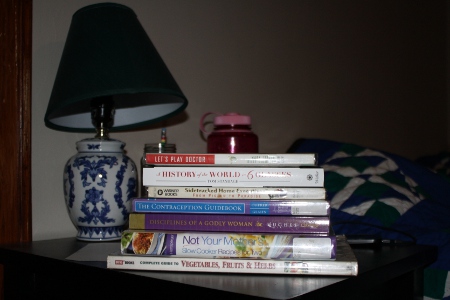
Thanks to yet another road trip (this time to Lincoln and back) where Daniel did a fair bit of the driving, I have some books to report in on this month. Were it not for that?

I’ve been struggling to keep my head afloat–except for the three days in which I whipped together a birthday party for Bilbo and Frodo Baggins.

8 hours, 20 people, 6 meals, 3 movies.

If I lie in bed for the entire rest of the month, I can still consider it to have been a HIGHLY productive month.

This month, I read:

  • Here I Stand: A Life of Martin Luther by Roland Bainton
    What I liked best about this particular biography is that it is very obviously written by a lover of Reformation theology. Bainton writes so passionately of the miracle of the gospel, of being saved by grace through faith that one can’t help but utter the occasional “Amen” after a particularly swelling paragraph. Whether in a paraphrase of one of Luther’s sermons or simply a description of Luther’s teachings, Bainton wrote so eloquently of the Reformation truths that have changed the world that my heart was moved to worship the One who is the Truth revealed. Also, Luther is hilarious. He’s so…real, so…blunt, so…human. I highly recommend this book.
  • Kneeknock Rise by Natalie Babbit
    A very sweet, quick read. I love that it doesn’t have chapters but instead has very short sections. That made it ideal for reading for bed, since Daniel and I couldn’t play the endless “Just one more chapter” game (in which he starts a new chapter while I’m finishing mine, and then I start a new one while he’s finishing his, ad nauseum.) Egan arrives at Kneeknock Rise to visit his family for the fair–and to hear the moaning of the Megrimum, the monster who dwells at the top of Kneeknock Rise. When his rather superior little cousin dares him to climb the verboten hill, he takes off like a flash–and discovers something he never expected. Read Carrie’s review for a more complete idea of what the book’s about.
  • Love Blooms in Winter by Lori Copeland
    The plot was pretty average as Christian pioneer fiction goes; but this book had the weirdest “conversion” story I’ve ever read. The hero tells of his conversion to…theism. Yes, he realized at some point that there had to be a God. Never once did he mention Christ. In fact, I’m not sure if Christ ever really came into the whole book. Which is rather disappointing.
  • Nothing Daunted by Dorothy Wickenden
    Read for book club last month. About halfway through, it tells the story of two college-educated society women of the 1910s who traveled to the “uncivilized” Western slope of the Rockies to teach school. The first half was hard to get into for me, since I wanted the society-girl-meets-wild-west story and was instead getting society-girls-grow-up-as-society-girls. If I’d been hearing that back-story AFTER I was already invested in the girls from their society-girl-meets-wild-west story, I might have liked it better. Nevertheless, I enjoyed the book overall.
  • 2 children’s picture books, author BRIGGS

On the docket for next month:

  • The Picture of Dorian Gray by Oscar Wilde
    I’m leading discussion for the Reading to Know bookclub this month–and boy am I excited to talk about Dorian Gray! Since my early teens, I’ve been fascinated by the general outlines of this story as told by Ravi Zacharias in the radio show my dad listened to every Sunday morning. But despite thinking about reading it every couple of years, I hadn’t actually read it until earlier this year, when I started it to get a jump start on discussion-leading for this fall. Oh my…so…much. Why did I wait so long? This is pretty intense.

    Join us?

Don’t forget to drop by 5 Minutes 4 Books to see what others are reading this month!

What's on Your Nightstand?


Thankful Thursday: Those who hold up my hands

Thankful Thursday banner

It isn’t an exaggeration to say that this has been one of the hardest weeks of my life. I don’t know that I’ve ever cried so much, for such a sustained amount of time, for no apparent reason.

This depression that has lingered for so long, which came to its breaking point this week, threatens to topple me.

I think of the song

“So I’ll stand
With arms high and heart abandoned
In awe
If the One who gave it all
I’ll stand
My soul, Lord, to You abandoned
All I am is Yours”

My voice breaks with a sob. I cannot stand. It is too much for me.

Instead I sit, like Moses on a rock, while others hold my hands high-helping me to see and to savor the gospel.

This week I’m thankful…

…for Daniel
He has held more than just my arms this week. He held me up quite literally, when I was having persistent dizzy spells on Sunday. He has held me physically and emotionally, as I bawled before and after work each day. He has held me up in prayer, consistently lifting me up to the Father. And he has held Christ’s love before my eyes when I haven’t the strength to lift even my eyes to the Lord.

…for Megan
When I said that it had been a tough day on Tuesday and she commiserated and chatted with me. When she welcomed us into her home for Bible study, with a far better birthday treat for Daniel than I had the power to muster. When she sat beside me and put her arm around me, praying for me.

…for Bev
She listened to my tale of woe. She told me I was okay. She asked me about my time in the Word. She pestered me about seeing a doctor. She praised my resolution to get ten minutes of physical activity each day. She challenged me to look to Christ. She held up my hands and told me that this darkness is not forever, and that God has a purpose when I see no purpose.

…for Ruth
She texted me last night to invite me to a Bible study this evening. I told her she should pick me up so I couldn’t talk myself out of going. When I realized this afternoon that I wouldn’t be able to make it through the night, and messaged her to cry off, she probed deeper. She asked how she could help. She gave me a chance to change my mind. She showed up on my doorstep to make sure I was okay, to give me a hug, to remind me that she was here for me.

…for Shirley
I’m sure Shirley has no idea that she was an agent of grace tonight when I went out for my ten minute walk and she asked me if my husband still had his job. She reminded me of the things I have to be grateful for–that my husband still has his job after the recent rounds of layoffs at his plant, that I have a neighbor who is concerned about us. She reminded me to lift my petitions with thanksgiving, even when the petitions weigh so heavily.

These have, probably unknowingly, been pillars beneath my hands, holding them up to the Lord–effecting victory (however small it seems so far) in the woman below.

“But Moses’ hands grew weary, so they took a stone and put it under him, and he sat on it, while Aaron and Hur held up his hands, one on one side, and the other on the other side. So his hands were steady until the going down of the sun.”
~Exodus 17:12 (ESV)

But most of all, I am thankful to my God, who sustains me.

“I give thanks to my God always … because of the grace of God that was given [me] in Christ Jesus, that in every way [I have been] enriched in Him in all speech and all knowledge…so that [I am] not lacking in any gift, as [I] wait for the revealing of our Lord Jesus Christ, who will sustain [me] to the end, guiltless in the day of our Lord Jesus Christ. God is faithful, by whom [I was] called into the fellowship of his Son, Jesus Christ our Lord.”
~1 Corinthians 1:4-9 (ESV)


Fits and Bursts

It seems I write in fits and bursts, just like I live the rest of my life.

I have a fit of kitchen zeal and my dishes get (almost) caught up, four dozen Runzas are packed away in the freezer, the load of cookie dough Daniel bought from a child is baked, and the fridge abounds with homemade yogurt. Above the fridge, an old Tupperware is full of homemade granola and two Pyrex with roasted chickpea snacks.

A fit of reading (on a trip, usually) has me writing reviews and book notes.

A fit of exercising means I walk to Braums for milk, to a friend’s house to drop off my husband for breakfast (yes, totally unnecessary, since he could have walked or driven himself–but still), to the library to drop off a book and get some more.

And then come the bursts.

I collapse on the couch after work, crying until my husband orders me into the bathtub to relax.

I burst into tears unprovoked and stare unseeingly at the wall, unable to contain my emotion.

I start the day crying and thank God that I have some time charting between clients because I need the moments for more fits of crying.

I just start to feel that things are getting better–that I’m making friends and finding my place. I just start to feel that I’m establishing routines and doing okay. I just start to feel that I’ve figured out how to be a wife and a woman at the same time.

And then the bubble bursts and I’m back in a fit.

I cry and cry.

I can’t see outside the moment, outside the days, the weeks of difficulty.

When does it get easy? I wonder. Will it ever?

When will I get out from under the cloud I’m living in? When will I gain perspective? When will I cease to be at the whim of these fits and bursts?

I despair.

I think I need help.

I tell myself that help is more trouble than it’s worth.

I don’t want to spend money for help. I want to pay down our debt so we can have a baby.

I want to help myself. I check out books from the library. Books on sleeping better, on overcoming depression, on managing the TMD related headaches. I don’t read them because the burst of energy to complete them never comes.

Daniel wants to help me, asks how he can help–but I don’t know how. I wish I did. I wish I knew what caused these fits, these crying jags, this persistent, lingering melancholy. We work our way through what we know, but we know so little.

What am I to do when the thunderstorm breaks and I find myself bawling in my office, unable to see any way out?


Formula, Apples, and Oranges

“We had to switch him to Enfamil because he was vomiting up the Similac.”

I clarify. “So he was vomiting on Similac Advance?”

Mom agrees.

“Unfortunately,” I tell her, “we only have a limited selection of formulas we can offer your baby, and that specific formula you’re providing your baby now isn’t one that I can give him. We could try Similac-”

As soon as I say the word, mom visibly starts and begins shaking her head.

I try to push through. “We could try Similac Total Comfort, which is another milk-based formula except that it has some of the proteins broken down so they’re…”

Mom is having none of it. “You can’t give me any Enfamil?”

“Not the type you’re using,” I say. “The only Enfamil product we provide is Enfamil ProSobee, a soy-based formula. That’s going to be different from what you’re using right now because you’re currently using a milk-based formula.”

I never did manage to get it through to mom that the BRAND isn’t the important thing to look at when you’re evaluating formula.


You, dear readers, will listen, won’t you?

When your child seems to be having tolerance issues to a formula, switching brands may help–but the brand isn’t really the issue. The issue–if there’s a formula issue at all (most of my clients wouldn’t believe it, but most of the things people switch formulas over are actually normal parts of infancy and the “improvement” they see once they switch has more to do with baby getting a bit older than with the new formula). Anyway, enough rabbit trails. The issue with the formula is that there’s some ingredient in that particular formula that baby isn’t tolerating.

So, you want to find another formula without that ingredient–except that you don’t know what the ingredient is, so you’re going to be playing a bit of a guessing game.

Almost every formula manufacturer (I’ve used Abbott/Similac and Mead Johnson/Enfamil, the two biggest formula suppliers, for my examples in the following list, but there are other brands of formula available) has at least four or five different varieties of formula*.

  1. Standard milk-based formula
    This formula contains milk proteins (from whey and casein) and milk carbohydrates (lactose). Examples include the aforementioned Similac Advance, as well as Enfamil for Infants. Most babies do well on this type of formula.
  2. Low/No Lactose milk-based formula
    This continues to use milk proteins, but exchanges some or all of the lactose with another sugar. Most of these types of formulas also have other changes (such as adding rice starch or partially or fully breaking down the milk proteins), but one formula (Similac Sensitive for Fussiness and Gas) is virtually identical to the standard milk-based formula except for this change. Infants who have a hard time digesting lactose (which is less common than many parents think) will do better on this type of formula. This type of formula is often used if a child seems unusually bloated or gassy.
  3. Milk-based formula with hydrolyzed proteins
    This type of formula uses milk proteins but breaks them down into smaller pieces, which may be more easily digestible by infants. The proteins may be partially hydrolyzed into small protein fragments (Gerber Good Start does this) or fully hydrolyzed into the component amino acids. Most of the fully hydrolyzed milk-based formulas are also lactose-free. Examples include Enfamil Gentlease and Similac Total Comfort. Hydrolyzed protein formulas are used if a protein allergy or intolerance is suspected, often when an infant experiences constipation.
  4. Soy-based formula
    This type of formula uses soy proteins and a non-lactose form of sugar. Examples include Similac Soy and Enfamil ProSobee. These are used by parents who are vegetarian or when milk-protein allergy or lactose intolerance is suspected.
  5. Formulas for Acid-Reflux
    Maybe you’ve heard the old wive’s tale about adding rice cereal to a bottle to keep baby from spitting up. Maybe you’ve even heard it from a doctor. Like many old wive’s tales, there’s a grain of truth and plenty of risk in following this advice. Added rice starch does seem to reduce acid reflux for many babies. But adding rice cereal to a bottle can pose a choking or aspiration (getting food in lungs) risk and can increase risk of obesity. Choosing a formula specially formulated with added rice starch may help with the reflux while minimizing the risk associated with adding cereal to a bottle. (Please note that there is virtually NO evidence that adding cereal to a bottle will help a baby sleep through the night. All the risks, none of the benefits–DON’T do it!) Examples of these formulas include Enfamil A.R. and Similac Sensitive for Spit Up. Infants with acid-reflux (this is spitting up beyond the normal spit up 0-3 month olds do after every feeding and includes additional symptoms) may benefit from this type of formula.

So, now that you know a little bit about formula, you can educate your friends. If someone is having a problem with their formula, let them know that it doesn’t matter which BRAND they’re using. It matters what KIND they’re using.

Compare apples to apples, people.


*Actually, the big couple have dozens of formulas–but most of the other types of formula NOT noted in the above have changes made to treat specific conditions and should only be used on a doctor’s recommendation.


Book Review: Why We Get Fat by Gary Taubes

Taubes. I’d heard the name before, seen it on Instapundit. He was a low carb guy or a paleo or something like that. I didn’t pay him any attention.

Before Daniel and I met, Daniel heard an interview with Taubes on Russ Roberts’ EconTalk and was impressed. Daniel had been trying to eat lower carb in response; but once I took over the cooking, he just ate whatever I made.

Daniel has never complained about my cooking–in fact, he regularly compliments me (and shows the greater compliment of eating even the leftovers). But every so often, he’ll mention Taubes or comment that I should try making a lower carb version of this or that (My husband also has a rather significant faith in my ability to work wonders in the kitchen.)

So I knew I’d need to read Taubes’ Why We Get Fat eventually. I checked it out from the library while we were still dating, but I didn’t get very far.

See, the first chapter of Why We Get Fat seems designed to (forgive my French) piss off nutrition professionals.

Taubes effectively says: “Nutrition professionals say we get fat because calories in are greater than calories out. That’s not true.” He goes on to give example after example of fat but malnourished people. Problem is, he wasn’t giving enough information to differentiate whether actual energy malnutrition was occurring concurrent with obesity or whether what he was describing was kwashiorkor or other non-energy forms of malnutrition. This frustrated me beyond belief–and I gave up after the first chapter more than once.

It’s this first chapter that led to arguments between Daniel and I. I got really upset about how I felt Taubes was dogging my profession–and upset that he wasn’t giving the sort of information I needed to evaluate his claim. At first, Daniel didn’t really believe me that Taubes was so anti-nutrition professionals–so he was feeling pretty defensive, like I wasn’t giving Taubes a chance. After re-reading the first chapter, Daniel realized I was right about Taubes’ antipathy towards people like me–which didn’t really help the matter. No one wants to be proven wrong in an argument with his wife–and much less so if his wife is on rampage because an author (who you think should be taken seriously) has royally ticked her off. So, yeah….We definitely had to communicate our way through the first chapter because emotion was running pretty high.

Moving on.

The whole first half of the book was dedicating to “debunking” (ineffectively, to my mind) the idea that body fat is a matter of energy balance. This was pretty frustrating to me because energy balance is really just a matter of the 1st law of thermodynamics. We can’t store energy (in the form of fat) that we don’t have. Energy balance isn’t really open for debate.

It seemed to me that Taubes was making a common mistake–assuming that the energy balance equation is how much we eat minus how much we exercise. Yes, these are a big part of the energy balance equation, but calories in and out are actually much more complex, influenced by genetics, hormones, environment, and a host of other variables. Eating and exercise are simply the two most alterable aspects of the energy balance equation–which makes them a prime target for intervention.

So, after 70 pages hating on energy balance, Taubes admits that energy balance is a truism–sort of like survival of the fittest–and that what he’s really trying to say is that some other mechanism is primarily responsible for excess adiposity.

Great, I though, as I read the last few chapters of the first section. You could have just told me that at the beginning so I didn’t have to read all this hateful mumbo-jumbo before I could get to your thesis.

At last, in the second section of the book, Taubes was ready to tell the reader what his hypothesis is for why people become obese (literally, why they develop excess stores of fat tissue vs. lean tissue.)

His hypothesis goes like this: Insulin causes our bodies to preferentially store energy as fat, making it unavailable as fuel. Carbohydrate in the diet increases the amount of circulating insulin, which then increases adiposity (amount of fat tissue). Adipose tissue–and an overabundance of insulin–decreases insulin sensitivity, which means we have higher blood sugars. Higher blood sugars make us produce more insulin, which makes us get even fatter. And the cycle continues.

Taubes argues that this mechanism, in which insulin encourages our bodies to preferentially store energy as fat, means that our body will essential “rob” energy from vital processes (organ functioning as well as ability to use it for physical activity) in order to store it as fat. This means that a person can have inadequate energy for body functions while still storing fat.

This is an interesting and plausible mechanism for the problem of obesity (which is ultimately about excess body fatness rather than about body weight). I would love to see this hypothesis tested.

Unfortunately, Taubes seems intent on alienating the very people who have the knowledge and skills to test his hypothesis. Which means he can continue to sell “why your doctor/dietitian/health professional is wrong” books–but isn’t likely to see any change in public health policy.

My conclusions?

I like Taubes’ hypothesis. Right now, it’s just one theory among many regarding the causes of excess adiposity–but it has some definite merits. I’d love to see it tested.

And…I think Taubes is a jerk.

Just sayin’.


Rating:I can’t decide
Category:Nutrition
Synopsis:Taubes tries to explain why energy balance isn’t responsible for obesity–and what he thinks is responsible
Recommendation: Did you read my review? Okay, then you probably don’t need to read this book. The first half is rubbish, the second a reasonable hypothesis that needs testing. Oh, and I mentioned that the author is a jerk, right?


A Lamp’s Tale

Snap, crackle, pop.

The sound wasn’t coming from my breakfast cereal.

It, along with a brief flash of light, was coming from my bedside lamp.

I rolled over, flicked the switch toggle back and forth to confirm. The lightbulb was burned out.

Books in Progress

Periodically through the next several weeks, I would reach over to turn the lamp on, only to rediscover that the lightbulb was burned out. Since I generally only turn the light on to read in bed, I generally don’t feel like changing a lightbulb just then. So I’d reach across the bed to Daniel’s nightstand and turn on his bedside lamp.

Finally, one lunchtime, I decided to actually change the bulb.

I pulled out my step-stool, climbed to the cabinet of lightbulbs, dug through the lightbulbs for prospective candidates. My bedside lamp has to have a low wattage, since I don’t want my body to think it’s daytime–and the bulb has to be able to handle the little wire clip that holds the shade on (something CFCs have a hard time doing.) After a bit of digging, I found two prospects: a CFC that might not work with the shade and an incandescent bulb that might be too high wattage.

I took off the shade, unscrewed the lightbulb. I screwed on the new CFC and flipped the switch.

Nothing.

Darn it all. I knew I should have been labeling those CFC that I was putting back in boxes until I could dispose of them at the Hazardous Waste place.

I unscrewed the CFC, returned it to its box, and screwed in the new incandescent bulb.

I switched the light on–and got nothing again.

Double darn it all.

Whatever caused the snap, crackle, and pop must have destroyed the lamp’s wiring. I like the lamp, it matches my blueware. I’ll have to rewire it some day–but for now, I guess I’ll just replace it.

I reached down to unplug the lamp–

and discovered that it was already unplugged.

That snap, crackle, pop?

My lamp coming unplugged months ago.

Yeah. Welcome to my life :-)


Thankful Thursday (8/29/2013)

Thankful Thursday banner

This week I’m thankful…

…for an unnecessary wake up call
Daniel prays with some other men early every Thursday morning. Two weeks ago, I feel asleep after he left and slept right through until I should have been at work. Last week, Daniel called me about 45 minutes before I had to leave for week–and I was glad to announce that I was up and just out of the bath!

…for help with Friday’s chili
I was behind on Friday, way behind. I had to get to work and the chili had to go in the crockpot. When time became desperate Daniel gave me orders. No touching the chili until I was all ready for work–including having finished breakfast. Which meant Daniel chopped the onion and browned the hamburger and added the seasonings to the crockpot. What a blessed woman I am, to have a husband who cares for me so.

…a dad who wants his daughter to explore the wide variety of careers available for women
I was surprised but pleased when a dad asked me a favor after I’d finished certifying his youngest daughter. He wants his eldest daughter to learn more about the types of fields she could go into someday. Could I describe my job and my education for her? I loved being able to describe my career path–but also to encourage her to read widely, to explore a variety of interests, and to shadow and volunteer wherever she has a chance.

a niece and nephew to play with my toys
Six-year-old E and four-year-old P stayed the night with us this last Friday while their parents were at a youth leader’s retreat in town. P and I dressed Addy, E and Daniel played with my cap gun. We played UNO and Connect Four and Memory. P put together the 50 states puzzle I picked up a couple years back at a used store. E found volume 11 of Childcraft, the same volume I pored over years ago as a visitor at the across-the-street neighbor’s house. He had seen my cardboard collection downstairs and asked if I had crayons, tape, scissors, and typing paper so he could make the foot-shaped fan he saw displayed on the pages. I was glad to assist him in completing one of those projects I dreamed of doing so often as a child myself.

…a friend
We met at a Sunday evening small group when I first moved here but didn’t really talk that much. When the small group ended in May, we parted ways. Then, about a month ago, Alexa texted me to ask if I wanted to hang out sometime. We took a walk and talked–and scheduled a date for tea the next week. This week, we made (and carried out) plans for Alexa and her husband (formerly Daniel’s roommate) to come over for dinner with Daniel and I. After a long stretch of feeling pretty lonely in this new town, it’s so wonderful to have a friend.

…a husband who serves me
Some might roll their eyes at how often Daniel appears on my “thankfulness” lists. They might presume that this is merely the rose-colored glasses of a newlywed. But when I read in Luke 22 how Jesus says that the greatest among you is the one who serves, and when I see that He reminds the disciples that He (Christ) is among them as one who serves, I thank God for giving me a husband who models Christ-like service. Just this week, Daniel has cleaned for me, has done dishes, has gone grocery shopping, has taken the trash to the curb, has picked me up food, has given me wake-up calls, has prayed for me, has comforted me, has let me sleep, has valued my input. I could never deserve such a great husband–He is a daily EOG (Evidence of [God’s] Grace).

I am so thankful to God, from whose hand all these things come, that He has called me according to His purposes and promised that all things (whether the nice things I listed above or the difficult things I have not listed) work together for my good–so that He might conform me to the image of His Son.

“For from Him and through Him and to Him are all things. To Him be glory forever. Amen.”
~Romans 11:36 (ESV)


Nightstand (August 2013)

After writing last month’s Nightstand lamenting how few books I’m reading these days, I promptly finished Flowers for Algernon by Daniel Keyes the next day. Hooray! My spirits were lifted and I am optimistic again.

That Daniel drove the entire way to Wisconsin and back gave me plenty of time to do additional reading, so this month is looking pretty good.

This month, I read:

  • The Fertility Diet by Jorge Chavarro and Walter C. Willett with Patrick J. Skerrett
    No, I am not trying to get pregnant. But seriously, when a dietitian sees a title like this from McGraw-Hill and Harvard Medical Press she just has to take a look. It turned out to be an intriguing look at what the Nurse’s Health Study reveals about diet and ovulatory infertility. Certain parts (the recommendation to eat full-fat dairy, in particular) may be a bit controversial, but the recommendations are generally science-based (although cohort studies are necessarily difficult at establishing causation) and probably useful for anyone struggling with ovulatory infertility. Because many of the recommendations work through managing insulin and adrogen production, this general diet may also be useful for women struggling with the effects of PCOS. I’d love to see some prospective studies using this diet for the treatment of infertility.
  • Flowers for Algernon by Daniel Keyes
    This was our second book club read. I put the title in the hat after reading Heather’s review and was a little surprised that we ended up drawing it. This book, about a mentally handicapped man who was chosen for an experiment to “make him smart”, turned out to be an excellent choice with plenty of opportunity for discussion. Read Heather’s review for the caveat emptors, but I do still generally recommend it as a good and thought provoking book.
  • The Longevity Project by Friedman and Martin
    I read this based on an article I read about it online. It follows an interesting prospective study of children from the twenties who were followed throughout their lives–and looks for predictors of long life. It looks like longevity isn’t quite so straightforward as we think–and there are multiple paths to long life. For instance, neurotic men don’t generally live a long time, but when wives die before their husbands, neurotic men are more likely to live longer than non-neurotic men. So you can’t necessarily say “neurotic is good” or “neurotic is bad”. The information was interesting, but the presentation was pretty dry. I don’t know that I’d recommend it for the casual reader.
  • Nurture Shock by Po Bronson and Ashley Merryman
    A look at what the science says about child-rearing (which isn’t always intuitive). I found this fascinating enough that I’m writing up notes on it for future reference (and, yes, you’ll probably be subjected to those notes in the form of blog posts–I apologize in advance.) Practically everyone read this before me and I know I saw it mentioned on half a dozen hundred blogs–but I can’t seem to find where I bookmarked any of them. So, if you reviewed this book you probably contributed to my reading of it. Please consider yourself thanked.
  • The Thyroid Sourcebook for Women by Sara Rosenthal
    It was a decent coverage of thyroid disease, but not my favorite resource. Meh.
  • The Ultimate Volumetrics Diet by Barbara Rolls
    I read this while I was an undergraduate (before it was “The Ultimate”) and loved the science-based recommendations. I use Volumetrics-type concepts daily in my counseling. This time, I spent a week following the Volumetrics recipes, to see how the official “diet” works on an every day level. The good news is that the recipes are varied and relatively easy to prepare. The bad news is, like my husband said, “They’re okay, but I like your cooking better.” I think the recipes suffer a bit taste-wise from being so low-fat. Adding in some good unsaturated fats in moderation will increase the caloric density of the foods (meaning that they won’t promote weight loss as quickly)–but will probably greatly contribute to the palatability of the recipes.
  • Why We Get Fat by Gary Taubes
    Someday I’m going to review this in full. For now, I’ll say that it has been a source of argument between me and my husband and has almost reduced both of us to tears. Taubes seems determined to keep nutrition professionals from taking him seriously (for the matter, determined to make nutrition professionals angry at him) in the first half of the book before getting to his actual thesis in the second half. After numerous starts and not a few angry rants, I finally got to the section including Taubes’ thesis and found that it is a reasonable hypothesis to explain excess adiposity (the deposition of excess body fat vs. lean tissue). That being said, don’t read until you’ve read my full review lest you learn from Taubes that you shouldn’t believe a word I say.

Also Reading this Month:

  • Daniel Deronda by George Eliot
    I got it for the Reading to Know Bookclub. I read 1 chapter. I got busy with other things. Bleh! I still think I’ll plug through, but I’m bummed that I’m yet again slacking with the RTK club.
  • Here I Stand: A Life of Martin Luther by Roland Bainton
    Continuing from previous months…this is a very interesting look at one of the leading Reformation figures.
  • Kneeknock Rise by Natalie Babbit
    Just started and not far enough along to have an opinion. I generally like Babbitt, though, and Carrie recommended this highly.
  • Nothing Daunted by Dorothy Wickenden
    This month’s book club pick; it tells the story of two college-educated society women of the 1910s who traveled to the “uncivilized” Western slope of the Rockies to teach school. It took a while to get into it (the author started telling backstory before I was invested in the characters, which was a bit distracting), but I’m enjoying it now–and need to finish it quickly to discuss on Thursday!

Don’t forget to drop by 5 Minutes 4 Books to see what others are reading this month!

What's on Your Nightstand?


Water-Rant

The Sedgwick County health-related organizations are doing a wellness challenge called “Chug a Jug” this month.

The goal is to have each participating employee meet their personal goal for water consumption in a day–with a suggested goal of 64 oz (a half gallon) of water per day.

I’m participating, but I’m complaining about it to my husband all the time.

Why am I complaining?

*****Begin Rant*****

Because it’s just wrong, just plain wrong.

Okay, maybe not that bad.

The health goal is ostensibly to have people replace caloric beverages with water–which is generally a good choice–but the execution leaves much to be desired (in my humble opinion.)

First, there’s the jug aspect. The challenge suggests 64 oz per day, the “8 glasses” we all grew up hearing. Problem is, there really isn’t any science that says 8 glasses is the optimum amount of water for even the average adult. That’s actually a pretty arbitrary number. For children, that number could actually be dangerous if kids tried drinking that much too quickly. (And yes, the challenge does let employees enroll their family members.)

Second, there’s the water aspect. Most of the benefits of water that are spread through e-mailed reminders are actually not benefits of water (that is, plain water) per se, but of fluid in general. Fact is, our bodies are remarkably good at getting water from all the fluids and even foods that we eat. When we drink juice, Koolaid, sports drinks, soda, coffee, milk, and tea–our body gets water. We don’t have to be drinking it plain from a tap or a bottle to obtain the benefits of water.

Third, there’s the two of them together.

Let me explain what I mean.

Assume I require 2000 calories per day. If I look at the USDA’s My Plate, I should be getting 3 cups of dairy in a day. That’s 24 oz, which (assuming that the 64 oz guideline is correct–which it isn’t necessarily) leaves me 40 oz of fluid for the day. Assume I decide to get 1/2 cup of my 2 cups of fruit from fruit juice. That leaves me 36 oz of fluid in the day. Now, say I like to wake up with a 16 oz coffee (without sugar or with an artificial sweetener). That would leave me with 20 oz of fluid in my daily requirement. If I were to drink 64 oz of water on top of that, I would be getting a whopping 108 oz of water (just 2 1/2 cups less than a gallon) in a day–which is more than is necessary by any estimation.

In other words, the challenge is silly.

*****End Rant*****