
What’s on Your Nightstand? (December 2009)

What's on Your Nightstand?

It’s time again for 5 Minutes 4 Books’ monthly meme. Here’s what I had on my nightstand last month.
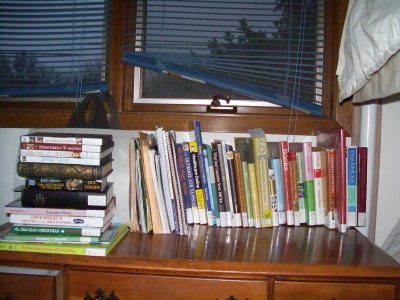
On my nightstand

What I actually read was:

Fiction

  • Bergdorf Blondes by Plum Sykes
    Bleh. I wasn’t impressed.
  • The Gatecrasher by Madeleine Wickham
  • When Comes the Spring by Janette Oke

Nonfiction

  • 101 American Customs by Harry Collis
  • Book of Common Prayer
  • Books: a memoir by Larry McMurtry
    Actually, I only read the first 60 pages of this one. I think it’s worthless. Click on the title to read the rest of my thoughts.
  • Cultural and Historical Allusions by Sylvia Cole
  • Everyman’s Library Pocket Poets Christmas Poems
  • Life, Liberty, and the Pursuit of Healthiness by Dean Edell
  • Michael Hague’s Family Christmas Treasury
  • Nourishing Traditions by Sally Fallon
    I didn’t have time to finish this before it had to go back to the Inter-library loan office. My initial thoughts on what I’ve already read are that there is some truth to certain aspects of Fallon’s reasoning (specifically that red meat probably isn’t as “evil” as many people would make it out to be), but the majority of the views promoted in this book are based on tenuous science and serve only to add unnecessary stress to meal preparation. Follow Fallon’s recipes if you like them, but don’t worry about destroying your family’s health if you don’t use raw milk, sprouted grains, etc.
  • PC Magazine Digital SLR Photography Solutions
  • What Your Counselor Never Told You by Dr. William Backus
  • Juvenile

    • Cinderellis and the Glass Hill by Gail Carson Levine
      Gail Carson Levine’s Princess Tales are quick, whimsical variations on old-fashioned fairy tales. They’re a fun read for pre-teen-ish girls for whom “classic” fairy tales are just a little too “childish”.
    • Keeping a Journal by Trudi Strain Trueit
    • Princess Sonora and the Long Sleep by Gail Carson Levine

    Picture Books

    For next month, I’ve got way too much on my nightstand–and way too much weighty stuff. I feel certain I won’t be able to finish it all in time. But I’ll try anyway.
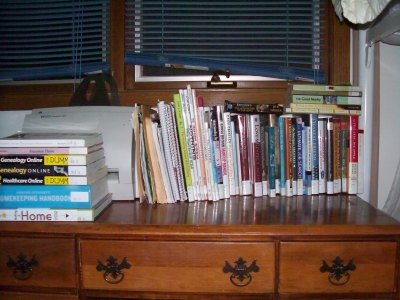
    On my nightstand

    Fiction

    • The Good Nearby by Nancy Moser*
    • Little Lady, Big Apple by Hester Browne
    • Resurrection by Leo Tolstoy
    • When Breaks the Dawn by Janette Oke
    • When Hope Springs New by Janette Oke

    Nonfiction

    • Better Homes and Gardens Making a Home
    • Confessions of an Organized Homemaker by Deniece Schofield
    • Dave Barry’s History of the Millennium by Dave Barry
    • Dearest Friend: A Life of Abigail Adams by Lynne Withey*
    • Genealogy Online by Elizabeth Powell Crowe
    • Genealogy Online for Dummies
    • An Idiot Girl’s Christmas by Laurie Notaro
    • I Married Adventure by Luci Swindoll*
    • I’m More than the Pastor’s Wife by Lorna Dobson*
    • Martha Stewart’s Homekeeping Handbook
    • Rocking the Roles by Lewis and Hendricks*
    • The Lord’s Suupper: Five Views edited by Gordon T. Smith*
    • What I with I’d Known Before I Got Married by Kay Coles James*
    • And a dozen more that I hope I can get to (but kind of doubt that I will)

    Juvenile

    • Fairy Dust and the Quest for the Egg by Gail Carson Levine
    • Mystery behind the Wall by Gertrude Chandler Warner
    • Picture books from AG to ?
    • The Stunning Science of Everything

    *The asterisk marks books I’m currently in the middle of.

    Drop by 5 Minutes 4 Books to see what others are reading.

    A Tailoring Trick

    A couple of weeks ago, I was horrified to realize that none of my clothes fit. And by none, I truly mean NONE.

    You see, I just so happen to be blessed with an ample top and a practically non-existent bottom, with long arms, legs, and torso. Which means that I can rarely find something that fits off the rack.

    Even brand new, my shirts tend to strain across the front, barely cover my belly, and unintentionally become three-quarter length sleeves. I’ve dealt with it for years by wearing wife-beaters under most of my tops.

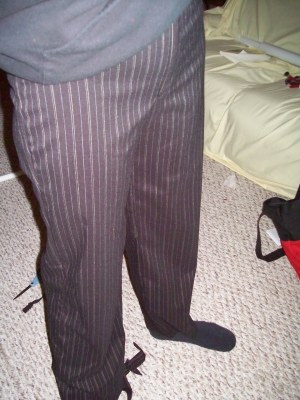
    Brand new slacks tend to be too short, and have big bags where most people’s hips and behinds go. I solve half the problem by buying slacks with cuffs–and then taking down the cuffs for extra length.

    Altering pants
    Note the “bags” in the hips.

    But I lost some weight last year, leaving me with even more fitting problems. Now my slacks and skirts slip right off my waist–in addition to bulging around my hips.

    I refrained from altering my clothes, except for adding belt loops to a few pairs of slacks, because I felt sure that I would regain the weight. After all, I’d maintained that weight for years–why would I develop a new set point?

    But maintain a new set point I have–and now I have decided that it’s time my clothes fit properly.

    So I loaded my machine with black thread, pulled all the black garments out of my closet, and got to business–and quickly remembered why I don’t like to do this too often.

    Tailoring is a laborious process of trying on, making adjustments, trying on again, adjusting some more, ripping out seams, redoing seams. It takes forever, and it’s pretty imprecise.

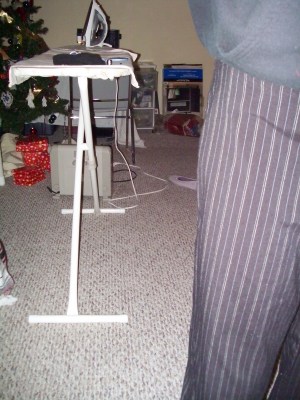
    I had just decided that maybe I’d only do one pair of slacks this evening when an idea hit me. What if–instead of trying on the slacks, guestimating what needs to be altered here and there, trying it out, trying it on, and repeating the process until perfect–what if I just put my slacks on inside out and pinned everything up. Then I could just sew along my pin line and call it good.

    Altering pants
    Pinning up those hip “bags”.

    Amazingly, it worked. I kept going and ended up getting 3 skirts, 3 pairs of slacks, and 1 dress altered this evening–much more than I had expected.

    Altering pants
    Pants that fit. Amazing!

    So, next time you’re frustrated at the fit of your clothing, try the little trick I learned this evening–turn your pants inside out.


    Thankful Thursday: Numbers

    Today I’m thankful for:

    • One pieced quilt top (Yeah, I’ll still have to get it quilted if I’m going to give it to them tomorrow. Break out the machine!)
    • Two turned-in papers (Why did I save them until today? Good question.)
    • Three on three basketball last night (Can you believe it? I barely can!)
    • Four requirements from God (Deuteronomy 10:12–“And now, Israel, what does the Lord your God require of you, but to FEAR the Lord your God, to WALK in all His ways…to SERVE the Lord your God…and to KEEP the commandment of the Lord.”)
    • Five books to return to the library. (Not that many, but I’m getting there on a couple more.)
    • Six days off before Christmas (okay, that’s kinda cheating!)
    • Seven fantastic siblings (even if sometimes they annoy me.)
    • An eight o’clock phone call. (Will that mean an earlier night or a longer conversation, I wonder?)
    • Nine A.M. with Joanna (Going to get that quilting done!)

    And above all that, I’m thankful that the Lord our God is One. He is the same yesterday, today, and forever.


    The ads I love

    Your left hand plans ahead. Your right hand plans for anything. Your left hand gets it done. Your right hand shows the world how it’s really done. Women of the world, raise your right hand.

    Little known fact about me: I love printed advertisements. Some printed advertisements, that is. Mainly, the ones that use words. The ones that use words well.

    Your left hand likes evenings at home. Your right hand loves a night out. Your left hand reads stories before bed. Your right hand lives a story worth reading. Women of the world, raise your right hand.

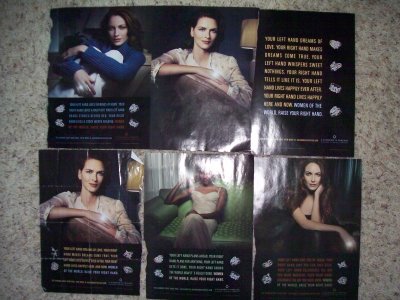
    For instance, I loved the Diamond Trading Company’s right-hand ring advertisements. I have copies of half a dozen of them in a file in my cabinet (I guess it’s good I have paper copies, because I’m having a hard time finding photos online.) They’re poetry, they’re empowerment. I love them.

    Your left hand dreams of love. Your right hand makes dreams come true. Your left hand lives happily ever after. Your right hand lives happily here and now. Women of the world, raise your right hand.

    Right hand ring ads

    Your left hand says you’re taken. Your right hand says you can take over. Your left hand celebrates the day you were married. Your right hand celebrates the day you were born. Women of the world, raise your right hand.

    Some from the most traditional camps might complain about the feminism found within these ads. I don’t.

    Sure, they’re emphasizing the right hand–but the point is that both the “right” and the “left” hands of women are powerful. Woman’s identity is not found merely in the ring found on the left hand ring finger–women are so much more.

    Right hand ring ads

    Note that I DON’T have the above in my collection. I don’t really like this one.

    Your left hand sees red and thinks roses. Your right hand sees red and thinks wine. Your right hand believes in shining armor. Your left hand thinks knights are for fairy tales. Your left hand says “I love you”. Your right hand says “I love me too”. Women of the world, raise your right hand.

    You see, that one–that one’s not quite right. That one trivializes the left hand–and makes the right hand into a selfish being. It makes the left hand about fairy tales and the right hand about self-love–cheapening both hands, in my opinion.

    So I’m not indiscriminate in my love of printed advertisements.

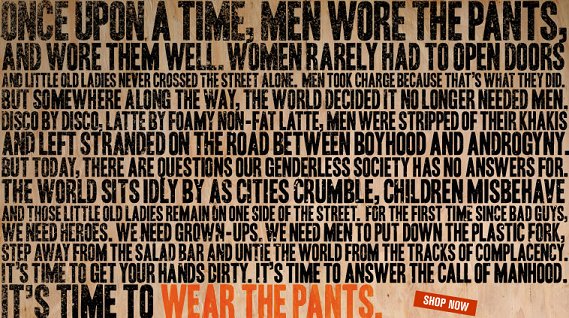
    Well, today I found a new ad to love. This time, it’s a men’s empowerment piece:

    Wear the pants ad

    Once upon a time, men wore the pants, and wore them well. Women rarely had to open doors and little old ladies never crossed the street alone. Men took charge because that’s what they did. But somewhere along the way, the world decided it no longer needed men. Disco by disco, latte by foamy non-fat latte, men were stripped of their khakis and left stranded on the road between boyhood and androgyny. But today, there are questions our genderless society has no answers for. The world sits idly by as cities crumble. Children misbehave and those little old ladies remain on one side of the street. For the first time since bad guys, we need heroes. We need grown-ups. We need men to put down the plastic fork, step away from the salad bar and untie the world from the tracks of complacency. It’s time to get your hands dirty. It’s time to answer the call of manhood. It’s time to wear the pants.

    It puts shivers up and down my spine and a prayer in my heart. Not that Dockers would make money (although perhaps they deserve it for this campaign), but that men would hear the call and respond.

    “Yes,” I say. “That’s what we need. That’s what we want. Pay no attention to the feminazis who would say we prefer men to be weak, to be feminine. Stand up for a manhood that’s beyond lust, for a manhood that’s powerful in its own right. Men of the world, it’s time to wear the pants.”


    On Feminine Discretion

    A recent article from the Wall Street Journal talks about women who lack discretion. Eric Felton opens his article with the startling words: “Pity the man whose wife writes a memoir.”

    Some things are meant to be hidden–but many women have difficulty keeping them hidden. Women are a sociable sort. We delight in revealing the details of our lives to one another.

    The mad swathes of “Mommy Bloggers” are just one manifestation of the delight women take in sharing their lives. Mommy bloggers (and mommy blogger wannabes like myself) share the minutiae of their thoughts, their days, their homes, their children–and all too often, their husbands.

    In Luke 2:19, we read that Mary “kept all these things and pondered them in her heart.” But this appears to be far from the norm for women. Learning discretion is often an uphill battle for us.

    Yet, Scripture makes it clear that discretion is a godly and desirable trait for women. Titus 2:4-5 encourages older women to “admonish the young women to love their husbands, to love their children, to be discreet, chaste, homemakers, good, obedient to their own husbands.”

    According to the Free Online Dictionary, the word discreet means “marked by, exercising, or showing prudence and wise self-restraint in speech and behavior; circumspect. Free from ostentation or pretension; modest.”

    Discreet, prudent, self-restrained, circumspect, un-ostentatious, unpretentious, modest. That is what God calls us as women to be.

    And why are we to be discreet? We are to be discreet because discretion makes us beautiful. Proverbs 11:22 provides incentive for women to embrace discretion: “As a ring of gold in a swine’s snout, so is a lovely woman who lacks discretion.” No matter how beautiful you are, if you lack discretion, you’re like a pretty ring in a pig’s nose. Blech!

    But discretion does more than simply enhance our reputation–it enhances God’s reputation too. Titus 2:5 tells us why young women are to be discreet: “that the word of God may not be blasphemed.” Our feminine discretion, or lack thereof, reflects directly on the God we serve. If we want our lives to glorify God, we must choose to cultivate discretion.

    Additionally, Proverbs 12:4 contrasts the excellent wife with the one who is indiscreet: “An excellent wife is the crown of her husband, but she who causes shame is like rottenness in his bones.”

    Wanna be a good wife? Learn discretion.

    I’ve been reading the book Rocking the Roles by Robert Lewis and William Hendricks. The authors speak of four “core concerns” for a wife. The first two are admiration and support. A wife is to admire and support her husband. Both of these fall easily under the umbrella term respect. Ephesians 5:33 says “And let the wife see that she respects her husband.”

    Respects her husband. What does that mean? The Free Online Dictionary defines respect as “to feel or show deferential regard for; esteem. To avoid violation of or interference with. To relate or refer to; concern.”

    How does a wife show respect for her husband? The question has risen in my mind several times throughout my reading.

    But I think the answer, or at least part of the answer, is simple. A wife sees that she respects her husband by cultivating discretion. She esteems him personally and publicly by showing her husband’s best side to the world–and by discreetly NOT sharing his faults with others.

    Proverbs 12:4 refers to this, saying “An excellent wife is the crown of her husband, but she who causes shame is like rottenness in his bones.” A wife can either crown her husband with honor, or she can shame him by her speech. It shouldn’t take a rocket scientist to figure out which is preferable.

    This discretion appears to be a mark of the Proverbs 31 woman. Verses 11 and 12 say “The heart of her husband safely trusts her; so he will have no lack of gain. She does him good and not evil all of the days of her life.” The Proverbs 31 husband can safely share himself with his wife, because he knows she will be discreet with what he shows her. He can trust her with his heart, his mind, his body; knowing that she will not ridicule him. Anything that she does share or reveal is for his good, not for evil. He never lacks gain because his wife actively promotes his positives and minimizes his negatives.

    Discretion is a trait worth cultivating for its own sake and for our own sakes–who wants to be a gold ring in a pig’s nose? But feminine discretion goes beyond just benefiting us as women–it benefits God’s reputation and it benefits our husbands.

    So let’s put aside the inclinations of our flesh that would have us be idle, wandering from house to house as gossips and busybodies, saying things which we ought not (I Timothy 5:13), and instead learn discretion. It’ll benefit us. It’ll benefit our husbands (even for the unmarried ladies–note that Proverbs 31:10 says she brings him good ALL the days of her life, not just the days that she’s married to him). And it’ll benefit God’s reputation.

    What have we got to lose? Only our sin. What’ve we got to gain? Much.

    Lord, I desire to honor You, to honor my husband, to be an honorable woman. Would you work in me both to will and to be a woman of discretion? Help me to lay down my personal inclination for over-sharing and to learn to guard both my heart and those hearts which others have entrusted to my care.


    Kept all these things

    “And all those who heard it marveled at those things which were told them by the shepherds. But Mary kept all these things and pondered them in her heart.” (Luke 2:18-19)

    Some of the mighty works of God, some of the events of our lives are meant to be shared, to be marveled over, to be spread abroad. Some of them are meant to be kept and pondered.

    I find one expression easy, the other infinitely hard. How can I not share, marvel over, spread abroad all that God has done and is doing in me? I was not born to be secretive or contemplative–I was born to yell the details of my life from the nearest street corner. And so I frequently do–often using this blog as a medium for those stories.

    But what of those times, those events, those experiences that are meant to be kept and pondered? What does an all-out-there girl do about these?

    Like the things that Mary saw, the things which are too precious, too confusing, too utterly too-too (a la Nellie Oleson in These Happy Golden Years).

    Some things can’t be shared. They are too fresh, too raw, too full of tangled thoughts and emotions to be spread abroad. To share them would be to lay open my heart to be beaten–for I cannot separate my heart from them or them from my heart.

    Yet those same things beg to be shared, to be released. If I did not relieve my heart of some of them, my heart would become too full to continue beating.

    And so I pour out my heart to God in prayer, and I release my thoughts into a paper journal, something to be seen by my eyes and His alone.

    Maybe someday I will be able to share them with you without handing away my heart pell-mell, maybe someday their attachment to me will become less. Or maybe these things are meant to be kept, hidden, pondered, a secret between God and I.

    I don’t know, but for now, forgive me as I choose to hide a half of me from the online world, in order to ponder the works of God in private. For right now, at least, it is the time to keep all these things and ponder them in my heart.


    Book Review: “What Your Counselor Never Told You” by Dr. William Backus

    What if some of your emotional and psychological problems aren’t just a medical problem–what if sin is playing a role?

    Dr. William Backus challenges the common assertion that all psychological illnesses are merely a physical or medical phenomenon in this fascinating treatise on the seven deadly sins. Note the word “merely” carefully. Backus does believe that true psychological illnesses do exist–problems that are medical or biochemical in nature and require medical treatment. But, he argues in this book that many psychological illnesses also have a component of sin co-existing with, and often intensifying the effects of, that psychological illness.

    One might think that a book about sin would be a book filled with condemnation. What Your Counselor Never Told You is anything but. Backus does more than encourage his readers to examine themselves regarding sin–he also offers his readers practical steps for getting out of sin.

    Backus’s stresses repentance and reliance on Christ as the most important step in becoming free from besetting sin. Then, he speaks of “three important rules for success”. First, he encourages his clients to “check [their] Spirit-given internal speech”. Basically, he is saying that we should choose to listen to the Spirit of God rather than the sin-driven self-talk. Second, he encourages his client to “choose incompatible behavior.” If greed is your problem, learn to practice charity. If pride is your problem, choose to praise others. If envy is your problem, choose to rejoice in others’ fortune. The third principle Backus speaks of is “zealous determination.” Here, he says that we really need to WILL to overcome sin. We need to decide that we are no longer WILLing to let sin have mastery over us.

    As someone who has struggled with seasonal depression, which certainly has a physical and biochemical link, I struggled a little with the discussion of depression in this book. Backus’s studies have found depression to be highly correlated with the Deadly Sin of Sloth. I struggled with this chapter because I experienced such a rapid and life-altering response to beginning antidepressant medication that I felt sure that MY condition was ONLY the result of biochemistry and had nothing to do with sin in my life.

    But as I read Backus’s discussion of depression and sloth, I became more and more convinced that this information, however difficult it might be, is vitally important for anyone who suffers from depression. Backus does not downplay the role of the psychological and clinical diagnosis depression–but he challenges the idea that all depression is “nothing but” biochemical. Backus describes sloth as “sadness and apathy in the face of spiritual good.”

    At least from my reading, Backus seems to suggest that many individuals use the real, biochemical, clinical depression as an excuse for sinful thoughts and behaviors. Often depressed individuals assume that because of the feelings brought on by the depression, they have no choice in the matter–and they give in to apathy, slothfulness, and a sinful view of God and His blessings.

    I think of Romans 1:21 and begin to see how Backus’s assertion has been true in my own life: “because, although they knew God, they did not glorify Him as God, nor were thankful, but became futile in their thoughts, and their foolish hearts were darkened.” There were certainly times when, in the depths of my depression, I turned my eyes from Christ. Even though I KNEW Him, even though I had EXPERIENCED His great love, I turned my eyes to my feelings and was not thankful–and it led me to increasingly futile and dark thoughts. At that point, my condition went from merely the biochemical seasonal affective disorder to the spiritual sin of despair. Marilla Cuthbert was right when she said, “To despair is to turn our backs on God.” The sin of sloth is when I look at my circumstances or feelings as greater than God and His mercies and despair.

    While Backus’s book is undoubtedly not perfect, I think it is a worthwhile read for any Christian–particularly for those who suffer from or have friends or family who suffer from a psychological illness. This book can raise questions that can allow you to begin to truly take your thoughts captive to the obedience of Christ. And, if you gain nothing else from this book, Backus’s three step “plan” for freedom from sin include some of the most simple and powerful concepts I have ever seen in relation to overcoming the power of sin. I highly recommend this book.


    Rating: 5 stars
    Category: Psychology/Christian
    Summary:Dr. William Backus discusses psychology and the 7 deadly sins.
    Recommendation: A thought-provoking, and spiritually adept discussion of psychology and sin. I highly recommend this title.


    Thankful Thursday: Bits and Pieces

    Today I’m thankful…

    • For ends and beginnings
      • Finishing my last grading for the semester
      • Packing up the lab in preparation for next semester with Joyce
      • Getting close to done with my last couple of classes (some papers written–still some more to go)
      • Almost done with a couple of good books (due back tomorrow so I’d better be almost done
      • About to embark on an adventure that scares me and excites me at the same time
    • For friends and Menter’s (pun intended)
      • A heart to heart with my mom while baking Christmas cookies yesterday
      • Lunch with Grace (grilled cheese and tomato soup) and help with packing this afternoon
      • Dinner with Rodney and Malinda and then quilting with Malinda this evening
    • For unexpected blessings
      • Being able to get out of my on-street parking after packing this afternoon
      • Having a bright sun-shiny day despite the cold
      • Getting all the lab reports graded today
      • Having Malinda call and invite me to dinner and quilting
    • For the limitless love of Christ
      • He knows me better than I know myself
      • He cares for me better than I could ever care for myself
      • He guides me into things better than I could ever dream of myself

    Thank You, Lord, for Your unending love. Thank You for Your mercies that are new each morning. Thank You that You are entirely trustworthy. I give You my life–I am Yours.


    Africa calling, Nighttime falling

    Working my way through the children’s section of my library, a la Reading My Library, I came upon Daniel Adlerman’s Africa calling, nighttime falling.

    The jacket inscription had me a bit worried: “At night when you dream of far away place you will find the animals. They will protect you. They will comfort you. They will call to you. Wander through this book. Let the engaging words transport you, and the stunning illustrations keep you there. The animals of Africa are calling you. Come!”

    The part about the animals protecting and comforting made me fear that the book would be pervaded by animism. Thankfully, the book jacket advertised falsely.

    Africa calling, nighttime falling

    Africa calling, Nighttime falling turned out to be pure poetry, introducing the reader to a half dozen African animals through lilting rhyme and hypnotizing cadence. As the book draws to an end, we see a young African-American girl sitting in her bed, surrounded by her favorite African stuffed animals. “Slumbering through the darkest night, I sleep protected till morning light. Africa calling, nighttime falling. Warmly beaming, peaceful dreaming.”

    The artwork is exquisite–three-dimensional collages that combine watercolor, found objects, and torn or cut paper figures. I’m not usually big into illustration–I tend to skip straight to the words–but these illustrations forced me to linger. They’re beautiful, artistic, but still approachable and down-to-earth.

    Africa calling, Nighttime falling turned out to be a pleasant surprise in my children’s book reading venture. Why not check it out yourself?