Thankful Thursday: Mother’s Day

Thankful Thursday banner

This week I’m thankful…

…for help from my in-laws
Daniel’s parents visited Friday and Saturday. They divided their time between playing with Tirzah Mae so I could work on indoor pursuits undisturbed and working with Daniel on lawn stuff. With their help, a tree was cut down and about a half dozen more were trimmed – with all the brush taken back to our palatial brush pile – all without me lifting a finger or swelling an ounce. Nurseries were inspected, potential tree species evaluated, books on landscaping consulted. And despite not going out for every meal (in fact, we had some of their friends over Friday night), the house was in order when they left. It was a delightful visit.

…for a wonderful mother’s day
Daniel and Tirzah Mae took me to Pizza Hut for lunch after church – but Tirzah Mae must have been just exhausted from the excitement of having her grandparents there, because she fell asleep while we were still eating! She napped all afternoon, giving Daniel and I some wonderful “just-us” time (a rarity since we don’t have family in town and since I generally need more sleep than our toddler does!) We talked and digged through boxes in search of a missing notebook and just generally spent time together. It was wonderful.

…for a thunderous evening
One of my favorite memories with my own mother is going out onto the front porch during an evening thunderstorm, taking in the sounds and sights and smells and feel of the storm. The wind whipping just the barest spray of the storm on my face. The thunder rumbling from afar, the rain pounding on the pavement and unsettling the leaves on the trees. The dark sky occasionally made bright by lightning flashes. There is little better. I’ve been dreaming of a good prairie thunderstorm since we built Prairie Elms – and this Monday, we got one. Our small group was cancelled due to the storms, so Daniel and I and Tirzah Mae stood on the front porch, enjoying the back end of the springtime storm (which was blowing rain and hail at a 45 degree angle from the west – I was glad to have an east-facing porch!)

…for encouragement and prayers
As I enter the scary season of pregnancy (for me), I have been so blessed by those who have encouraged me with truth – reminding me that God is in control, that His purposes are good and cannot be thwarted. I have been so blessed by those who have prayed for me – and who have let me know that they are praying. I have been so blessed by those who have offered for me to text them, to call them, to arrange a get together anytime I’m feeling overwhelmed and need someone to remind me of truth. God has been gracious to grant me friends such as these.

…for an eternal promise

“My sheep hear my voice, and I know them, and they follow me. I give them eternal life, and they will never perish, and no one will snatch them out of my hand. My Father, who has given them to me, is greater than all, and no one is able to snatch them out of the Father’s hand. I and the Father are one.”
~John 10:27-30 (ESV)

When the clamoring voices of fear and “what if” crowd in, the promise of God remains sure. As one of Christ’s sheep, I do hear His voice. He knows me. I do follow Him. He has given me eternal life – and nothing can snatch me from His hand.

So I am thankful that I can say with the hymn-writer:

“Be still, my soul: thy God doth undertake
to guide the future surely as the past.
Thy hope, thy confidence let nothing shake;
all now mysterious shall be bright at last.
Be still, my soul: the waves and winds still know
his voice who ruled them while he dwelt below.”

Thank you, Lord, that you are sovereign over all things. Thank you for this week’s blessings, for the things I can clearly see as good gifts from your hand. But thank you also that you are sovereign over the waves that threaten to capsize, the winds that blow off course. Thank you that even these are good gifts from a gracious Father’s hand. Grant me grace to trust you today and every day.

Like Mama, Like Daughter

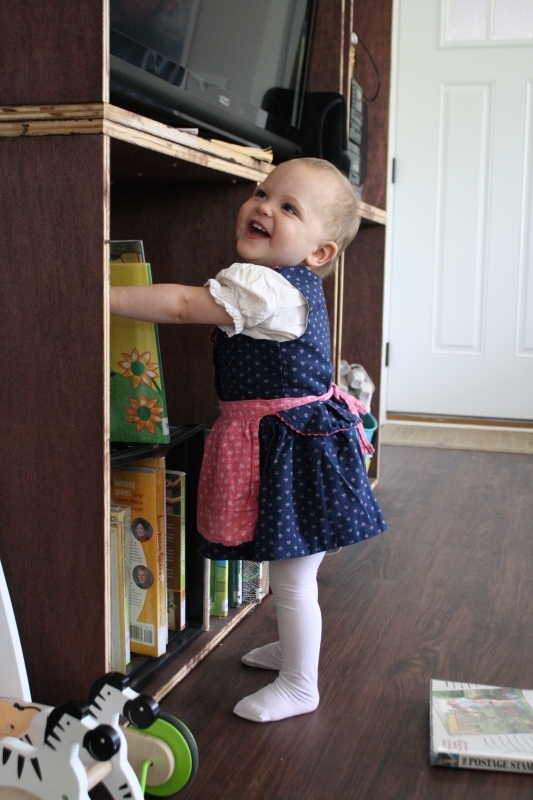
It was little more than a whim – I was feeling as though Tirzah Mae had been wearing the same dresses to church week after week, so I pulled out the bag of clothes I wore when I was a child…

I was thrilled that I had, since I discovered that this little jobber – what I’ve always referred to as the “Bavarian dress”, brought back by my Grandma from a European tour – was already almost too small for Tirzah Mae.

The "Bavarian" Dress

She wore it that day – and posed in it that afternoon.

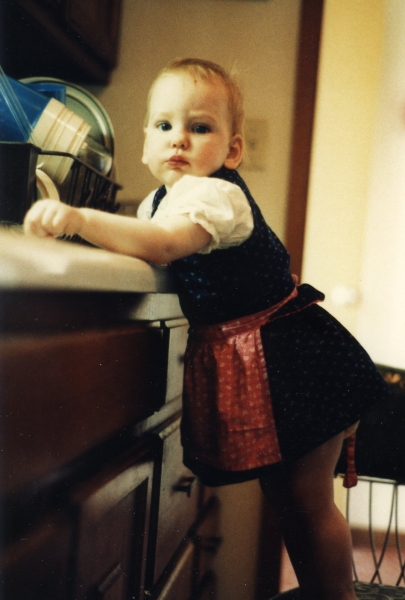
Here’s me, wearing the same dress some 30 years before.

Rebekah in the "Bavarian" dress


I also had Tirzah Mae take advantage of some of the last cool days of the spring to wear the little jumpsuit my mother made me.

Jumpsuit should fit in the fall?

As you can see, the jumpsuit is definitely on the long side for Tirzah Mae – and since I wore it sometime right around my 2nd birthday, I’m thinking that bodes well for getting a good deal more use out of it come fall!

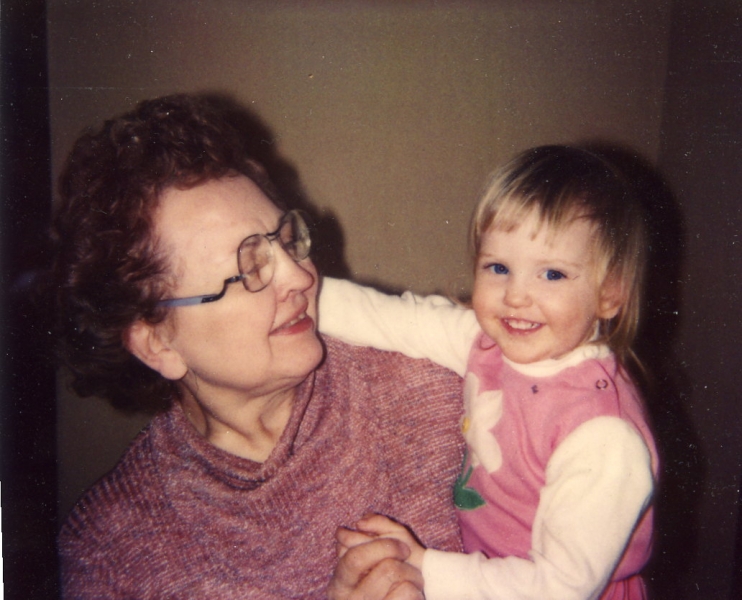
Rebekah with her Grandma Menter in the jumpsuit Mama made her

**Side note: See how little hair I had in the Bavarian dress – and how much I had by my second birthday? Perhaps there is hope for Tirzah Mae yet.**


When the Rubber Hits the Road

Compared to what many women experience in the first trimesters of pregnancy, my pregnancy with Tirzah Mae was easy. No signs of danger until we started rounding the corner from trimester two to three, when I started retaining excess fluid and my blood pressure started rising.

So when people have asked me how the pregnancy is going, my response has been cautious.

This has been a very easy pregnancy. Easier than Tirzah Mae’s. I’ve had virtually no nausea, have had mostly manageable energy levels, have felt baby move from impossibly early weeks.

But early pregnancy is not necessarily a predictor of pregnancy outcome. I know that.

The odds of having preeclampsia as severely as I had the first time? They’re low.

But they were very low the first time too.

I’ve been cautiously optimistic, knowing that the real struggle would come in trimester 3.

And now, as I begin to turn the corner from trimester 2 to trimester 3, the rubber hits the road.

Do I trust God like I say I do, that whatever comes is in His control and is for both my good and His glory? Have I learned the lesson He was teaching last time around, that His grace is sufficient for what He brings, not for the anxieties I’ve been told to cast on Him? Do I really believe that whatever happens, Christ is enough?

This is when the rubber hits the road.

So far, my body is doing well. Weight gain is appropriate; blood pressure remains low; baby is active all.the.time.

My mental state? It varies. Sometimes I’m bawling with terror, other times confident that God has it all in hand. You’d think the terror would be connected to my physical state, but it doesn’t really seem to be. The day it was super hot and I gained a few pounds of water over the course of the day? I was good. It was three days later, after the weather had cooled off and my weight was stable from morning to evening, that I fell apart and spent the morning crying.

It’s an exercise in trust, here in trimester 3 as the rubber hits the road.

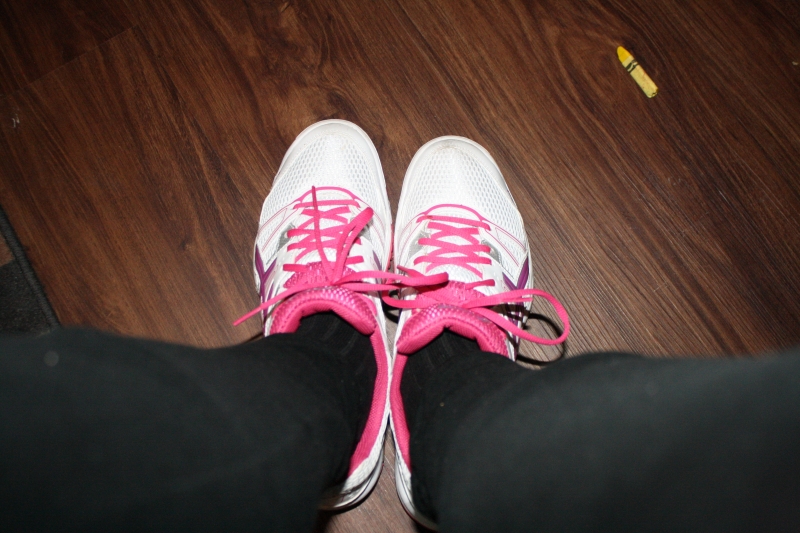
But while my mental state goes up and down, one thing is certain these days – I’ve got tennis shoes on my feet.

The combination of weight gain and pregnancy-induced relaxin production means my feet ache from the time I step out of bed in the morning until I fall into bed in the evening – which means I had to run out and grab a new pair of tennies to make it through trimester 3 (My previous tennies were pretty much destroyed by constant use and massive swelling during Tirzah Mae’s super-short third trimester – and I don’t wear tennis shoes unless I absolutely have to, so I didn’t bother to replace them once she was born.)

Pregnancy tennis shoes

I got these pretty white and pink jobbers at the Sports Authority store that’s going out of business – at $30, they mark my most expensive pregnancy clothing purchase thus far.


Book Review: Your Pregnancy Week by Week by Glade B. Curtis and Judith Schuler

The front cover of Your Pregnancy Week by Week proudly announces that it is “The only best-selling guide written by a doctor.” The spine contains a medallion announcing “The only best-selling guide written by a doctor.” The back cover proclaims the book to be “The expanded, fully updated edition of the best-selling pregnancy guide written by a doctor.”

So the major selling point of this book is that it is written by a doctor. Glade Curtis is a board certified OB-GYN, which means he’s the perfect guy to walk a woman through every week of her normal pregnancy, right?

Well, that depends a lot on your view of what pregnancy is. Is pregnancy a medical condition to be monitored and controlled (as you would diabetes or heart disease?) or is it a life event to be cherished and enjoyed (as you would an engagement and preparation for a wedding?)

Curtis (and the obstetric community as a whole) tends to think that pregnancy is a medical condition to be monitored and controlled. As such, Your Pregnancy Week by Week consists of telling a woman all the things that might go wrong with her at any given point during her pregnancy, all the tests which might be necessary to make sure that nothing is going wrong, and why she should trust her doctor implicitly and herself not at all during pregnancy.

Okay, someone not quite as passionate about pregnancy and birth as I am might feel that I’m overreacting to this book. Things can go wrong during pregnancy, they might say. Tests are sometimes necessary. You should be able to trust your doctor. Your own instincts aren’t always right when it comes to pregnancy. And, for that matter – pregnancy isn’t simply a life event like an engagement. Things are happening in your body!

And I agree completely, dear not-so-passionate-about-birth-as-I. Things do go wrong during pregnancy – I, of all people should know. I could have died during my pregnancy with Tirzah Mae. Tests are sometimes necessary – the ultrasounds to make sure Tirzah Mae was still growing when my body was no longer functioning as designed, the blood tests that finally told us that my kidneys and liver had stopped doing their jobs – those were necessary (and without the blood tests indicating the need for delivery both Tirzah Mae and I would have died.) It is incredibly valuable to have a caregiver you can trust – which is why I am SO grateful for my midwife, who was alert to normal pregnancy and knew when to refer when my pregnancy became anything but normal. That’s why I’m SO grateful for my OB, who values women and who works with them to help them have as normal a delivery as possible.

Pregnancy isn’t SIMPLY a life event like an engagement. Your body is changing, your hormones are changing. You’ve got extra blood pumping through your veins, an extra body inside your own. Things are happening to your body that you want to understand. You want to know if those changes are normal or if they’re something to be worried about. In some cases, you NEED to know if they’re normal or if you should be worried about them (ten pounds weight gain in one day – that’s not normal. It’s definitely something to be worried about.)

But Curtis and his co-author aren’t simply helping women understand what is normal and what isn’t. They are detailing, every week, another horrible thing that can go wrong during pregnancy (tacking a line at the end about how really only two in a thousand women are going to have this problem, so don’t worry.)

Curtis explains (week after week) why a woman shouldn’t ever be afraid to get a test or a procedure because they only ever help your doctor and you and your baby (and have never been PROVEN to be harmful – the anti-precautionary principle). And he explains (week after week) why a woman should be afraid to drink caffeine, eat sugar, eat artificial sweeteners, take an over-the-counter drug, etc (because it has never been PROVEN to be safe – the precautionary principle.) The doctor is always right and can do no harm. The woman is always to be doubted and will kill her baby if left to her own devices. (Okay, I’m exagerating a little.)

Oh, and don’t even get me started on the unscientific suggestions Curtis has for labor. He encourages enemas (for the patient’s safety and comfort, of course!), fasting during labor, lying down during labor, and episiotomies. Continuous fetal monitoring is necessary for baby’s safety. And if you aren’t sure you want a natural labor? A doula is a bad idea (well, actually, are you SURE you want a natural labor? If I give you this epidural, then you’ll be so much more comfortable and will be so much easier to monitor and won’t try to move around or anything… big plus? you won’t have to hire a doula!)

Yeah. No.

Choose to have a pregnancy and childbirth not defined by fear. Choose to trust that your body is fearfully and wonderfully made. Choose NOT to read Glade Curtis and Judith Schuler’s Your Pregnancy Week by Week.


Rating: 0 stars
Category: Pregnancy
Synopsis: An overmedicalized, fear-based, doctor-is-always-right tome on pregnancy
Recommendation:If you want to be scared out of your mind by all the things that could go wrong in pregnancy and to be convinced that every intervention your doctor might suggest is absolutely the right decision, you’ll want to read this book. If you prefer to learn what a normal pregnancy looks like, how to deal with the normal problems of pregnancy, and to make evidence-based (versus fear-based) decisions for your pregnancy and childbirth – this is not at all the book for you.


Playing Kitchen Detective

“Man, this dough is dry,” I thought to myself as I added yet another tablespoon of water to the bread dough I was kneading.

I mentally reviewed the adjustments I’d made to the recipe.

I’d doubled the recipe. No problem there.

I’d used 2 cups of milk instead of 1 cup milk and 1 cup water (got to use up that just-about-to-turn milk!) That could increase liquid needs just a little since milk has a small amount of solids in it. But I’d already added, what? A quarter cup of water?

And the dough was still dry – tons of flour still just sitting on the bottom of my bowl!

I’d used all whole-wheat flour instead of 2/3 whole wheat, 1/3 bread – and had added a tablespoon of gluten per recipe to compensate. That might increase water needs a little…but by now I’d added at least a half cup of water!

The only answer I could come up with is that I shouldn’t have measured out all the flour per recipe before kneading. I must have just never noticed that I never ended up needing the full flour allotment, since I usually mixed everything together with just half the flour and then added in a half cup extra flour at a time as I kneaded.

And then my ten minutes of kneading were up and I wet a dishcloth to cover the dough.

That’s when I saw the oil, still in the measuring cup where I’d carefully measured it out.

Half a cup of oil, substituting for four tablespoons of melted butter times two.

No wonder I needed an extra half cup of liquid.

I used the oil for a salad I was making for the evening meal – and let the bread raise and cook as usual.

It turned out fine.

Even so, I’m writing this down as a note to self: When a recipe isn’t quite turning out as you’d expected, check to make sure you included all the ingredients.


Brown Books

Now that I’m FINALLY done with Marc Brown’s awful “Arthur” books in the picture book section at my library, I’m getting on to some other “Brown” authors.

Secrets of the Apple Tree by Carron Brown and Alyssa Nassner

A delightful nonfiction picture book about the ecosystem of an apple tree. This is a “shine-a-light” book, which means the right hand page has a full-color illustration with a blank space somewhere. When you hold the page up to a light or shine a flashlight from behind it, you can see the outline of the black and white illustration on the next (left-hand) page. For instance, you might see a lizard that has scurried behind a stone at the apple tree’s base. I enjoyed this informative and non-preachy look at nature.

Alice Ramsey’s Grand Adventure by Don Brown

Another nonfiction tale, this book tells the story of the first woman to drive a motorcar across the US. It took Alice Ramsey fifty-nine days in 1909, but she made it! Alice Ramsey’s Grand Adventure is relatively text-heavy, but the watercolor illustrations are lovely and the story gives a great look at what the US (and transportation) looked like early in the 20th century. With Alice Ramsey being a woman and all, this might be an opportunity for feminist grandstanding – but Brown does a wonderful job of telling the story and letting parents come up with how to interpret it.

Darth Vader and Friends and Goodnight Darth Vader by Jeffrey Brown

For this Star Wars no-nothing, these comic-book style picture books were absolutely incomprehensible. Daniel read one and I guess there are lots of illusions to the Star Wars stories and characters but relatively little plot of their own.

Stone Soup by Marcia Brown

This retelling of the classic story was a Caldecott Honor book in 1948 – and well deserves it. The retelling itself is relatively involved, with enough text per page that I abbreviated the story for Tirzah Mae’s consumption; but the illustrations, done in shades of gray and red, are magnificent (and enough to keep Tirzah Mae turning the pages for several days.)

Imani’s Moon by JaNay Brown-Wood
A little girl is the littlest in her village and always gets made fun of. But she dreams of reaching the moon, and practices until she
can, despite the naysayers. People who are into feel-good, if-you-can-dream-it-you-can-do-it stuff might like this story – but I’m not one of those people. I’m all about encouraging dreams and working towards dreams – but dream or not, no little girl can jump into the moon. Fairy tales about jumping to the moon are fine, but this stuff? This is silliness.


Nightstand (March 2016)

A number of my blogging acquaintances are switching their end-of-the-month reading logs to the actual end of the month rather than participating in 5 Minutes for Books’ Nightstand Blog Hop on the last Tuesday of the month. I am not one of them. I enjoy the Nightstand community and don’t have any problem having my log be on a semi-arbitrary date.

What I have been having a problem with is getting my Nightstands posted, though!

I have half-completed Nightstand posts for the past 5 (FIVE!) months sitting in my drafts folder.

Which is why this month, I decided to post my Nightstand, however late it may be!

So here’s what I’ve read in the past month…

Books for Loving:

  • Concise Theology by J.I. Packer
    An excellent book with 2-4 page summaries of a variety of theological topics. I can see using this as a jumping-off point for a high school theology class (or something like that.) I especially appreciated reading this when I decided to add application – spending a brief amount of time framing a prayer of response after each section.

Books for Growing:

  • Sink Reflections by Marla Cilley
    I’ve read this book by the “Flylady” before, but it’s always useful when I’m setting up a new household and in need of some motivation to get my routines in place. I don’t follow Flylady to a tee and I find her annoying whenever she starts getting philosophical – but the idea of setting up routines to keep your household running is a good one.
  • The Accidental Housewife by Julie Edelman
    A completely worthless home how-to manual. Basically, Edelman advises you buy lots of disposable junk for cleaning, turn on music and dance while you clean, and drink lots of wine throughout.
  • On Becoming Toddlerwise by Gary Ezzo andRobert Bucknam
    I know plenty of folk who swear by the Babywise/Growing Kids God’s Way approach – but while I didn’t find anything overtly objectionable in this particular volume, the thought of trying to follow their routine with my toddler (the whole day divided into 15 minute segments of activities) sounds exhausting. I am a woman of routine, but our household routines are arranged according to the time it takes to clean up after meals and exercise and fold a load of laundry and clean the bathroom. In other words, Tirzah Mae’s routines fit into the household routines rather than trying to run a household in between arbitrarily set 15-minute cycles.

Books for Knowing:

  • Beast in the Garden by David Baron
    Baron tells the story of the mountain lion, once only a threat to cattle, and the process by which mountain lions in Boulder, Colorado became habituated to humans, culminating in some highly unusual human deaths. A fascinating look at how humans and animals interact (and how we can’t just “return to the wilderness”). I had a hard time putting this one down.
  • When to Rob a Bank by Steven D. Levitt and Stephen J. Dubner
    A collection of blog posts from the ever-popular Freakonomics authors. I enjoyed the randomness of this collection, as well as the smaller-than-a-usual-chapter articles, which allowed me to read them in bite-sized chunks. I did NOT enjoy the many articles about gambling (which I consider to be both boring and unwise).
  • Born in the USA by Marsden Wagner
    Wagner documents the deplorably woman (and baby) unfriendly practices of American maternity care and gives suggestions for how to fix it. Marsden deftly describes how obstetric care in the US pays only lip-service to evidence, choosing to experiment on pregnant women and their children in the absence of evidence (and even in the presence of evidence AGAINST certain practices such as Cytotec inductions). Marsden’s solutions were intriguing, but I had some definite quibbles: I don’t believe nationalized health care is the answer and I don’t think litigation is the answer. It was interesting to compare Marsden’s view of litigation with the Theresa Morris’s in Cut it Out!. While I agreed strongly with Marsden’s emphasis on the midwife model of care as a solution for the current system, I was disappointed that he did not also mention how primary care doctors are increasingly opting out of providing obstetric care (in part due to litigation, in part due to the scheduling demands of obstetric care.) I think that, especially in rural areas, this is a huge barrier to low-risk women receiving good prenatal and obstetric care.

Books for Seeing:

  • I made the mistake of trying to read Homer’s The Odyssey at the beginning of the year, while I was still in my first trimester exhaustion AND moving. Yeah. No.
  • Which is why I’m trying again with Mary Shelley’s Frankenstein. I’m about halfway through.

Books for Enjoying:

  • The Dinner Diaries by Betsy Block
    As a memoir, this fits with my generally enjoyable reading. Except that this was a memoir about feeding a family and Betsy Block did it ALL wrong. I wrote up the two main things she did wrong (and some alternate advice) in my full review.
  • The Yummy Mummy Manifesto by Anna Johnson
    Basically about staying hip even though you’ve become a mother. Occasionally interesting but generally kinda annoying (What if I’ve always dreamed of being able to wear twinsets and khakis without someone accusing me of dressing for a different stage of life? Don’t tell me that now mom’s aren’t supposed to dress like that.)

Don’t forget to drop by 5 Minutes 4 Books to see what others are reading this month!

What's on Your Nightstand?


Book Review: The Dinner Diaries by Betsy Block

Feeding a family. Raising healthy eaters. Topics I’m passionate about. Even while I was still working on my degree, I knew that helping mothers feed their families and raise healthy eaters was what I wanted to do as a career. I made that the focus of my graduate work. After a stint in long term care, I moved to WIC, where I was able to live my dream (at least as far as career goes.)

Subtitled “Raising Whole Wheat Kids in a White Bread World”, Betsy Block’s book should be right up my alley, right?

Wrong.

I should have known from the blurb on the back cover:

“A harried mother of two, Betsy Block is in pursuit of the perfect family meal: local, toxin-free, humane, and healthful.”

But the book was in a Dewey Decimal category I was trying to close and I figured “how bad can it be?”

Pretty bad.

Betsy Block’s The Dinner Diaries is basically a manual on how NOT to feed a family or raise healthy eaters. In order to save you the work of reading it, allow me to summarize the main points.

Tip 1: Start with all the wrong priorities

It’s no mistake that “healthful” is last on the list of Block’s priorities a la the back of the book. In reality, her definition of “healthful” is suspect enough that you might as well knock it off the list. Block is all about the local (which has very little impact on health), toxin-free (the American food supply, with the exception of methyl-mercury containing fish, is actually one of the safest in the world), and humane/sustainable (an ideological issue but not a health one.) Her couple of concessions to actually health practices include trying to eat less sugar and (at the very end of the book) attempting to eat more whole grains.

If you’d rather actually have some success at feeding a family or raising healthy eaters, I recommend starting with priorities that will actually help you achieve health. Try: increasing fruit and vegetable intake (no, it doesn’t have to be fresh – frozen or canned are fine), increasing variety (of protein sources, vegetables, starches, you name it – variety is good), sitting down together as a family to eat (even for snacks), having sweets around less frequently and subbing fruit instead, or experimenting with forms of cooking other than frying. I can give you more suggestions if you’d like, but those are some of the biggies.

Tip 2: Lecture your children about food

There’s nothing like a good guilt trip to help kids form a healthy attitude toward food, amiright?

Okay, no.

But Block seems to think it’s a great idea. She lectures about all those wrong priorities, lectures when kids won’t eat something, lectures when kids do eat something. She sets up learning opportunities for herself (like going to see a pig that she’s later going to eat) and leaves the children behind lest it be too tense for them – not that she won’t lecture them about it when she gets home. When her daughter asks to help cook, Betsy asks if that means her daughter will eat what they prepare. When her daughter says “probably not”, Betsy declines the offer of help.

If you’d like your children to actually develop a healthy attitude toward food, start by modeling healthy attitudes towards food yourself (by the way, Block’s obsessive interest in “perfect” food isn’t healthy.) Eat in moderation. Eat a variety. Don’t obsess over food (either in a “I must have sweets now” or in a “my diet must be absolutely healthy all the time” way).

If you’d like your children to develop a healthy attitude toward food, involve them in selecting and preparing food. Preschoolers will love searching for a red vegetable at the supermarket. Kids can learn to cook early on. Gardening or going to a farm to see how food is made is a great activity for kids. BUT…not as a way to coerce your kids into eating something. That’s Betsy’s mistake. She read that when kids cook with their families, they’re more likely to eat what they make – so she thought she could coerce her daughter into eating by letting her help cook. Letting your child cook isn’t a one-time magic bullet to healthy eating. Instead, it’s a process by which children develop positive associations with food, take ownership of food (in a healthy way), and learn skills that will help them eat well when they decide that they’re willing to try eating asparagus.

If you’d like your children to develop a healthy attitude toward food, move the conversation from nutrition to habits. Dina Rose’s excellent website It’s not about nutrition is a great resource for changing the way families talk about food. The gist of Rose’s message is to start talking about proportion, variety, and moderation (Check out this article for more info.) Changing the conversation makes a real difference, both in helping kids eat healthfully, but also in helping them think healthfully about food.

In the very first chapter of Betsy Block’s book, she writes of a nutritionist who refused to work with her because of her emphasis on organic foods. Block was shocked that organic foods were controversial. Except that to call the “health benefits” of organic controversial is putting it mildly. Despite many attempts to prove otherwise, there is no compelling evidence that organic foods are more nutrient-rich or more safe than conventionally grown ones. It’s fine for people to eat organic, but they’re fooling themselves if they think that organic = healthy. Block’s choice to focus on secondary issues instead of primary ones meant that her memoir is a recounting of an exercise in frustration, accomplishing next to nothing in terms of changing her children’s habits and attitudes regarding food.

The nutritionist who ended up working with Block (although we only hear about her in the first chapter) did a good job of trying to get Block to focus on some actually beneficial eating practices (unfortunately, she did not address the task of how to communicate with children about food) – but it was all for naught. Block would not be dissuaded from her ill-informed search for dietary perfection and from her agenda of changing her children’s eating patterns by coersion. I think the first nutritionist made a wise choice.

Please, people, don’t be Betsy.


Rating: 1 star
Category: Food memoir
Synopsis: Betsy Block tries to make over her family mealtimes.
Recommendation: Ugh. No.


Thankful Thursday: Generosity

Thankful Thursday banner

This week I’m thankful…

…for help hanging a mirror
Daniel arrived home Friday evening to find the house a mess and his wife frustrated. I’d dragged all the wallhangings out and laid them out on the floor to arrange them before hanging them on the wall. But when the time came to hang the big mirror that’s the centerpiece of the dining room arrangement, I couldn’t find the stud-finder (and that mirror DEFINITELY needs to be hung on something more sturdy than drywall!) I emptied all our toolboxes on every available surface in the kitchen and only found the studfinder (in the back of my car) after several hours of searching. Daniel was gracious to help me carry all the pictures and whatnot back downstairs and help me put away the rest of the tools – and to help me hang that pesky mirror right then and there.

Mirror wall in dining room

…for a birthday burger
We enjoy Red Robin, and belong to their loyalty club (or whatever it’s called – we get promotional emails and they give a free burger during our birthday months.) After the frustrating mirror incident (during which dinner was NOT made), we went out for my birthday burger. It was just the break I needed – and I enjoyed a delicious mushroomy burger (Daniel’s not the biggest fan of mushrooms, so when I make mushroom dishes at home, it’s usually pretty subtle.)

…for kitchen projects completed
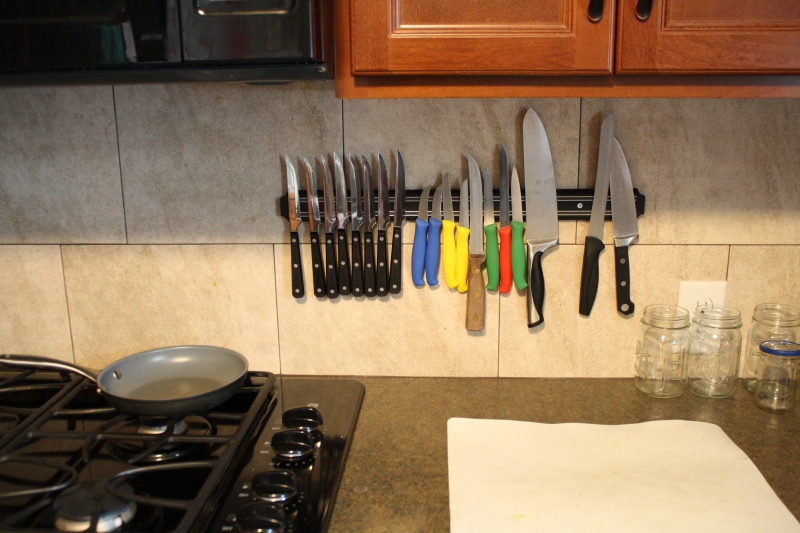
My husband could have done all sorts of things with his Saturday morning. He could have slept in or watched television or read a book or worked on his personal projects. Instead, he woke up early, took off to the Home Improvement store and set to work installing my magnetic knife rack in the kitchen. And, since the drill was out, he hung my swinging towel rack while he was at it too. With those two tasks complete, my kitchen is complete. It feels nice, awfully nice.

Knife rack all suited up

…for a birthday windchime
I already wrote about this, but the windchime has been delighting me all week – whether it’s catching a glimpse of it out the window or hearing its music on a windy day.

…for a generous loan
A friend who had a baby the summer before Tirzah Mae offered to loan me some of her maternity clothes. Tirzah Mae and I went over Tuesday for a playdate/clothing try-on session – and I walked out with almost 2 dozen articles of maternity wear! I’m probably set for most of the remainder of this pregnancy.

…for the generosity of God in Christ
These gifts of patience and time and food and help and objects and clothing are all wonderfully nice. But nothing can compare to the generosity of God, who gave HIMSELF. Even if my house remained a mess, the studfinder remained missing, my husband hadn’t provided help, the burger hadn’t been free, the kitchen hadn’t been completed, the windchime not given, the loan of clothing not made – the gift of Christ is beyond what my heart can bear.

What? All this and Christ beside?

“For you know the grace of our Lord Jesus Christ, that though he was rich, yet for your sake he became poor, so that you by his poverty might become rich.”
~2 Corinthians 8:9 (ESV)


Book Review: Mothering Your Nursing Toddler by Norma Jane Bumgarner

“How long do you intend to nurse?”

If my experience is typical, it’s a question many a nursing mother has heard many a time.

And my answer has always been… difficult to give.

Because I didn’t have any hard and firm answer. I intended to keep nursing until we stopped.

I did know that would not be until Tirzah Mae was at least 12 months old, since cow’s milk is not recommended until age 1 due to a high sodium and protein content that can tax an infant’s kidneys (and because I had no desire whatsoever to provide formula, that nasty-smelling, clothes-staining stuff.) But after a year? Who knew.

Generally, my questioners would follow up with the question they really wanted answered: “But you aren’t going to still nurse when she’s old enough to [lift your shirt, walk up to you, ask to nurse in English]?”

And I… didn’t really know what to say exactly.

My observation has been that most mothers I’ve talked to who have nursed for truly extended periods of times (past their child’s third birthday, for example) have often delayed practices that I consider healthy (for instance, waiting to give their nursing child solid food and water until long after six months) or prolonged practices that I consider less than ideal (such as frequent nighttime nursing.) Since I intended to introduce solid foods at six months and water to go along with solids – and felt that an infant or toddler should, at some point, learn to sleep through the night without waking to nurse, I imagined weaning would occur sometime before my child’s third birthday.

When Tirzah Mae turned one, I had an easy excuse for continuing to nurse beyond the American Academy of Pediatrics’ minimum recommendation of one year – Tirzah Mae was born early, so it was really only like she was ten months old. But I also knew it would be worthwhile to read up on this “nursing a toddler” thing – and I knew just the book.

La Leche League’s Mothering Your Nursing Toddler by Norma Jane Bumgarner is THE book on the topic – and my library happens to have it.

This book’s greatest strength is in encouraging mothers of nursing toddlers through countless stories that can assure them they are not alone – a very useful thing for those mothers who often DO feel alone as they nurse their baby-who-is-no-longer-a-baby.

On the other hand, Mothering Your Nursing Toddler seems to assume that nursing for a very extended period of time is both beneficial and desirable in almost all cases. While I don’t think that nursing for a very extended period of time is harmful, I don’t know that it is necessarily to be encouraged by default. But, since that is the position Bumgarner takes, she encourages those practices that I’ve observed in prolonged nursers – suggesting that following the practices I recommend is actually parent-led weaning.

And if that’s so, I started weaning at six months, when Tirzah Mae started eating solid foods and drinking small quantities of water to go along with it. We continued weaning when Tirzah Mae turned one and I started giving her small amounts of whole cow’s milk with a couple of meals or snacks a day. If I didn’t feel like nursing when she was grabbing for the breast, I offered her cow’s milk or water in a cup first. If she was satisfied with that, we didn’t nurse. If she refused the water or milk, we’d nurse despite my not feeling like it. Sometime around a year, I stopped automatically feeding her when she woke up at night. I cuddled her close and rocked her and put her back in bed without nursing unless she made clear that she would only be pleased if I nursed her.

Now, she’s nursing a couple of times a day, usually before naptime and bedtime – although we occasionally nurse more, depending on her state of mind and my own.

I have no plans for stopping anytime soon (although I also don’t begrudge the days when Tirzah Mae falls asleep before we’ve nursed and ends up not nursing at all.)

I feel no need to pump on days that Tirzah Mae chooses not to nurse. Before I read this book, I would have assumed that was a part of child-directed weaning. She doesn’t nurse, so my body doesn’t make as much milk, so weaning commences. But I don’t think Bumgarner would agree. She seems to think it quite unlikely that a child would self-wean before age 2 and would therefore encourage pumping to keep supply up.

So…what DO I think about this book? Just like this entire topic, it’s hard to say. I suppose it could be very encouraging to the mother who feels like her child could benefit from extended breastfeeding – and I would recommend it to that woman. The woman who is pretty sure she doesn’t want to nurse past a year is unlikely to benefit from this book (if anything, she’s likely to feel overwhelmed by the suggestion that she should keep nursing until three, four, or beyond.) It’s tougher for me to say whether I’d recommend this book for a woman who is uncertain about continuing to nurse.

I think there are definite benefits to continuing to nurse as long as both you and your child want to. I do NOT think that means that your nursing relationship has to be on your child’s terms (as Bumgarner generally seems to recommend). It’s appropriate that, as your child no longer relies on your breastmilk for the primary source of his nutrition (usually around a year of age), you as the mother would take a more active role in determining when and where you breastfeed your child.


Rating: ?
Category: Breastfeeding
Synopsis: All about breastfeeding a child at age 1, 2, and older
Recommendation: I’m not sure.