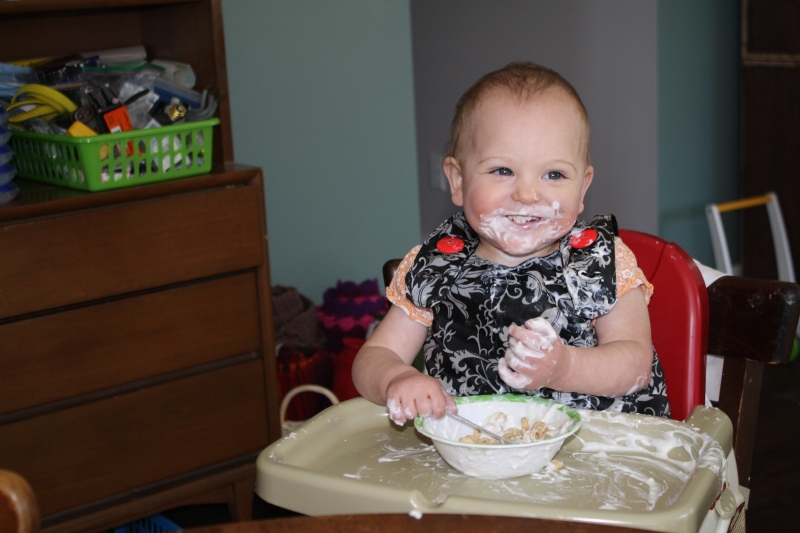
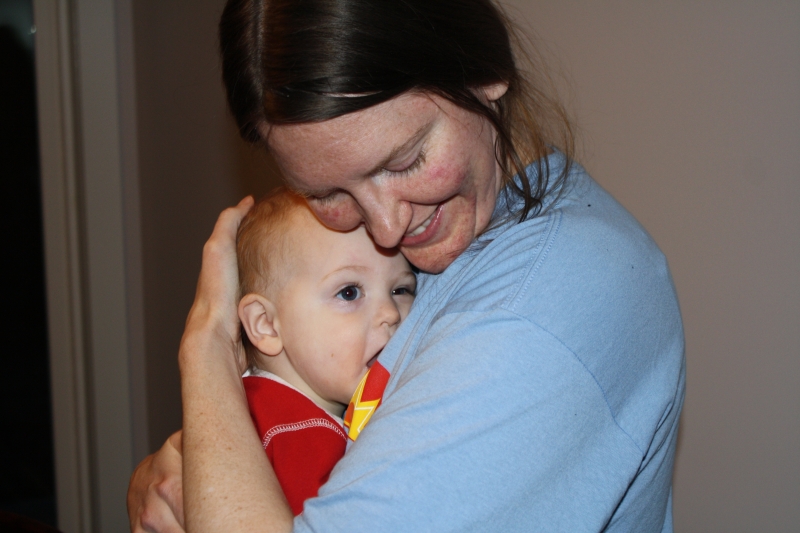
Happy birthday to me

I generally take a nap on Sunday afternoons while Daniel is home to take charge of Tirzah Mae.

This week was no exception. After completing a range of household tasks, I took myself off to bed.

I napped a bit, glad for the sleep and woke up to Tirzah Mae awakening from her own nap. I got her up, changed her diaper, fed her afternoon tea.

Daniel was nowhere to be found.

We went to investigate and found him in the garage, clearly hiding something.

Daniel’s work took him rather late into the afternoon, later than our usual dinner time – so, after a quick consultation with him (having warned him that I was going to open the garage door), Tirzah Mae and I started into dinner on our own.

About midway through our meal, Daniel came into the house, instructing me to close my eyes.

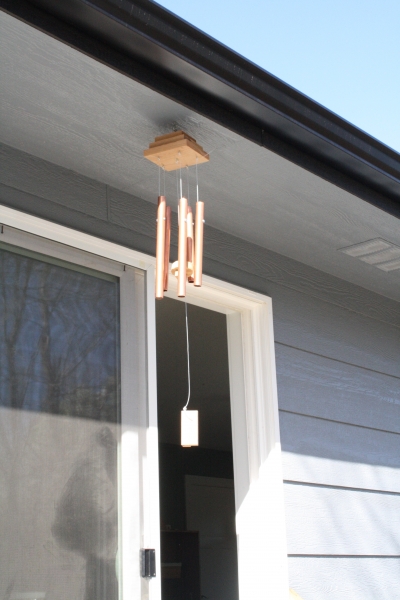
When I opened them, he was holding this windchime!

My birthday windchimes

Happy birthday to me!

(I’ve always wanted a windchime, but am not much of a shopper so it’s an item that’s perpetually been on the “buy some day” list. Except not anymore, ’cause Daniel made me one for my birthday!)


Skirt-Wearing in Pregnancy

Dressing for pregnancy is hard.

There’s trying to figure out how to adjust to a figure that’s changing on a weekly (no, make that daily) basis. There’s trying to avoid spending too much money on clothing you’ll wear for five months or less. There’s guessing what size you’ll be at what season, and figuring out how to layer to make that outfit you bought for when it’s hot and you’re huge work for now (when it’s chilly and you’re not quite huge yet.) There’s trying to strike just the right balance between comfort and style.

It’s hard.

One thing I’ve found, as a mostly-skirt-wearing-woman, is that skirts are an absolute lifesaver.

My pre-pregnancy pants stopped fitting somewhere around the end of the first trimester – and while I wore them for a little while with zipper unzipped and a belly band covering, it wasn’t long before I needed maternity pants.

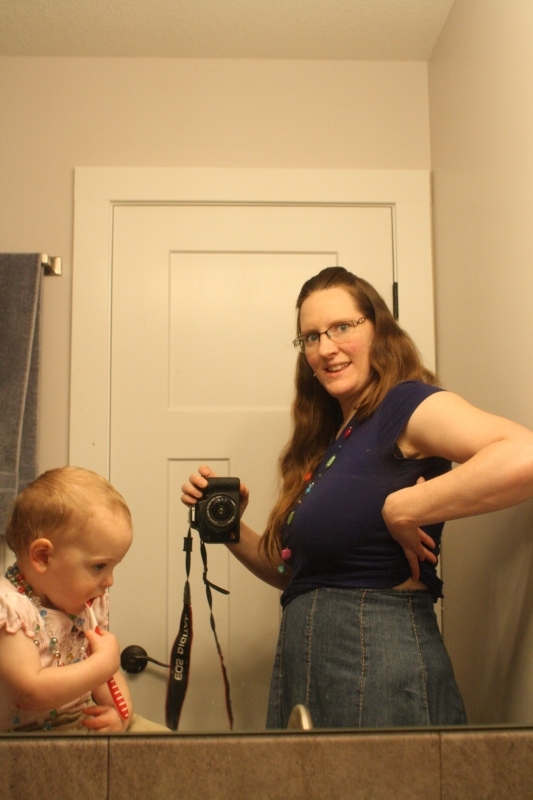
Skirts, on the other hand, don’t have that pesky crotch that forces the waistline to a specific place. You can wear them high over the belly (if they’re flowing) or low under the belly (if they’re more fitted or if you find it more comfortable that way.

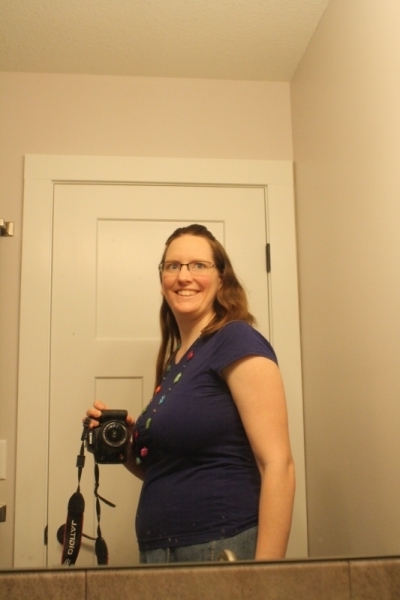
Wearing a skirt over my bump

Wearing a skirt over my bump

In addition to being easy to wear, skirts are wonderful for a variety of weather. If it’s cold outside, you can always throw a pair of tights, leggings, or pants underneath. If it’s warm, you can go bare-legged and enjoy the breeze.

One extra benefit – if you’re a leaker, you don’t necessarily have to resort to pads around the house. If you leak a little, you can just change your underpants without having to worry about changing your “over”pants as well. (TMI? Maybe. But this is pregnancy we’re talking about here – plenty of potentially embarrassing material to cover.)

Wearing a skirt over my bump, part 2

Check out how high that waist is!

I’ve had to retire a few skirts so far this pregnancy due to length issues (I generally prefer to wear a waisted skirt high over the bump and an elastic-waist skirt low; if the skirt is waisted and short, it gets a little TOO short once it’s over the bump) – but I’ve still got almost a dozen skirts that I’m still wearing, and expect to continue wearing for at least another month or two.

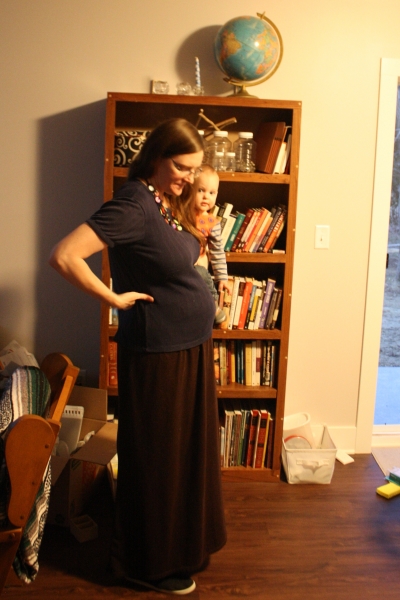
BONUS: My sister-in-law was giving away a strapless maxi-dress and I grabbed it on a whim, thinking it might make a good pregnancy skirt. I’ve been wearing the elasticized part (that’s supposed to go over the breasts) over my bump and and letting the skirt (which is supposed to start just below the breasts) hang just below my bump. It gives me the security of coverage while still letting me have a maxi-skirt. This tip probably only works for tall gals like myself, but I’ve found it to be wonderful.

Maxi dress turned maxi skirt

Maxi-dress turned maxi-skirt

Did you wear skirts during your pregnancy? What are your best tips for overcoming the clothing hurdles of pregnancy?


A Bookish Meme

A little over a month ago, Barbara H tagged me in a bookish meme. And now that I’m back to blogging (easing my way back in, apparently :-P), I figured it’s high time I answered Barbara’s questions!

Do you remember the first book you read or really liked?
I don’t remember the first book I read, but I do remember the first book (er…series) I was completely obsessed with. I LOVED the Little House books and read them dozens of times when I was maybe 7 or 8. I remember my older sister and I lying on the floor in our room, reading the Little House books in the thin crack of light that came in from the hall after our bedtime.

How did your love for reading come about (grew up in a reading family, a certain book captivated you, etc.)?
I suppose it’s because I grew up in a reading family. My mom was a voracious novel reader and, although I don’t know if I ever saw my dad just sitting and reading a book that wasn’t the Bible, he was all about information and was always looking up soemthing in an encyclopedia or dictionary. I was maybe four or five when my grandma bought us three different sets of Encyclopedias: a Children’s Encyclopedia, the Compton’s Encyclopedia, and the Encyclopedia Brittanica. We loved those – for reference, sure, but also for reading (the “cows” article and the “American Indians” article in the Compton’s Encyclopedia are wrinkled and stained from much love from a pre-adolescent Rebekah.)

What is your favorite genre to read?
Right now, it appears to be nonfiction of the practical sort: how to make curtains, how to raise a reader, how to have a baby, etc. But I’m not sure that’s really a genre. I’ve historically been pretty eclectic, but have fallen into something of a rut over the past couple of years – one that I’m aiming to get out of with my reading resolutions.

What genre do you avoid reading?
I’ve often said that I avoid reading “genre fiction” – science fiction and fantasy, romances, westerns, mysteries. But that’s not quite accurate. I love C.S. Lewis’s Chronicles of Narnia and J.R.R. Tolkien’s Lord of the Rings, both fantasy series. I read Georgette Heyer’s Regency romances rather often, and Christian romances not infrequently. I have recently very much enjoyed reading a couple of Agatha Christie mysteries. So maybe westerns are really the only genre I really and truly avoid?

What is your favorite movie based on a book?
The A&E miniseries of Pride and Prejudice. I love the book – and the movie’s reliance on dialogue from the book. I love the period costumes and dancing. I love Elizabeth as played by Jennifer Ehle and Mr. Darcy as played by Collin Firth. Really, I love it.

What’s your least favorite movie based on a book?
Pride and Prejudice with Kiera Knightley. Skipping entire plot lines while spending five minutes of precious screen time on a lovesick Elizabeth mooning on a swing? Ugh!

What is your favorite time and place to read?
I don’t know that I have a favorite, unless maybe in bed before a nap on a Sunday afternoon. I do most of my regular reading while marching in place to music between sets of weights in my living room.

Are you in any “real life” book clubs or discussion groups?
My church has a monthly book club that I participate in. We read mostly fiction, but the occasional nonfiction item as well. Since I don’t read a whole lot of fiction, the club helps me to broaden my horizons.

How many bookcases do you have?
I have five full-sized bookcases and three half-sized ones. I only have two of the full-sized and one of the half-sized currently set up and full, since we’ve decided we’re going to do things right and brace our bookshelves before we fill them here at Prairie Elms (and we haven’t done so with the basement ones yet.) Of course, that’s not counting the shelves full of library books in our entertainment center.

What is a favorite quote about books or from a book?
It’s a bit hard to pick favorites… but a quote that I come back to frequently is from C.S. Lewis’s Mere Christianity:

“If I find in myself a desire which no experience in the world can satisfy, the most logical explanation is that I was made for another world.”

Thanks, Barbara, for tagging me in this – it’s so fun to talk books!


Happy/Sad. Good/Bad.

Happy. A little boy wore a gleaming smile to match the word.

Across the page, the same little boy had giant tears rolling down his face to illustrate “sad”.

I turned the page to continue reading to Tirzah Mae, but then stopped short – for the next two words were “good” and “bad”.

After a bit of quick thinking, I told Tirzah Mae that the words were “kind” and “naughty”.

I won’t be buying that particular book for Tirzah Mae, nor will I be checking it out of the library again for her or her siblings.

Good and bad are such loaded words.

In one sense, the illustrations were apt – showing good or bad behaviors. But the rest of the book was describing opposites that modify not behaviors but the child. While each page included only one word, a parent could have “read” the sentence “The child is [insert word].”

“The child is happy.”

“The child is sad.”

“The child is alert.”

“The child is sleepy.”

Tirzah Mae is MESSY.

“Tirzah Mae is messy.”

But when it came to “good” and “bad”?

“The child is good.”

“The child is bad.”

It doesn’t fit my theology.

There is a sense in which every child is good. There is a sense in which every child is bad. But neither have to do with the child’s behavior.

Every child is good in the way that God declared Adam and Eve “very good” after creating them. Every child is created by God and, in some small or large way, reflects God’s image. In that, he is good.

Yet every child is bad, in that every child is born sinful. “No part of [him] is untouched by sin, and therefore no action of [his] is as good as it should be, and consequently nothing in [him] or about [him] ever appears meritorious in God’s eyes.” (J.I. Packer’s definition of total depravity from Concise Theology.) In that, every child is bad.

To suggest that a child is “good” because he engages in kind behavior and that he is “bad” when he engages in unkind behavior undermines both the innate “goodness” and the innate “badness” of a child.

I would not want a child of mine to think that she is only valuable in my eyes when she engages in kind behavior. She is valuable because she is a human, created in the image of God.

I would not want a child of mine to think that she is only bad when she engages in naughty behavior – and to think that by changing her behavior she can change her innate badness.

No, I want my daughter (and our unborn baby and every child who enters our family after that) to know that she is precious because God made her. I want my daughter (and our unborn baby and every child who enters our family after that) to know that she is born a sinner and acts sinfully because it’s who she is.

I pray daily that my daughter would recognize that there is nothing she can do to make herself “good”. Every day, I pray that she would recognize her inability to save herself from her sinfulness. Every day, I pray that she would fall upon the mercy of Christ to make her good.

And I want the words I use to help her to recognize her need for a Savior – not to encourage her to cling to works righteousness.

Am I too picky about words? Are there any common phrases that get your guff?


Thankful Thursday:

Thankful Thursday banner

The days and weeks and months continue to be busy – but good.

This week I’m thankful…

…for safe travels
Daniel’s Grandpa died a couple weeks ago and his funeral and burial were on Thursday and Friday of last week. Then my sister-in-law had a baby shower in Lincoln on Saturday – which meant we did a whole lot of traveling over the course of three days (something around a thousand miles.) In all our travels, our vehicle worked, we stayed well, and Tirzah Mae didn’t even complain too loudly about being stuck in her car seat!

…for precious last memories
By the time I met Daniel, his grandpa was already frail and housebound. Grandpa’s memory was failing and he repeated himself frequently. I can tell funny little anecdotes of the times we’ve visited, but the funny is tinged with quite a lot of sadness. But it just so happens that we visited Jack just one week before he died. No one had any idea how soon Jack would leave us – but I’m so glad we had that last visit. One day, I can tell Jack’s great-grandchildren about the last time Daniel and I visited him before he died. Jack asked the old familiar questions about jobs and families – but the overarching theme of his conversation was thankfulness. He was thankful for his wife and all the hard work she did bringing children into the world and raising them. He was thankful for his children, that God had given him five. “Are you going to have more?” he asked me, forgetting that I’d already told him we were expecting. “They’re worth a million bucks” he said. Precious memories I can pass on to our children.

…for ending and beginning with Betsy
Sure, we’ll probably do a thing or two more before we actually sell her, but we’ve got enough done with Betsy (our old house) that we’re ready to put her on the market. It’s a tremendous relief to me.

…for providential timing
Tirzah Mae rarely sits in her booster seat unless I’m sitting beside her eating – but it just so happens that she was still sitting in her chair from dinner (or already in her chair before second breakfast) when I dropped a glass bowl and a ceramic bowl on the floor (on two separate occasions). Since she was in her chair, I could clean up the shattered remnants of the bowls without worrying about her safety.

…for the one after whom all families are named
I’m moving along to memorize a second of Paul’s prayers for the Ephesians – this one in Ephesians 3. Paul writes

“For this reason, I bow my knees before the Father from whom every family in heaven and on earth is named…”
~Ephesians 3:14-15 (ESV)

It’s encouraging to remember that God is the author of every family. May our small family reflect Him more and more.


Goodbye to Betsy

Yesterday Tirzah Mae and I drove back to the old house (affectionately named Betsy) for what we’re hoping is one of the last times.

We cleaned the kitchen and bathroom – and gave our realtor keys to the front door.

Tirzah Mae and Mama post-cleaning
Tirzah Mae and her Mama post-cleaning

Lord willing, Betsy will be on the market by the end of the week.

Lord willing, she’ll be sold soon.

She served us well – Daniel for eight years, me for three, Tirzah Mae for one.

She was our newlywed home, the first home either Daniel or I had owned, the home where we started building our family.

And now, as we prepare to expand our family, as we celebrate three years of marriage, as we enjoy the home we built together, we’re ready to hand Betsy over to others.

Will she be home to a single person just starting out (as she was for Daniel)? Or will it be a young couple who moves in? Maybe it’ll be a family (although it’d have to be a small one – she’s just a little house)?

I don’t know what the future holds for Betsy, but I’m glad she was a part of our past – and I wish whoever comes next as much joy in her as we had.


Dietary Guidelines for Americans summarized

Remember how I said (back before I stopped blogging) that the Guidelines aren’t written for the general public? The reality is that the five guidelines can sound like mumbo-jumbo to the average consumer. My goal here is to translate the guidelines into more average-person-friendly language.

1. Your entire eating pattern is more important than specific foods or nutrients.

Eating a healthy diet isn’t about vilifying a food group (i.e. grains or meats) or an individual nutrient (i.e. fat or carbohydrates). Nor is it about consuming the current super-food fad (i.e. quinoa or coconut oil).

It’s about your whole pattern of eating and the balance of food groups and nutrients.

2. Choose a variety of the most nutritious foods in the quantities you need to stay healthy.

Variety. You should eat foods from all the food groups (i.e. not just meat and grains). You should eat a variety of foods within each food group (i.e. not just potatoes and lettuce in the vegetable group.)

Nutritious. This means with lots of vitamins and minerals without many empty calories. This means choosing whole grains more frequently and white flour less frequently. It means choosing fresh fruit over fruit drinks. It means choosing a steak (preferably lean) over a hot dog. It’s choosing the grilled chicken over the nuggets.

Quantity. Eat the amount you need to maintain a healthy weight. Eat until you’re satisfied instead of until you’re stuffed.

3. Decrease sugar, solid fat, and salt intake.

Drink less soda and more water. Eat fewer fruit snacks and more whole fruit. Eat less meat and more fish and beans. Eat less cheese and more low fat yogurt. Eat less processed food and make more meals from scratch.

4. Trade healthier foods for less healthy ones.

Is this starting to sound like a broken record? Use brown rice instead of white. Eat fruit instead of drinking juice. Drink low fat milk instead of whole milk. Choose fish as your protein more frequently. Have a spinach salad instead of an iceberg lettuce one. Choose a baked potato instead of fries.

**And here’s where I need to remind us of the first recommendation again. Your entire eating pattern is more important than specific foods or nutrients. Neither I nor the DGA is recommending that you NEVER EAT white rice, iceberg lettuce, or French fries. Juice is fine on occasion. For that matter, a full-sugar soda is fine on occasion. It’s the overall pattern of your eating that makes the difference.**

5. Everybody is responsible for helping Americans eat healthier diets.

It’s easy to want to play a blame game when it comes to nutrition and health. Some say the poor dietary habits of Americans are each individual’s fault. Others blame food manufacturers or school lunch ladies or food deserts or supersized meals at McDonald’s.

This Guideline doesn’t point fingers, but it does say that everyone can play a role in improving the dietary habits of Americans. Workplaces and schools can make healthy options more available in their cafeterias. Food manufacturers can work to reduce the sodium in their food products. McDonald’s can offer to sub a salad for the fries in a value meal.


Thermodynamics and me

The first law of thermodynamics says that energy cannot be created or destroyed.

Practically, this means that when something new takes up a large portion of my energy, something else must give.

Moving, and the process of settling into a new home, takes a massive amount of energy.

Since energy cannot be created or destroyed, the energy for moving and settling must be taken from elsewhere. To minimize damage to my family, my home, and my health, I have chosen to reallocate as little energy as possible from those arenas – meaning that the majority of the energy for moving has been borrowed from reading and from blogging.

The second law of thermodynamics says that entropy (disorder) always increases.

Practically, this means that when attempting to bring order to one aspect of life, other parts fall into disorder.

So as I work to bring order to our new home, all of the habits I’ve worked to establish over the course of many years tend to fall by the wayside.

Yes, I am getting our new home organized – but I struggle with the daily habits that keep a home running smoothly. Picking up toys. Washing and drying and folding the laundry. Making a menu and doing the grocery shopping. Making meals and cleaning up after them. Wiping down the tub after use. Sweeping the floor regularly.

I have kept active – loading and lifting boxes, carrying them up and down stairs. Arranging them in the car and in the garage or basement once I get them to Prairie Elms. But the habit of daily exercise – aerobic, resistance, and flexibility training? This habit has fallen aside. Daily Kegels, pelvic tilts, and squats? Nope. And relaxation exercises in preparation for childbirth. Yeah right.

But as much as the first two laws of thermodynamics have been active in my past month or so, the third has not yet exerted its power.

The third law of thermodynamics says that entropy (disorder) reaches a constant value as the temperature approaches absolute zero.

Thank God that the temperature here is quite a bit higher than that – and that disorder is not anywhere near a constant value.

In fact, it seems we are finding a new equillibrium.

Enough of the house has been moved in that things are starting to feel settled. We’re not constantly asking for some item that’s still at Betsy or hidden away in some still-packed box.

The house is moderately tidy and, most days, my cleaning to-do list is getting done.

I’ve slowly worked my workouts back up, from one set to two to three. I’m back to my previous routine.

And now that my world is slowly returning to a new normal, it’s time to add in those last few items of my previous routine.

Reading.

And blogging.

Old friends forsaken by the laws of thermodynamics.

But I’m resisting, I’m returning. Thermodynamics won’t have the final word.

Temperature’s not at absolute zero quite yet.

A couple things to know about the 2015 Dietary Guidelines for Americans

1. The Audience determines the message and the method of communication

A good question to ask yourself when reading anything is who is the intended audience?

The Dietary Guidelines for Americans (DGA) make clear who their intended audience is. The DGA website splash page states

“Intended for policymakers and health professionals, this edition of the Dietary Guidelines…”

In case that isn’t clear, the introduction to the Guidelines reads

“The primary audiences are policymakers, as well as nutrition and health professionals, not the general public.”

Why is this important? (That is to say, why do *I* think this is important?)

This is important because the intended audience determines what information is shared and how it is shared.

I’ve seen multiple criticisms in the popular media complaining that the 2015 DGA aren’t consumer-friendly or that they contain awkward language. But the DGA aren’t intended for the consumer. They’re to be used by professionals to craft consumer messages. That means they are going to say things like “Americans should limit added sugars to less than 10% of total calories” – leaving the “Americans should consume less soda” to those professionals who are creating consumer messages (such as MyPlate – The federal government’s consumer food guidance graphic.)

2. What the media focuses on is not necessarily what the guidelines focus on

What have you heard about the recommendations?

Let me guess: Cholesterol is okay now. Sugar is the bad guy. Women who drink more than one alcoholic drink per day are binge drinkers and unhealthy. Men need to eat less meat.

The media focuses on these items because they’re new (absence of cholesterol restriction, insertion of sugar restriction) or controversial (alcohol and meat intake in general). They make good stories.

But to focus on the new and the controversial misses the bulk of what the guidelines recommend: Americans need to eat more fruits, vegetables, and whole grains and need to consume fewer empty calories.

Does that feel boring? I’ll bet it does. You already knew that you were supposed to do that. But the reality remains that Americans are NOT doing that – and that those dietary changes (regardless of your views on the new or controversial stuff in the recommendations) are what is most important for improving the dietary quality of Americans.

If the message you got from the news coverage of the guidelines was “cholesterol is no longer the bad guy, sugar is”, you got the wrong message. If your application is to go out and eat a much beef, pork, and eggs as you can while eschewing everything with “sugar” on its nutrition facts panel, you’ve made the wrong application. But I fear that is the sort of messages people are going to be getting from the media coverage of the guidelines.


Memory Stories

I hear Tirzah Mae screaming and take a trust fall out of bed. I go to her crib, pick her up, and cuddle her close. We walk into the living room where I put the CD player on pause and drop to my knees to pray. A golden father dripping with glittering olive oil hands me a ghost carrying the book of Proverbs and wearing a gigantic pair of glasses. The ghost gives me the glasses, which I put on my chest. I can now see a basketball hoop hanging over the windows, with gold coins raining down through the hoop onto the couch. A man grabs hold of the hoop and begins doing pull-ups…

A really trippy dream, huh?

Well, not quite.

Instead, it’s my attempt to use memory tricks to assist me in memorizing Paul’s prayer in Ephesians 1:15-23.

Lisa discussed memory palaces in Day 7 of her 31 Days to Memorizing a Bible Chapter – and referenced Moonwalking with Einstein, which I’m reading through on her recommendation.

The idea behind a memory palace is that you attach things you’re trying to memorize (in a memorable and visual way) to location cues that are familiar (and also memorable). Mine is a little different because I haven’t attached everything to locations, per se – but I’ve created an outlandish but memorable story (outlandish is good when it comes to memories) to help me remember key details from the passage I’m memorizing.

Let’s see if I can share how that works.

I HEAR Tirzah Mae screaming…

“For this reason, because I have HEARD…”

…and take a TRUST FALL out of bed.

“…of your FAITH in the Lord Jesus…”

I go to her crib, pick her up, and CUDDLE her close.

“…and your LOVE toward all the saints…”

We walk into the living room where I put the CD player on PAUSE…

“…I do not CEASE to give thanks for you…”

…and drop to my knees to PRAY.

“…remembering you in my PRAYERS…”

A golden FATHER dripping with GLITTERING olive oil…

“…that the God of our Lord Jesus Christ, the FATHER OF GLORY…”

…hands me a ghost…

“…may give you the SPIRIT…”

…carrying the book of PROVERBS…

“…of wisdom…”

….and wearing a gigantic pair of GLASSES.

“…and REVELATION in the knowledge of Him.”

The ghost gives me the GLASSES, which I put on my CHEST.

“…having the EYES of you HEARTS ENLIGHTENED…”

I can now see a basketball HOOP hanging over the windows…

“…that you might know the HOPE to which he has called you…”

…with GOLD COINS raining down through the hoop onto the couch.

“…what are the RICHES of his GLORIOUS inheritance in the saints…”

A man grabs hold of the hoop and begins doing PULL-UPS…

“…and what is the immeasurable greatness of his POWER toward us who believe, according to the working of his great MIGHT…

I don’t consider myself a particularly creative person, so coming up with a story to help me remember the key points in this passage was difficult – but while I don’t have the whole passage down word-for-word yet (I started last Monday), just the practice of coming up with this story made me able to paraphrase these five verses with a reasonable degree of accuracy the day after I came up with the story.

Have you ever tried using a memory palace or other mnemonic devices to memorize a passage of Scripture?