Why is she still single?

It’s a question I’m betting all of us have asked at one point or another.

What’s more, I’m betting we’ve all tried our hand at answering it.

Maybe we blame men. They don’t know quality when they see it. They’re trigger-shy about asking women out. They’re too looks-focused. They’re too busy playing video games. They’re too content to be single.

Maybe we blame the woman. She doesn’t take good enough care of herself. She’s not content to be single. She’s not willing to put herself out there and talk to men. Her standards are too high. Her standards are too low. She’s bitter or catty or a flirt.

Maybe we blame circumstances. She belongs to a church with no single men, works in a female-dominated profession. She’s on the mission-field. Her family scares people off. She doesn’t have time to date even if she wanted to. She has an unfortunate hairy mole.

We can come up with thousands of possible reasons for why the girl we admire (or despise) is single. But we really can’t know which are correct.

Except for one explanation.

Because God, in His inscrutable (that means “impossible to understand”) wisdom (that means “excellent judgment”), has kept her single.

It’s not something we like to admit.

Well, actually. We like to say those words: “God, in His inscrutable wisdom” – right before we conjecture as to why God chose as He did or complain that it isn’t a wise choice.

Like Job’s friends, we come up with a dozen answers. God gave Job none – none except “Because I am.”

I remember complaining about being single and childless to a saint in her 90s who’d served over 60 years alongside her husband. “I always wanted to have children,” she told me, with tears in her eyes.

Why was I single? Why did she die childless?

Because God chose.


Thankful Thursday: Treasures in the Mail

Thankful Thursday banner

Tirzah Mae and I usually leave the task of getting the mail to Daniel, but I was eager to try out the ring sling I (finally) finished so we took the quick jaunt across the street. I was glad I had the sling, because I wouldn’t have been able to carry Tirzah Mae plus the mail plus the small brightly colored package and the larger Amazon package if I hadn’t had Tirzah Mae already tied on.

This week I’m thankful…

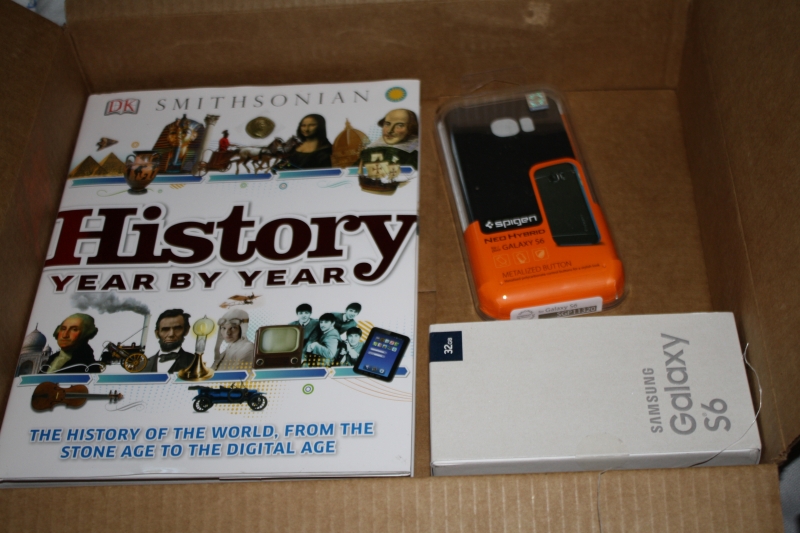
…for a new phone
I dropped my phone within six months of getting it, cracking the screen, but it’s worked okay since then. When the contract expired shortly after Tirzah Mae was born, I told Daniel I thought my phone was fine – we didn’t need to get a new one. Sure, it had some difficulties charging and the battery ran down quickly, but it met my needs. Then when I was in Lincoln for a week and Daniel in Wichita, we discovered that the phone calling function works only about half the time. We vowed we’d get me a new one before either of took another trip. The time got moved up a little more whenit became increasingly difficult to turn the screen off and on about a week ago. So now I have a fancy new phone with all the bells and whistles (including a case to prevent another screen cracking!)

Phone and Book

…for my first homeschool purchase since Tirzah Mae’s birth
We could pay $6 for shipping or $15 on another item to qualify for free shipping so Daniel asked if there was anything I wanted. I checked my list and didn’t really find anything, until, on a whim, I looked up the book I’ve been drooling over since I checked it out from the library: Dorling Kindersley’s Smithsonian History Year by Year. I expected it to be much too expensive (it’s hardcover and not a small book) – but, to my surprise, it was just under $19! I was getting ready to congratulate myself on not purchasing any homeschool materials since we’d been married, until I remembered that we’d stopped by a used store where I’d picked up an art text and a couple history books. I might be a compulsive homeschool shopper (and have been for the past 10+ years!)

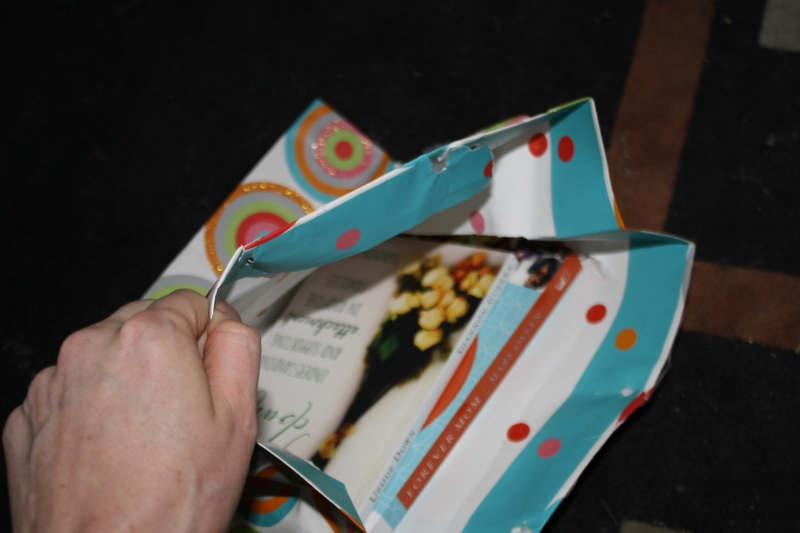
Opening the fun colored package

…for adoption books
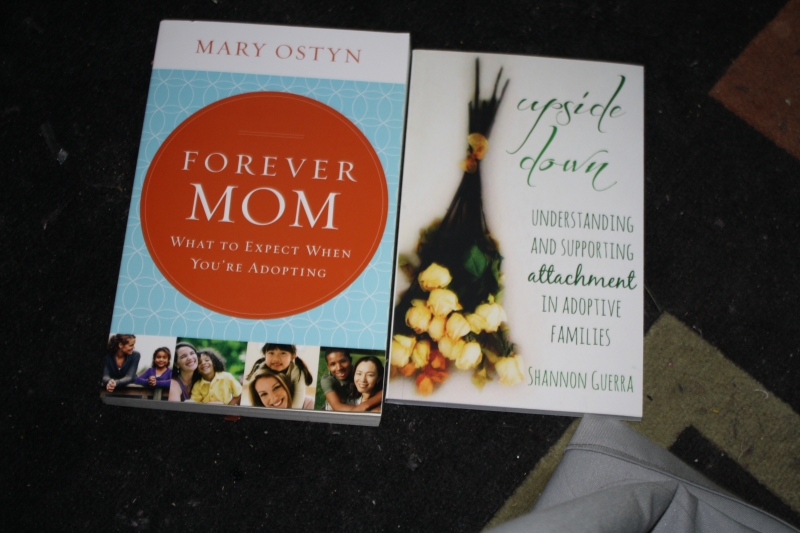
Mary Ostyn of Owlhaven recently hosted a giveaway of her book Forever Mom and Shannon Guerra of Copperlight Wood‘s Upside Down: Understanding and Supporting Attachment in Adoptive Families. Daniel and I have talked about adopting, would like to at some point, but don’t know much about the process at this point. I’m super excited to learn what these moms have to say about the process and how it works within existing families. (Sidenote: Do these books intrigue you? Shannon is hosting a giveaway of the same two – the giveaway is open until the morning of April 28, so go check it out!)

Adoption books
…for a heart-rending read
This one is a treasure that arrived in the mail a few weeks ago, but which I finished yesterday. It’s Stephanie Fast’s She is Mine – sent from Stephanie thanks to Carrie. I’ll be reviewing this soon – but for now, it’s enough to know that this book read like one of the best novels I’ve read in a long time – except that it’s not a novel, it’s an autobiography. It’s absolutely worth reading.

“Every good gift and every perfect gift is from above, coming down from the Father of lights with whom there is no variation or shadow due to change.”
~James 1:17 (ESV)

Thank you, Father, for these good gifts.


Different Definitions of “Custom”

Custom: adj Made to fit the needs or requirements of a particular person. (Definition from Merriam-Webster.)

When I think of the term “custom” (as an adjective), I think of something with a unique pattern created after a person’s needs. For example, if I were to say I created a custom outfit, I would mean that I had drafted a pattern for myself and created an outfit to my own specifications. If I were to adjust a pre-existing pattern to fit my body dimensions (by using one size bodice and another size skirt, for example), I would call it a “customized” dress.

I am beginning to believe that I may be the only one that makes this distinction between “custom” and “customized”.

The reason I think so is because my husband and I have started interviewing builders.

We’ve explored the floor plans builders have online, have walked through dozens of homes in the Parade of Homes (both last October and this month). And we’ve discovered that the current popular house plans are not our forte.

We have pretty specific ideas about flow (no traffic through the work triangle in the kitchen please!), lighting (get those living areas on the south side by all means!), placement of garages (we have an acreage – we don’t want the first thing you see to be a garage.) And pretty much every plan people are building in Wichita defies our specifications.

So we want a custom home.

We walk into the home of yet another builder and ask (usually the realtor, but sometimes we’re lucky and the builder himself is hanging around) a couple of quick questions: Does the builder build custom homes and does he build homes in our price range?

The response to the question of whether a builder builds custom homes is telling. One builder assured us that he did, turning to a plan he’d made (and could show off) that could be customized for a larger lot. Another talked of walking homebuilders through a half-built home and letting them choose where they wanted electrical outlets. One showed us how he’d done pillars instead of a solid wall in one of his stock plans.

Now, I’ve looked at thousands of houseplans (I’m not exagerating, people), and messed with quite a few. And while I’ve used some other plans as a jumping off point for my own plans, I’ve only once ended up with a finished product close enough to the original for me to consider it “customized” rather than “custom”. And I’ve found maybe three plans out of the thousands that comes anywhere close to meeting our specifications. Which means the chances that any builder in town has a spec that can be customized to meet our needs is virtually nil.

We’re looking for a builder who’ll build a custom home – and I’m discovering that one of the difficulties is sorting out which builders understand “custom” as I do.


The incredible, mutant eyebrow hair

“You have pretty eyebrows,” she told me. I carried that compliment around with me for years. She was an older girl, one of the cool girls. I was surprised that she even deigned to talk to me, much less to compliment me on the eyebrows I worked so hard to obtain.

That was when I was much younger, when I read beauty books. When I balanced pencils at just the right angle against my nose so I could arch my eyebrows just so.

Even as I plucked my eyebrows, I kept in mind the injunction that sometimes eyebrows don’t grow back after plucking. I needed to be judicious, to only pluck what I was willing to have never regrow.

I left the perfect arch behind with my teenage years (probably before), but plucking is still a part of my life.

This time, it’s trying to get rid of that ONE WHITE HAIR.

I can feel it when I smooth my eyebrows. It feels different from all the rest – coarse where the others are smooth.

I can see it when I look in the mirror, a blank spot amidst the otherwise dark hair, a disproportionately long hair amongst the normal-length hairs.

When I see it, I pull it, hoping that the books would be right, that continued plucking would cause that hair follicle to give up. But it never does. A new mutant hair springs up overnight, twice as long as the others.

I don’t remember what got us talking about it when my brother and his wife were in Lincoln at the same time as I, but we got to chatting about our eyebrows and my brother confessed that he too has the mutant hair. His hairdresser clips his every time he gets his hair cut – and it regrows to double length with surprising speed.

I seem to recall that my sister and I have commiserated over the hair as well.

One case, two does not a trend make. But three in the same family? Maybe there’s something in the genes. Within our otherwise perfect* genetic code lies a gene for that incredible mutant eyebrow hair.


*Okay, maybe our genetic code isn’t perfect. It seems that to perfect the mind, one must sacrifice somewhere. Our family’s genetic defects include not only a mutant eyebrow hair but persistently crooked (non-squishy) noses. :-)


Chronological Snobbery and my Library

Libraries experience a great pull to stay up-to-date, to provide the newest material and the newest technology. They’ve got to try to keep people interested in them, have to justify staying open. Who would visit them if they couldn’t provide the newest bestsellers, the neatest computers?

Sure, they could cater to the reference crowd, but honestly, with the internet explosion, who wants to dig through a paper copy of a reference work?

So libraries, willingly or unwillingly cater to what C.S. Lewis refers to as our culture’s “chronological snobbery” – assuming that newest means best.

Never is this more evident (or more annoying) than in my local library’s online catalog.

Wichita Public Library’s online catalog sorts search results by DATE, then by title. Which means that if you search for C.S. Lewis’s Mere Christianity, the title is third, below The Great and Holy War: How World War I became a Religious Crusade and C.S. Lewis at War: The Dramatic Story behind Mere Christianity.

In a surprising accident, the book I was searching for ended up on the first page. Searching for Lewis’s The Four Loves gives me 80 titles before I get to the one I want. And I’m lucky that The Four Loves was reprinted in 2004 – and that was given as the publication date. Otherwise I’d be waiting until response 101, a reprint from 1991.

Chronological snobbery.

You should really try it out yourself.

Thankfully, there is another option – I can select “Sort by Relevance” after the search is conducted and end up with the results I was actually searching for. But it takes extra steps that shouldn’t be necessary, wouldn’t be necessary if it weren’t for that darned chronological snobbery.


Book Review: 1984 by George Orwell

Who isn’t familiar with the phrase “Big Brother is always watching”?

It’s a phrase that’s entered into common parlance, quoted by people from all across the political spectrum. Actually, one thing ties together the frequent quoters – they’re generally Chicken Littles.

Okay, okay. That’s maybe a bit extreme. But the doomsday nature of those who quote Orwell’s famous slogan made me apprehensive as I started reading this novel. I continued on with this apprehensiveness for about the first third of the book. I love Orwell’s writing, loved how the story was drawing me in, loved his dystopia. And I thought, “How will I ever be able to discuss this with anyone? This is going to bring every ‘America is going to hell in a handbasket’ out of the woodwork.”

Then the story progressed and I lost myself into it, devouring it in just a few days.

It was an engaging story. I felt for Winston, the main character. I felt betrayed, heartbroken at the twist at the end. I contemplated the dreariness, not just of life under a completely totalitarian regime, but of life without Truth (with a capital T). You see, Winston dreamed of love and of freedom – both wonderful things, bits of eternity set within our heart. But the biggest hole in Winston’s life, the chasm so large he couldn’t even peer into its depths, was his lack of God.

Big Brother wanted to narrow his perspective. They wanted to narrow language so he couldn’t think anything they didn’t want him to think, wanted to narrow his dreams so that he wouldn’t look to anything beyond the now. They wanted to channel all his emotion into one thing and one thing only – love for Big Brother and hate for whoever was the enemy at the time (and had always been the enemy).

In a way, Big Brother succeeded, even while Winston was dreaming of love (and carrying on an affair), even while Winston was dreaming of freedom (and joining a revolutionary society). Winston wasn’t so narrowed that he could not dream of life outside of Big Brother’s control – but he was so narrowed that he never even dreamed of a Life (with a capital L) that could make him free even under Big Brother’s eye.

I’m still apprehensive about discussing 1984, still fear the doomsdayers. Truth is, this nation, just like every other nation has ebbs and flows. Freedom never lasts long, and even while it lasts, it is often more illusory than we make it out to be. And political freedom, as much as I love it and desire it and want to fight for it, is only one small thing.

One can be politically free, can be free from the “thought police”, can be able to live one’s life in peace and still have just as empty a life as Winston Smith. And one can be politically bound, can be under physical and emotional and mental persecution because of one’s beliefs, can be tortured in this life and still be absolutely free.

Because freedom isn’t political, it’s spiritual. And God is bigger than every Big Brother.

That’s what I came out of 1984 with – a conviction that the solution to totalitarianism is not democracy or republicanism (neither in the party sense or the form of government sense), the solution to totalitarianism is Christ.


Rating: 5 stars
Category: Dystopian fiction
Synopsis: Winston Smith dreams of a life outside of Big Brother’s totalitarian regime – and tries find it.
Recommendation: Engaging, thought-provoking, and on every reading list in the country (for good reason).

I read this as a part of Carrie’s Reading to Know Classic Bookclub.


Thankful Thursday: Perspective

Yesterday felt like one of those awful, terrible, no-good days.

I got cavities filled on both sides of my mouth and my teeth ached for the rest of the day.

The realtor for one of the builders we wanted to interview contacted Daniel in the morning to see if we could meet that afternoon (I wanted to – well, I actually told Daniel to say no. I think it’s incredibly rude and unprofessional to expect someone to make plans on that short of notice. I had a dinner on the menu that required me to be in the house for a good part of the afternoon and really didn’t want to be disturbed. But I found some food in the freezer that I could thaw quickly and put in the crockpot, so we went ahead.)

I started messing around with one of the floor plans we’ve been looking at and lost most of the day with what ultimately turned out to be unproductive adjustments.

Our meeting with the builder didn’t give the information I sought and made me further annoyed with the realtor – and resulted in the conclusion that the house plan I like best would be basically unsellable in our community should we ever want to or need to move.

Furthermore, Tirzah Mae had a blow out while we were meeting with the builder and I was definitely not in the mood to deal with it once we got home. Instead, I sat on the couch with a bag of chips, moping and feeling bad about being a bad mother by letting my daughter sit in dirty clothes while I was pouting.

And then Jason showed up.

Jason who considers David Garcia (Daniel doesn’t bother to correct him) his friend.

Then again, he’d probably consider anyone who gives him tennis shoes and rides across town and meals at restaurants a friend.

Because Jason is homeless.

He asked for food and Daniel consulted with me. We invited him in, heated up some homemade pizza rolls, gave him a glass of milk.

He talked at us until 8 o’clock rolled around and Daniel had to tell him he’d need to finish up dinner quickly because we needed to get to bed. Truth is, we usually start preparing for bed long before that.

He left and I sprayed down the house to rid it of the peculiar odor of unwashedness and stale cigarette smoke. My petty complaints seemed so little when I looked at Jason.

I have people who love me, who delight in my presence. I have conversation, real conversation, with people who value my opinion and whose opinion I value. I have food and shelter and clothing that fits. I have a (relatively) clean toilet to relieve myself on and a sink to wash up. I can bathe or shower every day. I can hide from the sun when I want to, can seek out its warmth when it’s pleasing to me. I have food in abundance. I have a home and a clean bed to sleep in every night. I have options for travel – my feet, a bicycle, two cars. I have a mind not blown out by drugs. I have a marriage not destroyed by drugs.

And I have Jesus. Oh, of all the things I have that he lacks, this is the best, the most precious. Even if I were reduced to his level of poverty, I would still have Jesus. As he rambled his mostly incoherent fragments, rarely pausing for us to reply and interrupting us if we ever tried, I was reminded how thankful I am that I have Jesus.


Book Review: The Pursuit of God by A.W. Tozer

One can’t read A.W. Tozer’s The Pursuit of God without grappling with the question of knowledge of God versus experiencing God. It’s the central theme of the book.

Tozer argues that it is insufficient to simply know about God or to pursue knowledge about God – but that one must pursue God Himself and experiences with God.

I agree.

The difficulty comes in when we start to make one exclusive of the other. When we start to think that pursuing God means not pursuing knowledge of God. When we start thinking that knowing about God precludes experiencing God.

And that’s exactly what Tozer seems to do.

It’s hard for me to put my thoughts about this book into words because my thoughts are so mixed. Certain passages in this book had me nodding my head and saying amen, some even brought tears to my eyes, so true and so profound they were.

“…Faith is the gaze of a soul upon a saving God….

Believing, then, is directing the heart’s attention to Jesus. It is lifting the mind to ‘Behold the Lamb of God’ (John 1:29) and never ceasing that beholding for the rest of our lives.”

I love it – and Scripture testifies to it.

But the passage I just quoted is a part of a thought experiment in which Tozer asks what an “intelligent, plain man, untaught in the truths of Christianity” would think upon reading the Scriptures. This thought experiment is a part of Tozer’s regular derision of education in the truths of Christianity and of those who seek doctrinal truth.

I despise his derision.

Much of my mixed opinion of this book probably comes from having belonged to churches that belonged to either of these camps. I spent my teenage years in a church that explicitly or implicitly valued experiences with God over knowledge of God. There I saw (and experienced) great passion for God and willingness to do God’s will – coupled with a tendency to be pushed to and fro with every wind and wave of doctrine and to lose faith when experience wasn’t forthcoming. Now, I belong to a church (and more generally, to a doctrinal camp) that explicitly or implicitly values knowledge of God and right theology over experience. Here, I see a great passion to understand the word and to trust what God has spoken – couple with a tendency
to value right thinking over right living and to draw the lines of orthodoxy so narrowly as to exclude most of the Christian world.

Reading The Pursuit of God reminded made to long for and delight in the experience of my youth – but Tozer’s animosity towards training in theology, really towards any Biblical education besides a man and his Bible in a closet, made me thankful to belong to a church and a doctrinal camp that values education.

Because what Tozer misses is that the more you know, the greater you can appreciate. Knowing about justification doesn’t keep you from experiencing a right relationship with God – in fact, it deepens your ability to experience that relationship, because you understand by faith what you don’t always feel. And often, knowing and understanding by faith leads to experiencing.

So, very mixed thoughts and feelings towards this book – so much so that I can’t really write my usual end-of-the-book-review synopsis and recommendation. Sorry!


I read this as a part of Carrie’s Reading to Know Classic Bookclub. To read more thoughts on the book, check out the March summary post.


Like me, not like me

There are a couple of families of my ilk at the ALDI I frequent.

Frugal women with long hair, wearing skirts and with children in tow.

I silently appraise them, count their children (oh, yes I do!), and note all the daughters also in skirts. I sort through the possible categories in my mind. Gothardite/ATI. Biblical patriarchy. Quiverful. Every category I try to place them in has negative connotations in my mind – but every time I see them, I smile. These are people like me.

I see them silently appraising me. Mentally calculating. Am I one of them? I have the hair, the skirts, the frugality. But only one child at my age? And the skirts that show my knees? Occasionally, a bra strap peeking out? I am a woman not like them.

When I see these women, I assume that they love children and family. I assume that they haven’t bought into our culture’s maxim that children are too expensive. I assume that they love their husbands and submit to them. I assume that they think there are differences between men and women and that femininity is something to be appreciated. I assume that they are like me.

When I see these women, I assume that they don’t use birth control, that they went straight from their fathers’ homes to their husbands’. I assume that they think that femininity means always wearing skirts and modesty means making those skirts long. I assume that they’re not like me.

Every time I see them, I rejoice to find women like me. Every time I see them, I sorrow that even in this I have found women not like me.

I very clearly don’t belong to mainstream mommy culture – my values, beliefs, opinions, and practices are frequently in opposition to theirs. I feel a great kinship with these women I see in the grocery store, these women who are so counterculture.

I wish I could be a part of them. Not because I want to take up the things they believe and do that I do not – but because I want to be a part of their group. I want to have friends, even just A friend who feels like I do or acts like I do.

I’ve probably seen her before, the woman who was in front of me in line with her two little girls. We’ve probably appraised each other before. But this time, after the appraisal, she turned to me and struck up a little conversation – the small talk we have in stores, about leaving our reusable shopping bags at home in a neat pile. It was ordinary and extraordinary.

And it made my heart yearn, like running into these women so like me and not like me often does. It made me yearn for a friend.


Book Review: I was a Really Good Mom before I had Kids by Trisha Ashworth and Amy Nobile

Are you tired of scrolling through the Facebook newsfeed and Pinterest front page, feeling more and more like a failure at motherhood? Have playdates become torture as you learn from other mothers yet another thing good mothers simply MUST be doing? Do you wince as you set the store-bought cupcakes you swore you’d never purchase next to another mom’s fancy homemade cookies on the Bible study snack table?

If so, you might find Ashworth and Nobile’s I was a Really Good Mom before I had Kids a helpful perspective-check.

When I first picked up this book, I figured it must be a memoir, full of stories of a mother failing to live up to her expectations. Alas, a memoir it is not – but despite not being what I expected, I enjoyed and appreciated this book.

Ashworth and Nobile found for themselves that motherhood wasn’t at all what they expected, and got tired of feeling so… defeated … as mothers. They didn’t feel at all the happy, perfect, “good” moms that every other woman seemed to be. They wondered if they were the only ones who felt this way – and they set out to find out the truth about those other mothers.

They interviewed hundreds of mothers and discovered that they weren’t the only women who felt like failures as mothers. They discovered that more mothers than not “love their children, but not being mothers” – and they set out to write a book to help women learn to love motherhood as much as they love their children.
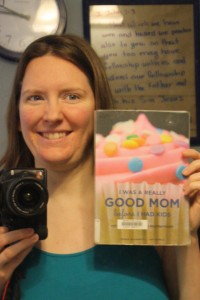
Me with book "I was a Good Mom Before I had Kids"

The book goes through a series of steps to help moms do just that: align their expectations with reality, make peace with their choices, lose the judgment, let go of the guilt, communicate with their husbands, take time for themselves, learn to say no, and live in the moment.

Each step has its own chapter, which begins with a tongue in cheek quiz, such as the one that asks you to “rank these questions in order of bitchiness” and offers “That’s so cute – he has Spider-Man shoes and a Spider-Man lunch box. Does he watch a lot of TV?” as one of the options. After each chapter, the authors offer several action items to help mothers work on the topic broached by that chapter.

While the general concept of this book is not new (there are certainly dozens if not hundreds of books and articles and blog posts on the same subject), I feel like the authors did a good job at creating balance within their book. It seems to me that articles I’ve read in this category tend to fall into two different camps: the you’ve-got-to-take-care-of-yourself camp and the you’ve-got-to-lose-yourself-in-your-child camp.

The you’ve-got-to-take-care-of-yourself camp elaborates a series of self-care rituals that mothers ought to engage in so as not to become bitter over motherhood. Mothers should take time to go to the spa to get a massage or their nails done. They should work out daily. They should eat healthy. These articles tell moms that they need to do these things for themselves – and for their kids. Because a mom who doesn’t take care of herself isn’t good for her kids. The authors of this book discuss the need for mothers to take time for themselves (and for the same reason), but instead of giving another list of things mothers ought to do (and therefore feel like failures for not doing), they encourage mothers to think through and find out what things make them into “a person they enjoy being with”. The authors acknowledge that motherhood may change the things that women find enjoyable – and that’s OKAY. Maybe crafts used to energize you, but now facing the prospect of cleaning up after crafting makes you cringe. Maybe you used to think seeing movies in a theatre was pointless – but now the thought of being able to be in a dark room with no one talking to you is your idea of bliss. That’s OKAY. The important thing is finding out what makes you tick where you’re at now, and finding some way of incorporating that into your life.

In contrast, the you’ve-got-to-lose-yourself-in-your-child camp argues that mothers spend way too much time worrying about the laundry and the dishes and the myriads of things that need to get done – and says that what mothers really need to do is recognize that their children have only one childhood and it should be spent cuddling/playing/talking/reading/exploring with their mothers. So moms should just be okay with the dishes and laundry not being done, meals not being prepared, errands never run, etc. This perspective also tends to make moms feel like failures – because, try as they like, they still can’t feel good about mountains of laundry and unwashed dishes and unmade meals. The authors of I was a good mom address this topic as well – “live in the moment” and “align your expectations” – but they do so in a way that helps moms think through what really is important to them and in a way that acknowledges that mothers will never be able to completely “drop everything.”

In short, I highly recommend this book to mothers who feel overwhelmed by the task of mothering. While I’ve not yet dealt with many of the frustrations discussed in this title, I’ve certainly discovered the need to adjust my expectations since becoming a mother.

As a short caveat, this book is not written from a Christian perspective and there is some inappropriate language found within. Additionally, while the authors do a decent job of encouraging women to understand their husbands’ perspectives in parenting and to communicate well with their husbands, some of the quotes from the women they interviewed convey highly unhealthy attitudes towards husbands.


Rating: 4 stars
Category: Mothering
Synopsis: The authors encourage moms to learn to enjoy motherhood by letting go of unrealistic expectations and developing healthy attitudes and behaviors for mothering.
Recommendation: Recommended to mothers who are struggling with mommy guilt, fighting in the mommy wars (or wishing they could get out of the crossfire), or who are just plain overwhelmed by mothering.