Nightstand (May 2015)

It’s been another very long month, made up of very short periods of sleep (Although – Tirzah Mae slept a 6 hour stretch last night, at least double as long as she’s slept since Easter. Praise God!) So this is another skeleton post.

Fiction read this month:

  • The Unknown Ajax by Georgette Heyer
    A little hard to get into at first, but I ended up liking this Regency romance quite well.
  • The Phantom of the Opera by Gaston Leroux
    Read (for the third time) with my real-life bookclub.
  • Christy by Catherine Marshall
    Read with the Reading to Know Classics Bookclub.
  • 3 board books by Sandra Boynton

Nonfiction read this month:

Books about health:

  • Lose that Baby Fat! by La Reine Chabut
    A month-by-month selection of exercises for the post-pregnancy year. The exercises are generally good if you already have the equipment (or were already intending to get it). You have to be proactive about setting up your own schedule and making sure you don’t lose gains you’ve made during previous months working on different body parts. See my full review for more information.
  • Drop Dead Healthy by A.J. Jacobs
    The author of The Year of Living Biblically and The Know-It All embarks on another giant project – this time, to be the healthiest man alive. Jacobs makes a ginormous list of possibly healthy practices and works his way through them in an entertaining couple of years. As a project memoir (which is what it is), this is fun – as health journalism, this is pretty poor. Since I enjoy project memoirs, I enjoyed this – but since I generally have a hard time with health journalism that tries, I had an even harder time with Jacobs’ lack of even trying to learn whether the health practices he was partaking in were actually legit.

Other nonfiction:

  • The Urban Homestead by Kelly Coyne and Erik Knutzen
    Interesting to compare and contrast with the 70s-style “back to the land” tomes I read as a teen.
  • And Baby Makes Three by John Gottman and Julie Schwartz Gottman
    Developing the skills to preserve your marriage as your couple becomes a family. The bulk of the book is on managing conflict well – and it has lots of good recommendations (even couple activities to help you practice good communication and effective argument). Even as I agreed with the value of the things the authors mentioned, I didn’t learn a lot – Daniel and I have been blessed with good communication in our marriage and we naturally (or perhaps I should say more accurately, by the grace of God) do many of the things that make for constructive conflict (instead of marriage-breaking conflict.) The addition of Tirzah Mae has certainly affected our marriage and made time and energy more precious – but it hasn’t brought up all sorts of conflict that drives us apart. Even while I didn’t personally find this useful, I do think it has lots of wisdom for those couples who struggle with constructive conflict (and since most every couple I’ve talked to has mentioned how strange it is that Daniel and I still haven’t fought, I’m guessing we’re in the minority here.) ***Also, please be aware: just because Daniel and I don’t fight and have constructive conflict when we do disagree, this does NOT mean that we’re perfect – by no means. Our struggles are just different than many couples’, not necessarily less than others.***
  • 97 Things to Do Before You Finish High School by Stephen Jenkins
    If it weren’t for the few items encouraging kids to dabble in the occult, this would be a decent list for any high schooler. Like many books targeted at high schoolers, though, this suffers from an overwhelming supply of already-dated cultural references (a lot changes in 8 years if you’re talking social media sites, cool music, and fashion trends.)
  • Create an Oasis with Greywater by Art Ludwig
    The definitive book on greywater systems – read my notes here.
  • Cut, Stapled, and Mended by Roanna Rosewood
    A birth memoir about VBAC. An interesting story, a few good points. A lot of raunch and pagan spirituality. I won’t be recommending it.
  • Prairie Girl by Laura Ingalls Wilder
    I absolutely devoured this.
  • A Builder’s Guide to Wells and Septic Systems by R. Dodge Woodson
    Understandably focused on builders, this book gives a basic overview of systems and how to reduce costs while ensuring quality work. Disappointing lack of information about advanced septic systems such as the one we’ll be installing.

Now that the mobile home is empty and Tirzah Mae is (maybe) starting to sleep again, I have high hopes for reviewing many of these in greater depth. For now, I’d encourage you to check out the review I hadn’t posted as of my last nightstand: Stephanie Fast’s She is Mine. It was a tremendously compelling read – and I think you should read it.

Don’t forget to drop by 5 Minutes 4 Books to see what others are reading this month!

What's on Your Nightstand?


Lifecycle of a nightie

Some 20 years ago, my little sister Grace grabbed one of my mom’s nightgowns out of the laundry basket and started carrying it around.

It was a “slicky” nightgown you see, some sort of synthetic with a silky feel, perfect for snuggling against or rubbing between one’s fingers.

As I remember it, Grace carried the nightgown with her whenever she had a chance, slept with it, and generally loved it until Mom made her a “slicky” of her own – something akin to a handkerchief made out of similarly “slicky” fabric.

Years later, mom retired the nightgown and I grabbed it up. I cut off the lower portion, added a casing at top for elastic and wore it as a slip for eight, ten, or more years.

Recently, I pulled the slip from my drawer and added it to a pile of mending sitting atop another dresser in our room. The elastic in the waist is shot. Either I need to replace the elastic or convert the slip to other purposes.

But one day, about a week ago, Tirzah Mae’s lovey (a “slicky” I made for her with ribbon tags) got dirty and was in the wash – and Tirzah Mae was not settling down for a nap without it. I grabbed the old nightie-turned-slip from the dresser and snuggled it against Tirzah Mae’s cheek. Safely nestled in a “slicky”, Tirzah Mae fell asleep.

Tirzah Mae with the old nightie

Today, she wraps her hands in it and waves it around, just as her aunt did some 20 years ago.


Going Green with Greywater (or not)

Greywater. It’s not sewage, but we send gallons of it into our sewers daily. It’s the water we wash our hands with, shower with, bathe in. We can reduce the amount we create but we can’t eliminate it entirely. We’ve got to get clean.

But we don’t have to send it into our sewers. It’s not sewage.

I’ve been doing the most low-tech of greywater recycling for years – dumping my dishwater out the door instead of down the drain – but when we bought ourselves a piece of land and started thinking about building on it, I started thinking about a more elaborate greywater system.

A little bit of research brough me to Art Ludwig’s Create an Oasis with Greywater, the definitive resource on greywater systems. Art describes the value of greywater, helps readers set goals for their greywater system, and helps them design a greywater system that fits their context. It’s a great (if not very pretty) book.

It also made clear that a greywater system is not for us.

Really? You might be asking. How’s it a great book if it convinced you to not go with a greywater system?

That’s the thing. Ludwig (unlike a lot of so-called green gurus) is an environmentalist with his head screwed on straight. He’s not interested in designing or implementing something that seems green but really doesn’t do any good. He spends quite a bit of time helping his readers to scale down their expectations of a greywater system and to evaluate what sort of system makes environmental and economical (he makes the excellent suggestion that economics can be a proxy for environmental soundness, which I wholeheartedly agree with) sense given their individual context.

In our case, our soil demands that we put an advanced septic system on our land. All our wastewater (greywater and the “black” water from our toilets and kitchen sink) will be sent through a dual-chambered system where aerobic fermentation will purify it before it is pumped through a series of tubing to irrigate our lawn from below. So we’ll already be getting one of the primary advantages of a greywater system (without installing separate pipes) – we’ll be irrigating with our water instead of sending it into a sewer. Furthermore, since the “irrigation” step is an important part of the septic process, we cannot add extra irrigation on top of the irrigation field (which will cover most of the area close enough to the house to be feasibly irrigated with greywater). In addition, a septic system requires a certain amount of “dilution” water to work – so it is possible to remove too much water from the septic through a greywater system.

So a greywater system isn’t for us.

Does that mean I won’t be using anything I learned from this book?

Actually, no. Ludwig points out that there are some forms of greywater reuse that can be done without a fancy system. Using your bathwater and a bucket to flush the toilet? Go for it (I fill our low-flow toilet with bathwater to rinse Tirzah Mae’s diapers in – and then flush it with more bathwater.) And throwing my dishwater out the door after I’m done with it? Well, that’s a tricky one. Kitchen sink waste is actually considered blackwater, since it contains organic matter that can feed icky bacteria, causing them to proliferate and make you sick. Even ordinary greywater is not encouraged for vegetable garden use, since it can can contain pathogens. The compromise I make is to discard my dishwater down the drain but to apply the rinse water to my garden. An even better choice would be to use that water on non-edibles, but I currently don’t have any nonedibles that require water.

If you’re at all interested in greywater reuse, I highly recommend Ludwig’s Create an Oasis with Greywater as a resource to help you evaluate a system. Ludwig’s website is also a great resource.


A springtime project

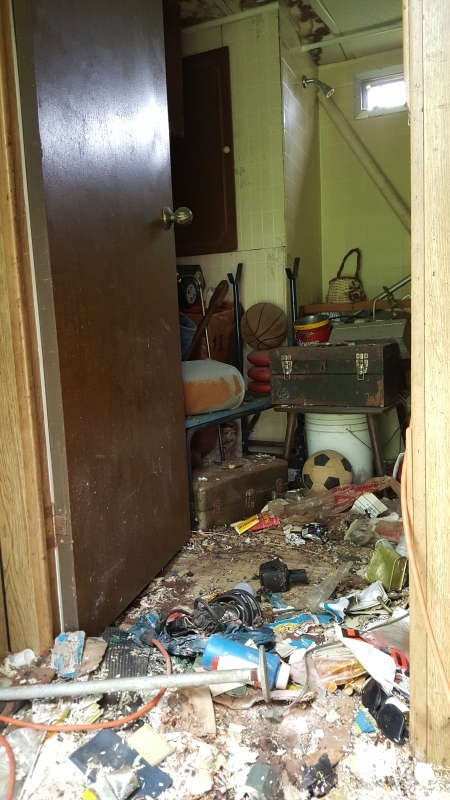
Posts might get scarce around here for the next month or so – because I’ve got quite a spring cleaning project to work on.

The bathroom after two hours of work

A peek inside the trailer’s back door – after two afternoons of work

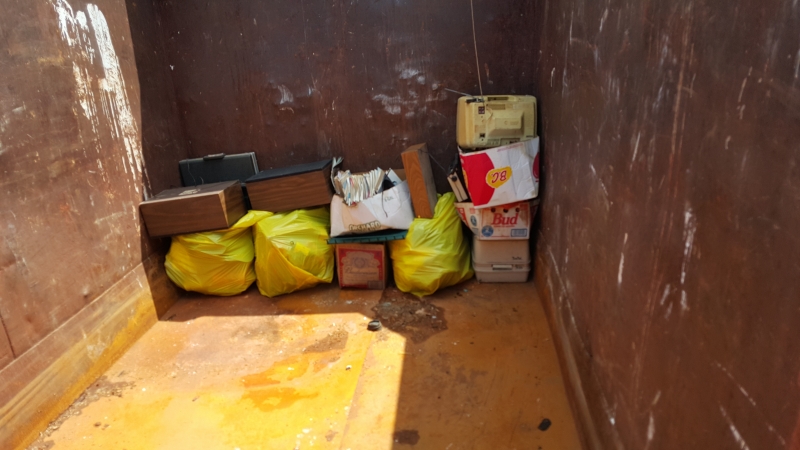
We’ve got a rolloff out on the land and my task is to empty the trailer into the rolloff.

The roll-off after one hour of work

One hour’s worth of trash

Since Daniel is still needing to work mega-overtime, Tirzah Mae and I are mostly on our own for this project.

My cleaning buddy

My cleaning buddy

Which means we’ll be busy – really, really busy in the next several weeks.


Book Review: Lose that Baby Fat! by La Reine Chabut

Despite ending my pregnancy eight weeks early, I gained significantly more than the recommended amount – at least 50 pounds. Much of it was water weight, which means that, after rigorous diuresing, I returned from the hospital only 8 pounds above my prepregnancy weight. Which perfectly explains why I’m now closer to 18 pounds above my prepregnancy weight.

Well, actuallly, there is an explanation for that. Almost three weeks of bedrest meant a rapid loss of muscle mass, leaving me with a still-voracious appetite (from breastfeeding), but nowhere near as much muscle to use up the calories I’m consuming.

Now, I’m not particularly worried about my weight – I’m still in the healthy range and only a bit above my post-high school norm (I was about 5 pounds lighter than this through college). But I am worried about the loss of muscle mass (and gaining fat mass). Which is why I’ve been making a concerted effort to be active – and to include strength training in my routine. And, of course, this gives me opportunity to read some more books!

Lose that Baby Fat! is supposed to be a month-by-month exercise guide for the first year after having a baby – but I didn’t use it as such. Instead, I worked through the various exercises and routines more quickly (about one month per week) in order to allow me to try and review other books as well. This means that I can’t comment on the effectiveness of the program as written except from a theoretical standpoint – but, actually, there is very little guidance as to how often one is supposed to do the monthly exercises (or whether one is supposed to do anything in addition to them), so I suppose it’d be hard to comment on effectiveness anyway – it will be what you put into it.

As I worked my way through the book, I wrote up comments as seen below.

First Six Weeks: Kegels
Very simple version of Kegels.

Month 2: Walking and Stretching
Do stretches REALLY need to use an exercise ball? I had a hard time balancing well enough to get a good stretch – and nearly all of the stretches could just as easily be done without any equipment at all. (In the author’s defense, it’s easier to balance with tennis shoes on – and I frequently exercise without them.)

Month 3: Abdominals
I like the use of the ball for abdominal exercises like the bicycle and the abdominal crunch – I felt like the ball helped me stay focused (or maybe distracted from the monotony?) and made me less likely to hurt my neck than with the traditional floor exercise. This chapter included a nice range of difficulty, from very easy to quite difficult, perfect for ramping up after a life-experience that rather stretches out those abs :-) (Little complaint here: at the beginning of each chapter the author has a “how you may be feeling” blurb, and this month’s is “Thinking twice about continuing with breastfeeding.” My experience as a WIC dietitian is that women who stick it out to three months very rarely have second thoughts – by then they’ve gotten through the most difficult learning curve and can’t imagine having to wait to mix up a bottle and get it warm before feeding their baby.)

Month 4: Arms and Chest
Pretty standard arm exercises (biceps curls, triceps kickbacks, chest presses) done on the exercise ball with a resistance band. We own an exercise ball, so I did the exercises on it – but I didn’t purchase a resistance band to test these out (I know enough of myself to know that buying a piece of exercise equipment will not motivate me to use it.) Instead, I used the 3 pound weights I already have. All the exercises in this chapter happen to have the resistance working in line with gravity, so no postural changes were required to adapt from one to another. I officially like doing arm exercises on the ball (versus standing or on a bench) – it adds a bit of an ab workout and doesn’t take as much space as a weight bench.

Month 5: Butt
A couple of the exercises involved standing with some part of your body against an exercise ball which is positioned against a wall. Obviously, the author is a fitness-lover rather than a book-lover – she has a room with plenty of wide-open walls. All of my walls are jammed full with either bookshelves or windows. Thankfully, the exercises that she does this with (squats and lunges) can be done just as well without a ball or a wall.

Month 6: Shoulders and Upper Back
This includes four ball and band exercises, half of which require postural modifications to do with free weights (of course, the author doesn’t explain how to do that). Disappointing chapter.

Month 7: Legs
Jumping rope in 30 second intervals. I didn’t do this because I couldn’t be bothered to find my jump rope.

Month 8: Full Body
The first workout that is actually a full workout (as opposed to just a few exercises for a target area). Most of the exercises are duplicates from past chapters – making me wonder if one was really supposed to only be working on the butt in Month 5, for example, instead of incorporating each new monthly set of exercises into a weekly rotation (as I would have assumed).

Month 9: Circuit training
A very short (6 minutes total) but very intense (at least for me) workout with 30 second intervals (Daniel uses a HIIT interval timer on his phone for interval training – and I tried it for this workout, which worked well). This workout uses a coffee table for triceps dips and pushups, but since I don’t have a coffee table, I used a footstool for dips and did girlie pushups straight on the floor. I’m definitely going to have to try this again – it was a good FAST workout.

Month 10: Strength training
These are fairly traditional dumbbell exercises using the exercise ball as a bench.

Month 11: Running
Sorry, even if I did decide to purchase a jogging stroller, you’re not going to get me running. I had enough trouble keeping my bosom controlled before baby and breastfeeding – trying to do it now sounds like a major OUCH!

Conclusion!
If you read through my notes so far, you’ve seen that I had numerous comments regarding equipment use. This book assumes that you have 1) an exercise ball, which is used for almost every exercise, 2) a fitness band, 3) a jump rope, and later on 4) dumbbells and 5) a jogging stroller. I do not feel that any of these are necessary for a good post-pregnancy workout (although having some form of resistance for strength training is worthwhile). I did find that I enjoyed many of the exercises using the ball.

If you have this equipment already, I would recommend this book as a good source for a variety of exercises that can be done using them. If I were to use this book as my complete program, I would plan on doing some sort of aerobic activity (probably walking) at least three times a week and do at least two or three exercises from the current month a couple times a week, adding in a couple exercises from each previous month as well. (It seems crazy to me that the author only puts things together into a full-body workout in month 8 – you’d lose any muscle tone you’d gained in your abs, for example, by then if you hadn’t kept on working with them.)

**Side note: The author knows nothing about nutrition. Disregard anything she says (thankfully, she doesn’t say much.)**


Rating: 3 stars
Category: Post-pregnancy exercise
Synopsis: A month-by-month selection of exercises for the post-pregnancy year.
Recommendation: A good selection of exercises if you already have the equipment (or were already intending to get it). You have to be proactive about setting up your own schedule and making sure you don’t lose gains you’ve made during previous months working on different body parts.


Grandma on childbirth and baby feeding

I was telling my grandma about our Bradley class (I think) when she commented that she’d heard about natural childbirth somewhere toward the end of her childbearing years. She told her doctor she’d like to try. He told her no, she didn’t. She had twelve children, including one set of twins. None were born “naturally”.

I was talking with Daniel’s grandma early on in our marriage (before we were pregnant) and somehow we got on the topic of childbirth and breastfeeding.

She doesn’t remember anything about how her children were born – she was out for their delivery.

She didn’t even see her babies for a fair while after they were born – but she breastfed all four.

Daniel’s other grandma didn’t breastfeed her children. “It wasn’t encouraged in those days,” she told me apologetically. Now she regrets that she didn’t “nurse”. She’s so glad I’m nursing Tirzah Mae. “It’s such a wonderful thing,” she said.

I was mentioning how NOT fun pumping had been when we’d had to do that – but that my supply had been abundant. My grandma told me she’d tried with her first but that it didn’t work out. Grandpa complained about all the money that Similac got from them – twelve children’s worth.

None of Tirzah Mae’s great-grandmother’s had ideal situations. But they managed the best they could. They raised their children with the resources that were available.

And they raised some pretty terrific children.

It’s worth remembering, even as I long for the ideal – and long that the ideal could be available to as many women as possible – that generations of women have experienced the less-then-ideal, have pressed through, have raised their families well.

Natural childbirth. Immediate skin-to-skin. Successful breastfeeding.

I wish that every woman had the physical capability and the support she needed to achieve them.

But when she doesn’t?

She can still mother well.

Take heart, mothers who feel disappointed with your birth or breastfeeding experiences. It’s okay to be disappointed. For those who were coerced, it’s okay to be upset. But your birth or breastfeeding experiences do not define your mothering.

You do.

Our grandmothers pressed through the less-than-ideal and raised our parents well. You can too.


The child will live

Anxious caregiver stays up all night applying compresses to feverish child’s face, chest, limbs.

Child tosses and turns, moaning and breathing laboriously.

Everyone knows that the child is on her deathbed, everyone wishes they could do something – but to no avail. They stand vigil outside the child’s door, waiting for news. The doctor’s worried face declares that the danger is real.

Then, as daylight breaks, the child’s fever subsides. She falls into a “deep, unlabored sleep.”

The doctor declares the worst to be over, orders the anxious caregiver to sleep.

All breathe a sigh of relief. The child will live.


What story am I telling?

I’m not really sure. I feel certain I’ve read this story or a variation on it at least a half dozen times if not more – but I can’t remember where.

Do you know?


All I know is that I felt a little like I was in this story (and yes, I am being melodramatic) last night.

Tirzah Mae went to sleep at nine, woke up screaming at 10:30, midnight, one o’clock, two o’clock, three o’clock, four o’clock, and five o’clock. I had a nightmare that I was (thankfully) able to wake myself up from at 11:15.

It’s been four weeks now that Tirzah Mae’s not been sleeping well, been waking up screaming, been inconsolably fussy during the day. My own sleep has (understandably) suffered.

We took her to the doctor Friday, got some medication. And this weekend has been the worst that it’s been so far.

But this morning, as I was reaching my very wits end, I breastfed Tirzah Mae and she fell into a “deep, unlabored sleep”. She slept for four hours (longer than she’s slept at a stretch since returning from Lincoln on Easter Sunday).

And her mother relaxed into sleep as well. The worst is over. The child will live (and so will her mother.)


Thankful Thursday: Six months ago today

Six months ago today, I was sicker than I’d ever been in my life.

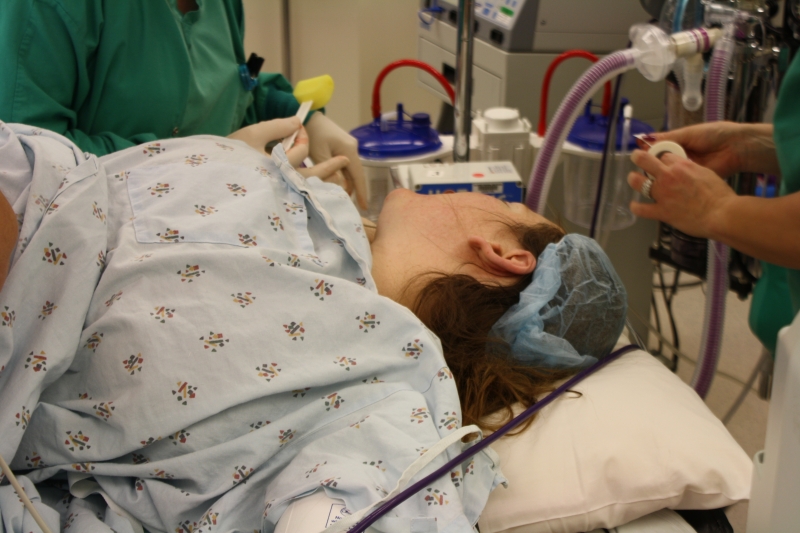
Prepping for the c-section

Six months ago today, I made a decision I’d never thought I’d make.

Six months ago today, my infant daughter was delivered via C-section, eight weeks before her due date.

Weighing in

Six months ago today, my Tirzah Mae was born.


She spent her first 26 days outside the womb in the NICU. She was fed through her veins at first, and then through a tube into her stomach, finally at the breast. She went from an incubator under bili-lights to the incubator without then to an open crib.

Tirzah Mae under the bili lights

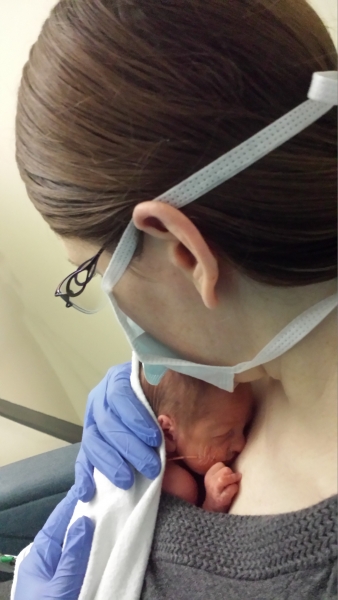
She’s spent the last 155 days with us. She is fed at the breast, sleeps near us, is warmed by our warmth when she needs it.

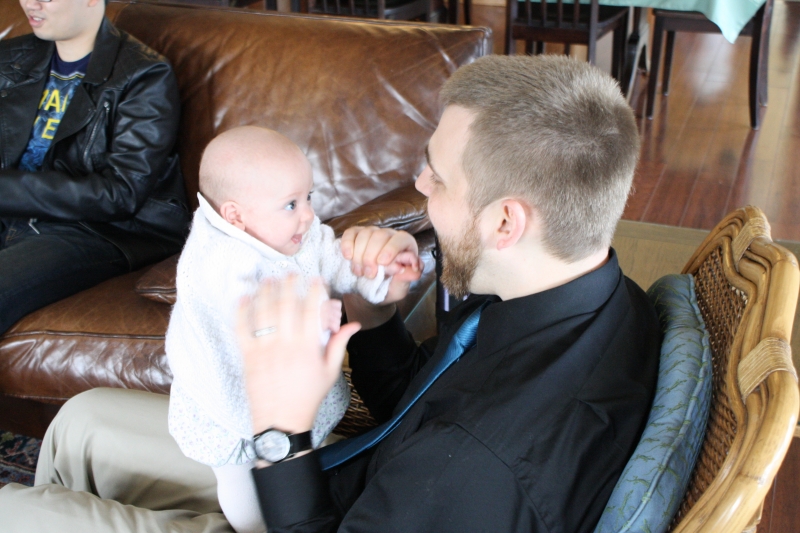
Tirzah Mae and Papa enjoy each other's company

Five months out for just the one month in.


The books say that parents never forget their preemies’ births, their hospitalizations, their difficulties. And maybe the books are right.

But already, the memories start to fade. I forget how tiny she was, how helpless. I forget how desperate we were. I forget that she isn’t just another baby.

Snuggling inside mama's dress

When people ask her age, I tell them she’s about six months – starting to leave off “but she was born two months early”.

Tirzah Mae smiles as she swings

Six months makes a big difference.


One thing hasn’t changed in those six months though.

I still look at her little fingers, so perfectly formed, now full of flesh where once was only skin and bone. I wonder at them – how perfect, how delicate, how complete they are.

Setting her to scale

Eight weeks early, she was still complete. She was a baby, a human fully formed though immature.


I become sentimental, my thoughts meander.

What can I say that means anything, on this day six month out?

Perhaps the only thing I can say is to sing:

“‘Tis grace hath brought us safe thus far
And grace shall lead us home.”

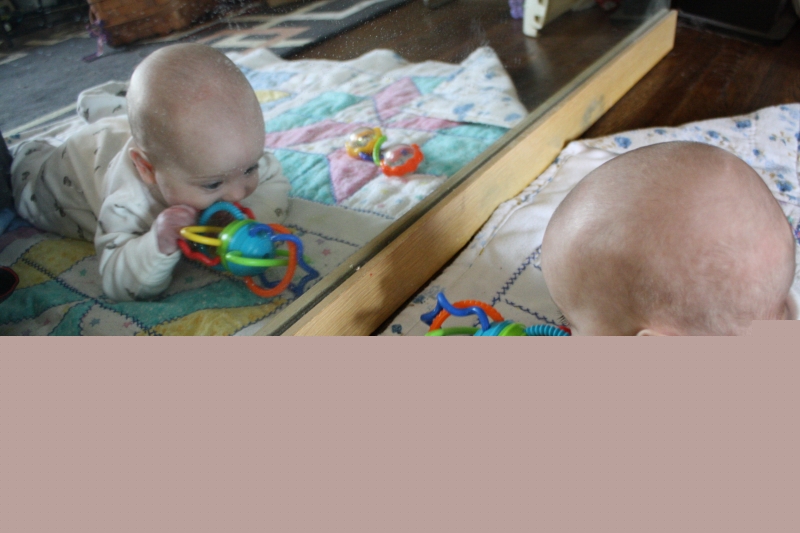
Today, I am thankful for God’s grace. God’s grace in granting me life, in granting Tirzah Mae life. God’s grace in eight extra days in the womb. God’s grace in 26 short days of the NICU. God’s grace in 155 long days at home. God’s grace in sleepless nights, in pumping and shield use. God’s grace in spit up and diapers. God’s grace in baby laughter and Tirzah Mae recognizing herself in the mirror. God’s grace has been omnipresent.

Tirzah Mae plays in the mirror

Thank You, thank You, Gracious God.


Book Review: She is Mine by Stephanie Fast

Written in the third person, Stephanie Fast’s She is Mine reads like a novel. Written in three parts, it unfolds like a play.

It’s the story of the daughter of a Korean woman and an American serviceman. She never knew her father – he didn’t know her mother was pregnant. She was rejected by her mother’s family, said to have brought dishonor on her family. She was abandoned by her mother.

Five year old Yoon Myoung figures that if she travels along the railroad tracks – the railroad tracks that took her away from her mother – she’ll find her way back, back into her mother’s arms. So she walks the tracks, eating roots of grasses then insects and trapped animals. She steals. She is beaten and chased off. She is abused.

I couldn’t put this book down. The story was so compelling, so well-told. As I turned page after page on horror after horror, I almost forgot that this isn’t a story Fast invented. It’s a story she lived.

She is Mine reads like a novel, unfolds like a play – but it’s really an autobiography.

And while it’s the story of an abandoned child, of unspeakable horrors, it’s also the story of hope. It’s the story of a God who sees sparrows and war-orphans, who weeps when the sparrow falls from the sky and who rescues orphans from pits. It’s the story of a God who sees the outcast and declares “She is Mine”.

She is Mine is told in the third person because, the author tells us: “While this is the story of my life, it differs only in cultural details from the stories of the innumerable nameless and faceless orphans around the world today.”

Reading She is Mine pierced my heart. It undid me. I cried practically from the first page to the last.

I cried because life is precious. People are important. Yet there is so much pain, so much injustice, so much horror in the world. She is Mine didn’t shrink back from sharing that pain, that injustice, that horror.

I might have been tempted to close the book. You may be tempted to not pick it up. We don’t like to see pain, injustice, horror. We like happy tears, not anguished ones. We like to read of the human spirit conquering, not being crushed.

But the pain, the injustice, the horror is not reason to close our eyes, to close the book, to tune out the voices of need.

Jesus didn’t. He saw the pain, the injustice, the horror. And he stepped down into it. He bowed under the yoke, was beaten and defiled. Why? So He could lift us, His people, out.

And He calls His people to do the same.

It would be easier to shut our eyes to the plight of the orphan, to busy ourselves with little petty things. But it is not the way God calls His church to live.

If you will let it, Stephanie Fast’s She is Mine could be a tool God uses to open your eyes to the pain of this world, could be a tool God uses to compel you to step into that pain, could be a tool God uses to lift another out.

Will you read this book? Will you let your heart be moved? Will you let your reading compel you to ask God what you can do? Will you listen and obey when He speaks?

I pray that you will.


Rating: 5 stars
Category: Autobiography
Synopsis: The story of a Korean war-orphan, abandoned, abused, and ultimately accepted.
Recommendation: Everyone should read this book.


I received this book from the author thanks to Carrie’s generosity and passion for this story. All opinions are my own – including the opinion that you should head to Amazon (I don’t get anything from them) and order this book right away.


Nightstand (April 2015)

Tirzah Mae’s routine (and mine by extension) is still recovering from our weeklong trip to Lincoln last month, which has meant that I’ve got a fair bit of reading and pretty much nothing else done this month.

Tirzah Mae in a Sunhat

Fiction read this month:

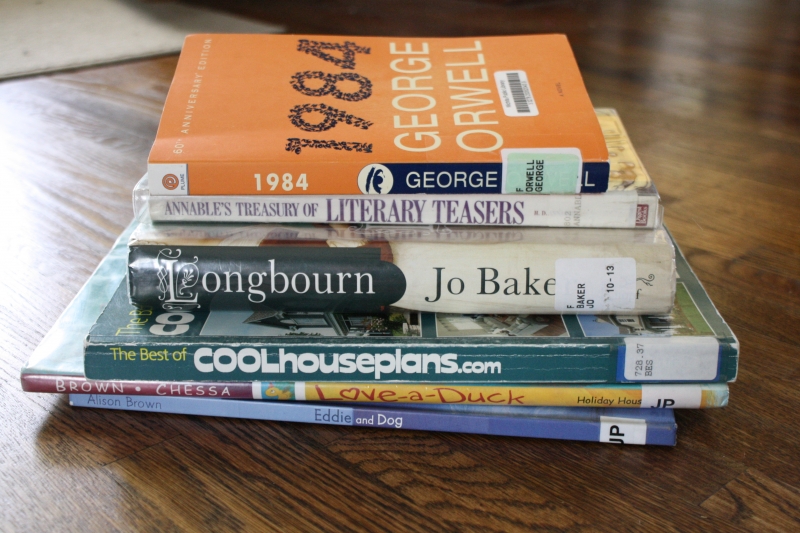
  • Longbourn by Jo Baker
    A tale of the domestic help at Longbourn, home of the Bennets (of Pride and Prejudice fame). I would have loved to have recommended this book, with it’s intriguing premise and generally engaging story (after the first few chapters). Unfortunately, the lewd language, sexual immorality, and otherwise inappropriate content sprinkled throughout makes me unable to recommend it.
  • 1984 by George Orwell
    A fascinating dystopia read with the Reading to Know Classics Bookclub and reviewed here.
  • 6 picture books author last name BROWN
  • 1 board book by Sandra Boynton

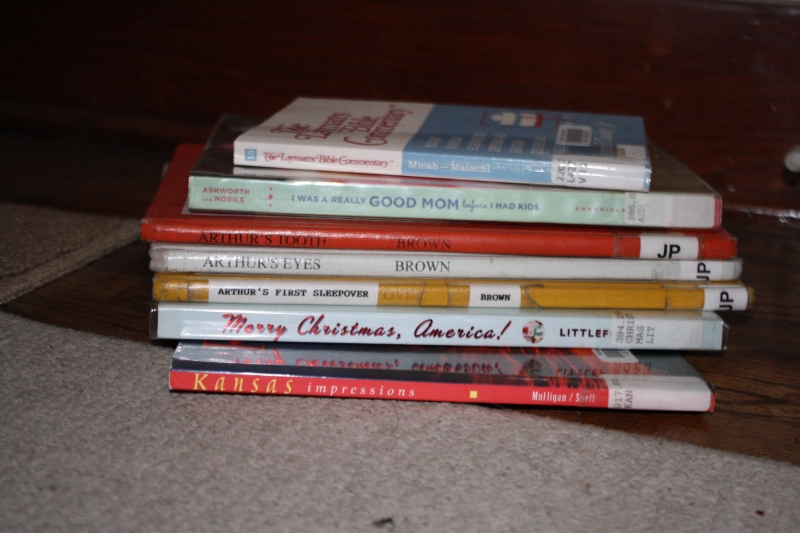
First stack of library returns

Nonfiction read this month:

Books about building a home:

  • The Complete Guide to Building Your Home for Less by Michael Conroy
  • What not to Build by Sandra Edelman, Judy Gaman, and Robby Reid
  • Old-House Dictionary by Steven J. Phillips
  • 3 House Plan Books

Second stack of library returns

Other nonfiction:

  • Annable’s Treasury of Literary Teasers by H.D. Annable
    A volume full of question-and-answer-style literary trivia. I love that the answers to questions were on the very next page (questions on page 1, answers on page 2 so you flipped just one page to get the answers). I hated that I felt like an absolute literary dunce trying to answer the questions.
  • I was a Really Good Mom before I had Kids by Trisha Ashworth and Amy Nobile
    A good book about loving motherhood as much as you love your children. I reviewed it in greater detail earlier this month.
  • She is Mine by Stephanie Fast
    A gripping autobiography of the child of a Korean woman and an American serviceman, abandoned early in life and forced to fend for herself. I definitely recommend it (and will be reviewing it more fully soon.)
  • The Layman’s Bible Commentary: Micah, Nahum, Habakkuk, Zephaniah, Haggai, Zechariah, Malachi by James H. Gailey, Jr.
    Having had one good experience with The Layman’s Bible Commentary, I keep checking out volume after volume to use in conjunction with my personal Bible reading. Unfortunately, this volume goes on the list with others as one in which the author undermines the inspiration of Scripture by presuming all sorts of cobbled together edits of Scripture to produce the finished work, despite the clear reading of the text indicating that, well, these are the words of a specific prophet. Disappointing.
  • Merry Christmas, America! by Bruce Littlefield
    Photos of extravagent Christmas light displays across America – along with stories from the people who create the displays (mostly private homeowners.) A lot of the displays are too gaudy for my taste, but they’re always interesting, as are the stories behind them.
  • Kansas Impressions by Steve Mulligan and Michael Snell
    As a lifelong resident of the Great Plains, I’ve always despised those who dismiss Nebraska or Kansas with a “nothing to see here, move along.” We may not have mountains or oceans, but the plains have their own gentle beauty (perhaps this is one of the reasons why I love Laura Ingalls Wilder’s lovely stories of pioneering in the plains?) Kansas Impressions is a book packed full of beautiful Kansas scenes. If you’ve been inclined to disparage your own state (if you’re a Kansan) or to roll your eyes and not even bother to look for a stop as you drive through Kansas, you should take a look at this book – and see Kansas through new eyes.
  • The Ultimate Breastfeeding Book of Answers by Jack Newman and Teresa Pitman
    Newman is one of the foremost experts in breastfeeding medicine – and I love the way he lets his voice come out in this informative and practical book. It won’t be for everyone, but I did write up some comments on one passage here (regarding whether breastfeeding should be considered the norm or the ideal “best”.)
  • Quick, Cheap Comfort Food by Victoria Shearer
    Over-reliance on convenience items (especially seasoning packets) meant there were only a half dozen or so recipes I found interesting. I tried a couple, which weren’t bad. Skippable.
  • The Pursuit of God by A.W. Tozer
    Read with last month’s Reading to Know Classics Bookclub, it took me forever to get my review up.

Don’t forget to drop by 5 Minutes 4 Books to see what others are reading this month!
What's on Your Nightstand?