Nightstand (June 2013)

I’m back to slow reading, not much completed on my Nightstand this month–but I’m learning that we have seasons of reading and seasons of working, seasons of new stuff and seasons of old familiar. These seasons are good–and I’m still enjoying what books I am reading.

This month, I read:

  • The Fan by Peter Abrahams
    This is the earliest of Peter Abrahams’ that I’ve read so far–and I didn’t really like it. It took quite a while to get to the suspense part of the story, the main characters motivations were never really clear, and it had way too much sex in it. If I end up with another one like this from him, I may end up 50-paging it.
  • While the Clock Ticked by Franklin Dixon
    Picking up the Hardy Boys again–this time at a new library with different parts of the series.

What's on my Nightstand

Currently in progress:

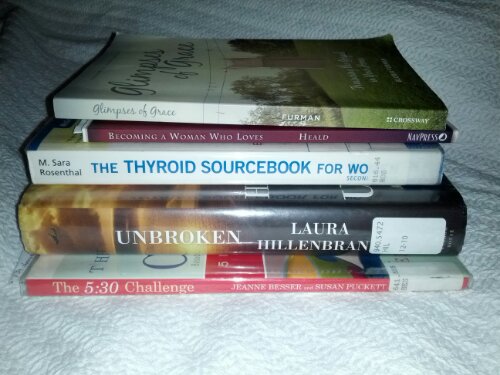
  • The 5:30 Challenge: 5 ingredients, 30 minutes, dinner on the table by Jeanne Besser
  • Bondage of the Will by Martin Luther
  • Glimpses of Grace by Gloria Furman
  • The Thyroid Sourcebook for Women by Sara Rosenthal
  • Unbroken by Laura Hildenbrand
    Everyone who read and reviewed this in the past year has raved about it–so when a few gals from church started talking about starting a book club and wanted suggestions for books, I threw this title into the mix. So far, at about halfway through, I’m loving it.

Don’t forget to drop by 5 Minutes 4 Books to see what others are reading this month!

What's on Your Nightstand?


Wood, Hay, Rubble

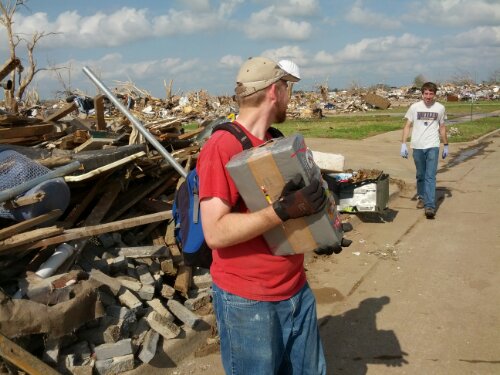
About two weeks after a massive tornado cut a swathe through Moore, Oklahoma, Daniel and I took a team from our church down to help with relief.

We essentially walked around until we found homeowners who were digging through the ruins of their homes–and asked if they needed help with anything.

Different people had different requests.

Daniel and I stopped first at a home where a woman was digging about for anything that might be salvageable. Helping was difficult, because we really didn’t know what she wanted or didn’t want. What was important to her? What did she consider worth saving? We didn’t know, so we busied ourselves with moving bricks and beams and broken furniture, piling up anything that was at all intact for her to sort through. Once she started looking herself, it became apparent that the items she cared about the most were DVDs.

Daniel amidst the rubble

Her next door neighbor stood outside her house, unsure of what to do. This second homeowner, unlike her neighbor, understood that insurance would cover ruined belongings. She wasn’t interested in searching for this item or that. Her daughter (in the elementary school that was devastated) was out of the hospital. Her sons were safe.

But that didn’t mean she didn’t have a request for us.

Her mother was worried that the church people might show up and see the couple dozen trash bags worth of beer cans now strewn across the property. What would they think? Her Christian reputation would be ruined if they could see that evidence of how much she drinks. Would we help?

Two friends held open trash bags as Daniel and I shoveled beer cans as fast as we could. We filled the bed of a pickup truck. They’d be able to recycle them for some cash.

When we met up with some others of our group, they had a different story to share.

A family was searching for an heirloom–a family Bible full of underlinings and notes, with leaves outlining births and deaths and baptisms. Our team searched with them, digging through the remains of their lives.

A Bible was found, was brought to the homeowner. The homeowner opened it, confirmed that this was indeed the Bible. The couple dropped what they were doing, called off the team.

That was it. The rest could be bulldozed. Nothing else mattered.

They circled the team for a prayer of thankfulness before they headed back to their temporary housing.

“Now if any man build upon this foundation gold, silver, precious stones, wood, hay, stubble; Every man’s work shall be made manifest: for the day shall declare it, because it shall be revealed by fire; and the fire shall try every man’s work of what sort it is.”

I Corinthians 3:12-13 (KJV)

Before the Day stands these lowercase days, days when wind–not fire–exposes our hearts. Are we set on the entertainments of this world? Are we building merely a facade to hide our sin? Or will the wind expose a life that sets its hope in the eternal?

I pray that the Day…and every lowercase day…will find me building with gold, searching for silver, storing up precious stones.

What a loss, if the wind should come and all I be left with is wood, hay, and rubble.


Wrapping up “Our Story”

This is the final installment in a rather long series about how Daniel and I met–and became engaged. Click on the “Our Story” tag for context.

Two weeks after Daniel and I were engaged, Daniel’s mother and I road-tripped from Lincoln down to Wichita, where I saw the house that was to become my new home. I cooked my first meal in my future kitchen–and entertained Garcia family friends at the same time.

A month later, in November, my car broke down less than a week before I was to travel to Wichita again. I bought a new (used) car, drove it 300 miles to Wichita, and signed the title over to Daniel. We added me to Daniel’s car insurance, licensed the car in Kansas, and then drove it to Topeka for his mom’s family Thanksgiving. From there, we drove it up to Lincoln for my family Thanksgiving. The Sunday after Thanksgiving, we drove it back to Wichita to drop Daniel back at home–and I drove it back to Columbus again. We named the car “Alejandro” in honor of his new “Mexican” owner (hah). Alejandro gained 1200 miles in that crazy week.

Just a month later, I worked my last day in Columbus, traveled to Lincoln where we celebrated Christmas with both of our families, and we traveled back up to Columbus with a moving truck. We packed all my earthly possessions and made a caravan to Wichita. Daniel in the moving van, me in Alejandro, my dad driving Daniel’s car.

We unloaded all my earthly goods (except some clothing, which went to the home of the couple I would be staying with) in Daniel’s house and then returned my parents to Lincoln.

The next two and a half months were a whirlwind of unpacking, house-readying, wedding preparing, and new-life-starting. And then we were married at last.

At which point the story ends…

and begins.

You can catch the rest in real-time (errr…almost) right here on bekahcubed.


Recap (6/15/2013)

Stuff I’ve Read:

  • Suggestions for Thankfulness from Mark Altrogge (quoted by Vitamin Z)
    1. Thank God for all he did to redeem you.
    2. Thank God for your spouse and children if you have them.
    3. Thank God for spiritual blessings.
    4. Thank God for his word and hundreds of promises.
    5. Thank God for your church.
    6. Thank God for material blessings.
    7. Thank God for how he treats you.
    8. Thank God for as many mercies as you can discern in every affliction
    9. Thank God for future blessings

Nutrition News:

  • Nature rebukes Harvard epidemiologist for shooting off at the mouth (HT: Instapundit)
    According to the chair of Harvard’s Nutrition and Epidemiology chairman Walter Willett, one particular scientific study that disagrees with current nutrition dogma is “rubbish, and no one should waste their time reading it.”

    The study in question was a meta-analysis indicating that overweight (but not obese) people live longer than those in the “normal weight” category. From Willett’s criticism, one might think that this work was published by self-submittal on a non-peer-reviewed web-only journal, right? Think again. How about the prestigious, 130-year-old peer-reviewed Journal of the American Medical Association? You got it.

    Apparently “the church” isn’t the only institution interested in squashing science that contradicts its beliefs.


Transitioning into Marriage

About a month ago, Melinda and Carrie from Wholesome Womanhood asked me if I would be willing to participate in a blog carnival answering the questions:

“How did you transition between singleness and marriage? Was it difficult? Were there some things about marriage that surprised you?”

I immediately agreed, thinking I’d love to share my (very) recent experiences. What I wasn’t necessarily thinking about at the time was what the really honest answer to those questions would be–and how hard it would be to write those down.

The truth is, to answer the questions in reverse: Sex surprised me. It was difficult. I’m not quite sure how the transition happened–except with lots of grace, lots of patience, and lots of communication.

I want to give a warning to my readers. I’m not going to be graphic, but I am going to talk about sex pretty frankly–since that has been the most difficult change for Daniel and I.


In retrospect, we were given some warning. Kevin Lehman talked in Sheet Music about how married sex is different than illicit premarital sex (I am so glad neither of us had to deal with comparisons there!) in that you’re learning what makes *one person* tick. My mom cautioned that all the books in the world couldn’t tell me what *Daniel* would want or what would feel good to *me*.

Still, I somehow had the impression that sex would just be a matter of doing the right things. Furthermore, I read three different books on sex (Kevin Lehman’s Sheet Music, Gary Smalley and Ted Cunningham’s The Language of Sex, and Ed Wheat’s Intended for Pleasure) so I had a good idea of what the right things were. Or so I thought.

I learned pretty quickly that my perception was completely wrong.

What I learned is that Daniel is not just any man and I am not just any woman. I am myself, he is himself. Just because the books say men prefer this or that doesn’t mean Daniel prefers either. Just because the books say women like this or that doesn’t mean I like either. Instead, we had to learn (mostly from scratch) what pleases one another.

What I learned about sex as a newly married woman (Okay, so I’m still a newly married woman–just three months in) is that sex is hard work. Sex requires practice, persistence, patience. And it requires communication.

We learned that we had to relax our expectations. Sex will not necessarily be amazing every time. Sometimes it might hurt. What seemed to work a few days ago may not work today. We learned that trying to make every time we had sex a “10” just stressed us out–and too often resulted in tears of disappointment instead of tears of joy. We had to relax and focus on intimacy, on learning about one another, on enjoying the small (and sometimes large) pleasures. As we did, our overall experience improved–as did our outlook towards the more “ho-hum” moments.

We learned that we had to be willing to experiment. A lot of the practical advice in the books I read was centered around spicing up a boring sex life–which I suppose is useful for a couple who’s been married for a while and maybe has gotten into a rut. But for the couple who hasn’t really figured out what works for them? The books weren’t too helpful. We had to learn to experiment on our own–with different positions, different types of foreplay, different ways of communicating with one another what we liked, different brands of lubrication, different times of day. We had to be willing to retry things that didn’t quite work, switching up a variable or two. As we did, we learned more about ourselves and each other–and added to our list of shared experiences.

We learned that we had to keep on communicating. We both of us had to be willing to say “That’s really not working for me” or “Why don’t you try…” We’ve had to be vocal about when we were enjoying something. We’ve learned that we need to keep talking about differing expectations for frequency of sex, length of sex, whatever. We’ve had to learn to ask when we don’t understand each other’s facial expressions or sounds. Even though we discussed sex, including our expectations, prior to getting married, we have had to keep on discussing sex frequently since then.

We learned that we had to be patient.

Sex isn’t learned overnight. Great sex doesn’t happen in a week-long honeymoon or even a month of regular practice. There are plenty of things that we still need to learn about each other and how to please one another more fully. But, the good news is that we know that practice and patience pays off. Communication and care produces results. And we have the rest of our lives to continue to learn how to have truly outstanding sex.


Please note: When I had my husband read this over, he reminded me that what I’ve said above isn’t really new. The books *did* warn of these same things–but in our premarital optimism we somehow glossed over those things. Daniel says that the most important thing *he’s* learned has been from the paragraph that starts “What I learned is that Daniel is not just any man and I am not just any woman.”


Don’t forget to visit Melinda and Carrie’s blog post to see how other women transitioned into marriage.


It’s not just dietitian stuff

She asked if I had a food handler’s permit. I told her that I didn’t.

“I am a Registered Dietitian, though. I’m not sure what the regulations are here regarding that.”

She looked confused and moved me to a non-food-handling position.

A few weeks later, she approached me following a training at the Health Department. “Mrs. Garcia, right?”

I didn’t remember her.

“From The Soup Kitchen?” she reminded me.

Ah yes.

She explained that I could sign up for Food Handler’s courses just around the corner. “I think you’ll find it very informative,” she said. “It’s not just dietitian stuff–they talk about the proper temperatures to keep food at and what kind of sicknesses you can get from food, and how to wash your hands right.”

I bit my tongue and reminded myself that just because someone works for the health department doesn’t mean they have any idea what a dietitian’s training is.

It’s true that food safety isn’t everyone’s first thought when they think of a dietitian’s training–but that doesn’t mean my training isn’t in food safety.

I’ve analyzed recipes for critical control points. I’ve audited kitchens for food safety compliance. I’ve taught handwashing and appropriate temperatures. I talk about one of those food-borne illnesses (listeria) on a daily basis with my clients.

Additionally, I am certified to TEACH the food safety class a lot of food service managers have to go through to be able to manage a restaurant.

That’s dietitian stuff.

Really.

It may be hard to believe, but dietetics IS about more than just calories.


My “Personal” Collection

I don’t think my client’s intend to steal from me.

They’re in a hurry, the kids are screaming–they don’t notice that one of the kids has a toy up his sleeve.

Little Jenny has her bucket of personal toys. Mom checked to make sure she’s carrying the bucket out, but didn’t notice that Little Jenny had stashed all my sorting shapes inside.

I don’t make too big a deal of it.

Life happens.

I take the sorting lid off the bucket and now I have my own bucket, devoid of shapes to sort.

image

Likewise, I don’t intend to steal from my clients.

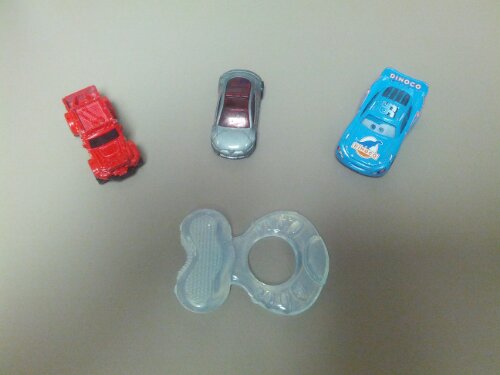
They’re in a hurry, the kids are screaming, I’ve got ten minutes to chart on all four before we close down the office–I didn’t notice that Little Johnny left behind his toy car.

By the time I find the toy the next morning when I’m tidying up my office before new clients, I can’t say for certain whose toy it was–and the client is long gone.

I don’t make too big a deal of it.

Life happens.

image

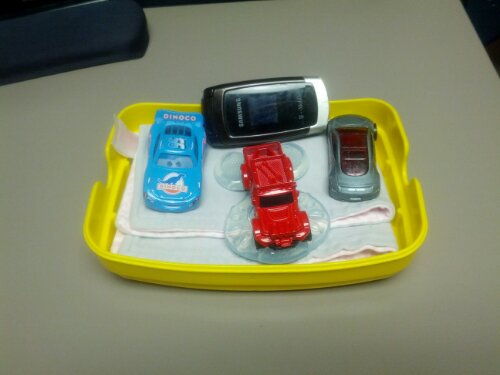
I collect the detritus in a corner of my desk.

So far, I have

  • 3 matchbox cars
  • 1 teething toy
  • 1 flip phone without a back
  • 1 gray and pink burp cloth

They nestle carefully in the shape sorting lid from my bucket, reminding me that sometimes you lose things and sometimes you gain things–but, generally, life happens.


Recap (6/8/2013)

Books added to my TBR list:

  • Equal of the Sun by Anita Amirrezvani (reviewed by Elizabeth of 5M4B)
    What looks like a fascinated fictionalized glimpse into the court intrigues of a sixteenth-century shah–through the eyes of the eunuch of a powerful (and power-hungry) princess. This sounds like a whole lot of fun.
  • Glimpses of Grace by Gloria Furman (reviewed by Lisa of Lisa Writes)
    Actually, I didn’t just add this to my TBR list–I rushed to Amazon.com and bought myself a copy. When it arrived the next day, I skipped washing dishes over lunch to read the first chapter. I need this look at the gospel in the midst of ordinary homemaking.
  • Where’d You Go, Bernadette by Maria Semple (reviewed by Jen E at Momma Blogs A Lot)
    An epistolary novel about a woman who runs away after her daughter wins a family vacation to Antarctica and a school fundraiser goes wrong. Jen E says:

    “I found myself relating to Bernadette a lot, which was a little bit scary for awhile there, but it also kept me rooting for her and her family. This is a great look at mental illnesses both perceived, ignored and real – and a story that shows the complexities of families, marriage, neighborhoods & the world.”

Recipes Tried:

  • Sweet Potato and Spinach Curry (from Serious Eats)
    The dish itself is vegetarian, but I added some beef and served it with quinoa. It combines two of the most spectacular “super-foods” and turns them from sides into a fantastic meal. This recipe produced a delicious sweet and spicy curry that I’ll definitely be trying again (although I’ll probably try either decreasing the cinnamon a smidge or increasing the other ingredients just a bit–it seemed just a little sweet to Daniel and I.)

Stuff I’ve Read:

  • If Dependence is the Objective, Weakness is an Advantage (Vitamin Z, quoting JD Greear)
    This is great–and great comfort for me as I endure a season of great emotional weakness:

    “God loves to use the weak because he loves to show off His power. That’s why he so often works by revealing our weakness, not showcasing our strength. He does not want to put our talents on display, because although that might impress people, it will not help them. So he chooses the weak to shame the strong, the simple to confound the wise, and sometimes he humbles the strong—so that our boast would not be in our strength, but in Christ as our righteousness, strength, provider, and security.

    The greater your weakness, the greater the chance for God to display His power.”

  • Challies asks if he’ll still delight in God’s sovereignty if…
    In a nice complement to Greear’s post above, Challies asks himself a series of questions regarding the strength of his belief in and delight in God’s sovereignty–when the story isn’t about someone else, but about himself.

    “Jonah, will you love my sovereignty even when you don’t see it as good? Or will you trust my sovereignty only when it gives you what you would have chosen anyway?

    Will you still rejoice in my sovereignty if I decree that you will be like her, if I call you to be the next Joni Eareckson Tada? Or are you quite certain that you can best glorify me by serving with an unbroken body?

    Will my sovereignty still be good if your neck is bent to the sword?

    Will you still declare your joy in my sovereignty if I sovereignly decree something that painful, something that shameful, for you or for someone you love?”

    A stunning and thought-provoking post.


Recap (6/1/2013)

Help Wanted:

Stuff I’ve Read:

  • The Most Important Type of Church (linked to by Lisa Notes)
    My husband and I have been asking ourselves what the most important aspect of the church is. What is the primary function or functions of the church? While mulling over these questions, I ran across this blog post. The author concludes:

    “The Bible doesn’t call us the Body of the Holy Spirit or the Body of the Word. We are called the Body of Christ and if we know that the the Bible is God’s very words and the Holy Spirit is the indwelling of Christ in us, well then it seems that Jesus should and must come first.

    A church relying mostly on the Bible or mostly the Spirit, or teaching only tenants of Christ, but not living them out, is broken, lop-sided, and lacking.

    The more I have begun to grasp the necessity to cling to the Person of Jesus and seek Him and His headship over everything else, the more I have felt a part of the church…the more I have felt whole as a member within His body.

    The church where Christ is head is best. Everything else is just secondary.”

    Of course, how that practically plays out within a church body is somewhat difficult to quantify.

  • The Indulgence Box
    Tim Challies writes about the difference between the view of justification typified by the indulgence box and the view of justification Martin Luther was developing from his reading of Scripture:

    “Indulgences came to typify the widening gulf between the church’s teaching on justification and Luther’s new and growing understanding.

    Its significance is found far more in what it represents than it what it actually is. The pennies that slid through the slot and into the coffer represented a gospel of salvation by works, a gospel foreign to the Bible, a false gospel. Luther had recovered the great doctrine of justification by grace alone through faith alone, and there would be no place for indulgences and no place for meritorious good works.”

    The entire article is worth reading.

Books added to my TBR list:

  • The Thirteenth Tale by Diane Setterfield (reviewed by Susan at Girls in White Dresses)
    I’m pretty sure I had this one on my list already, but Susan’s review convinced me to bump it up to the top again. Her conclusions?

    “So many threads to this story — twins who are separated, a gothic mansion, a fire, tragic accidents, plots twists (most of which I didn’t see coming; I love that in a story!), and more.

    Read this if you like a well-written, good story. Thirteenth Tale delivers!”


Rabbit Trails and Fertility Data

One of the many reasons I love my husband…

When I assert that I doubt white fertility rates reach replacement level anywhere in the developing world, he challenges me to a race to determine if this is true in the US.

For those of you uncertain about the concept of “replacement rate”, this is the number of children a woman would have to have to keep the population stable. In most developed countries, this rate is about 2.1

Daniel beat me (finding this CDC dataset), but the challenge led us to making an excel spreadsheet to evaluate which states, if any, were reaching the replacement rate (irrespective of race).

Our results showed that nine states and four US territories have fertility levels at or above the replacement rate.

Oklahoma came in closest to the replacement rate, with 2.105 children born for every woman of childbearing age. Nebraska, Hawaii, Kansas, and Texas were next up, with approximately 2.15 children born for every woman. Idahoan and South Dakotan women had about 2.25 children each; while Alaskan women have 2.35 children each. Utah tops the count, with 2.45 children per woman.

I don’t find this information particularly surprising. In general, states that exceed the replacement rate are conservative, Bible-belt or Mormon states with a heavy emphasis on “family values”.

More interesting to me was the knowledge that Northern Marianas, the Virgin Islands, Guam, and American Samoa have very high fertility rates. In fact, the last three on the list have the highest fertility rates in America, ranging from 2.49 to 3.11.

Why is this, I wonder? Could this be evidence supporting my assertion that developed countries tend to have fertility levels below replacement rate while developing countries (and maybe developing territories too?) have fertility rates above the replacement rate? Could this support my assertion that white fertility rates (especially in developed countries) are less likely to reach replacement rate than those of other races and ethnicities?

I’m just going to have to see if I can find some kind of data on the fertility rates of different nations around the globe.

Well, wouldn’t you know…the CIA keeps record of such things and the
CIA list of fertility rates can be found on Wikipedia.

Of the 34 countries listed by the CIA as “developed countries”, only four meet the replacement rate: Israel (2.67), Faroe Islands (2.4), South Africa (2.28) and Turkey (2.13). Of these, South Africa’s black peoples exceed the replacement rate, while their white peoples have a total fertility rate of only 1.4-1.8 (per table A3 in this report from Statistics South Africa). Both Israel and Turkey are difficult to classify racially, since their residents often have white-toned skin but claim a variety of ethnic backgrounds. Only the Faroe Islands is undeniably white.

Additionally, of the 117 nations listed in the CIA Factbook as having fertility rates of above the replacement rate for developed nations (note that replacement rate is higher in less developed countries where mortality is higher), only four can potentially be called “White”. Three of the four are from the “developed country” list: the aforementioned Israel (2.67) Faroe Islands (2.4), and Turkey (2.13). Kazakhstan (2.41) is a newcomer to the mix, being composed primarily of Turkish ethnicities but with a substantial population that could be called “white”.

So my original claim (that I doubt there are any countries in the developing world where white fertility rates reach the replacement rate) is not true. The Faroe Islands almost certainly has white fertility rates above the replacement rate.

On the other hand, my underlying premise does appear to be true. Overwhelmingly, the developed world has fertility rates below the replacement rate–and primarily white nations are exceedingly unlikely to have fertility rates above the replacement rate.

So there you have it. Rabbit trails I’ve taken tracking fertility data.