Nightstand (September 2011)

I am happy to announce that I read everything I showed you in my picture last month (except for the books I own which are still in progress.) I pretty much never do that.
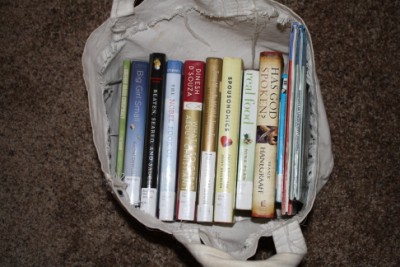
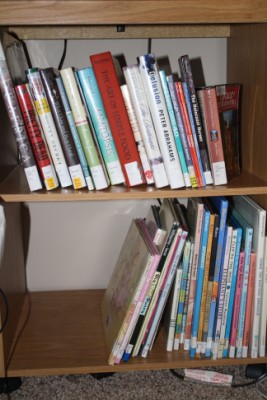
Books in progressBooks in the wings

Adult Fiction

  • Delusion by Peter Abrahams
    My second book by Abrahams, this one actually lived up to the designation “suspense”. I enjoyed this tale of a woman whose life unravels when a new bit of evidence releases a man who has years before been convicted of murder on the basis of her testimony.
  • Big Girl Small by Rachel DeWoskin
    When I reviewed Big Girl Small earlier this month, I couldn’t decide whether or not to recommend this book about a teenaged little person who finds herself the topic of a national scandal. It’s got some very mature content–and I’m not sure that the good is enough to outweigh the bad.
  • Job’s Niece by Grace Livingston Hill
    The least romantic GLH I’ve read so far. Included a very interesting page on dispensationalism. Yes, Carrie, I do enjoy these-and it is somewhat incongruous.
  • The Birthright and The Distant Beacon by Janette Oke and T. Davis Bunn
    I’m almost done with my library’s collection of Janette Oke–this is the last series (I think). I’ve been enjoying the series, but I’ll be glad to be done.
  • Amy Inspired by Bethany Pierce
    Sherry gave a rave review, Barbara a rather more subdued one. I agreed with both.

Adult Non-fiction

  • Dave Barry Turns 40
    I’ve gotta be almost done with Dave Barry’s 817s. Gotta.
  • Cats of Africa by Bosman and Hall-Martin
    Lovely paintings and drawings by Bosman, interesting text by Hall-Martin. It’s a coffee-table type book, but stuffed full of information about the 10 species of cats found in Africa: the cheetah, the leopard, the lion, the caracal, the serval, the black-footed cat, the African wild cat, the swamp cat, the sand cat, and the African golden cat.
  • Beaten, Seared, and Sauced by Jonathon Dixon
    A project memoir focused around the author’s chef’s training at the Culinary Institute of America. Reviewed here.
  • What’s So Great About Christianity? by Dinesh D’Souza
    Definitely a fascinating defense of Christianity. I’ve excerpted liberally in the following posts: The Future of Christianity, Christianity and the West, and Christianity and Science
  • Spousonomics by Szuchman and Anderson
    An absolutely fascinating book applying the principles of economics to marriage. A single woman, I’m not the target audience for this book. But I laughed my way through (Szuchman and Anderson are hilarious)–and even ended up applying my new-found knowledge of loss aversion to my computer-building trials.
  • American Spartans: the US Marines in combat from Iwo Jima to Iraq by James A. Warren, read by Dick Hill
    A fascinating history of the modern corps. I was rather amazed at the Corps’ ability to adapt to the wide variety of combat conditions they’ve faced throughout the past century. I was also rather amused at how the reader’s “Marine quoting” voice was gruff with a Southern accent.
  • The Art of Simple Food by Alice Waters
    I may pick this cookbook up again when I have more time to spend cooking. For now, the only recipe I used from this book was a chicken salad. I chose it because its instructions read: “First, make a mayonnaise.” Those instructions were definitely not for a beginner. The end result was rather blah, but I’m not sure if that wasn’t my fault since my mayonnaise broke and I had to mix in an additional egg yolk to get it to re-emulsify. Like I said, I might have to pick this book up again to see if it’s actually any good.
  • There Must Be More than This by Judith Wright
    Should have been titled “There must be more than this book”. Wright tries to teach people how to live a life of “more” by getting rid of their “soft addictions”, but her formless “more” leaves something lacking. True fulfillment can only be found in Christ. All other quests for “more” fall short.

Juvenile Non-Fiction

  • The Holocaust Heroes by David K. Freman
    Another title in the Holocaust Library series. Not sure whether they’re getting less good as I read more or whether it’s just the repetition of the same material (within the same series of books) that’s making me perceive these last couple as not as well written.
  • The Nobel Book of Answers edited by Bettina Stiekel
    A collection of essays by Nobel prize winners. Some are okay, most are vapid, all are patronizing. “How Do I win the Nobel Prize?” by Mikhail Gorbachev is a real winner (NOT!)

Juvenile Fiction

  • Anatopsis by Chris Abouzeid
    I have a full review of this dystopian novel in my notebook. Unfortunately, I haven’t yet transcribed onto bekahcubed. So, for now, I’ll say that I give it four stars–and kudos to the author for writing a non-morally-neutral book with witches and warlocks (and gods and demigods, for that matter.)
  • Close to Famous by Joan Bauer
    A great little story about a girl with big dreams and big secret–and who manages to accomplish big things, with the help of some neighborhood kids and the famous movie star who hides out down the street.
  • Pretty Dead by Francesca Lia Block
    In my handwritten review, I write that of all Block’s books I’ve read so far, this is the one I’m most likely to recommend. Alas, I haven’t transcribed this review either. Which means I’ll only warn you that it’s a vampire novel and, like the rest of Block’s work, it’s rather edgy.
  • What I Saw and how I Lied by Judy Blundell
    I gave this YA novel set in post-WWII America four stars, recommending it for more mature and thoughtful audiences because of its weighty subject matter.
  • The Hooded Hawk Mystery by Franklin W. Dixon

Children’s Books

  • Cam Jansen and the Mystery of the Babe Ruth Baseball by David A. Adler
  • Picture Books Bi-Bl
    I read a few dozen of these, including the ever-amusing Chicken Cheeks by Michael Blake.

As always, there are still more books in progress or in the wings, preparing to be taken up for the next go-round!
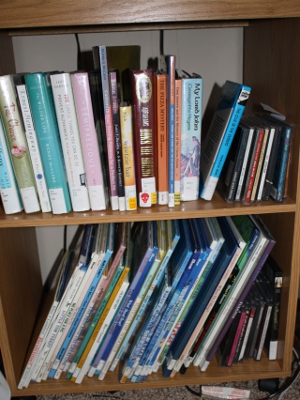
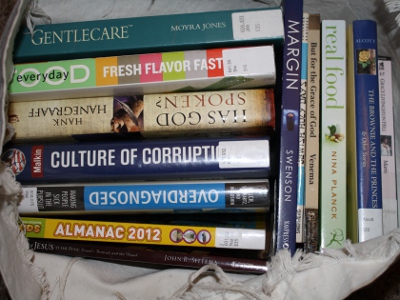
Books on NightstandBooks in travel bag

Don’t forget to drop by 5 Minutes 4 Books to see what others are reading this month!

What's on Your Nightstand?


Book Review: “Amy Inspired” by Bethany Pierce

Sherry’s review had me quickly placing a hold at my no-longer-local library, to be picked up the next time I was in town. Barbara’s review, read after the book was already in my possession but not yet read, had me itching to find out whose view I would take.

Amy Inspired, by Bethany Pierce, turned out to be everything Sherry had said it was–and everything Barbara described.

Amy is almost thirty, a single adjunct writing instructor who dreams of being a published author. Unfortunately, she is plagued with rejection letters and is in a perpetual state of writer’s block.

She gives an exhausted agreement to her roommate’s proposal to let an out-of-work friend crash at their place while his apartment is being fumigated for bedbugs–and ends up flabbergasted to discover that she’s just obtained a second roommate, a seemingly permanent fixture on the living room futon.

Eli is the typical starving artist, a brooding sort who ekes out a living as a coffee-bar barista while women swoon over his every step. Amy is not immune to his charms, but rather wishes she was, considering that he’s her roommate–and that he has a girlfriend (albeit a girlfriend who’s studying abroad and therefore not around).

As Sherry wrote, Amy Inspired has a very true-to-life ring to it. I couldn’t help but nod my head in recognition as Amy reads yet another freshman essay that makes absolutely no sense:

“Since the dawn of time there have always been forms of entertainments. And like most everything else, entertainment has been criticized since there existed a Being knowledgeable enough to know how to do it. In ancient times, Jesus was criticized by many of the people and even went so far as to crucify him by nailing him to a tree in front of all his fans.”

Yep, that’s freshman (or even sophomore) writing. (Three semesters teaching at the university level is more than enough to make a cynic of this particular lover of the written word.)

I felt as though Amy (er, Bethany Pierce writing as Amy) were writing my own heart when she described her thoughts after watching a marathon of “A Baby Story”:

“It made me want to scream and push, to be part of a miracle. It provoked cravings for the sweet powder smell of a baby’s hair. I told myself this was a biological phase on par with the hormonal revolution that made prepubescent boys ache at the sight of breasts and bucks chase doe tails right into oncoming semis. But still.

I’d tried praying about these feelings, but had a bad habit of praying tangentially…. All the years I’d wanted a husband, I prayed God would make me content as a celibate, confident that if He saw my willingness to remain forever His chaste servant, He would see fit to send me an unexpected blessing of a very handsome man….And now whenever the desire for a family of my own began to gnaw at my heart, I prayed for my students and thanked God for the brood He’d already given me.

Meanwhile, Valerie, who had never waited on God for a blessing in her life, was in the third trimester of her pregnancy and looked positively Rubenesque.”

When Amy goes to dinner with Eli, she orders beer to prove that she’s not the teetotaler he might think her because of her fundamentalist background. The exchange is essentially honest about the predicament that faces my generation of believers. Determined to not be legalists, we sometimes lose our identities trying to be all things to all men. So what if Amy doesn’t like beer? If she doesn’t order it, Eli might think she’s looking down on him, considering him an inferior Christian because he drinks. So she orders a beer, only to discover that the tattooed artist doesn’t drink.

For all that I can identify with in this book, there is certainly plenty that I can’t identify with. Amy’s Christianity is the Christianity I’ve seen in quite a few of my peers. She’s rejected her legalistic upbringing, but hasn’t quite figured out the spirit behind the law–which leaves her with a trembling hodge-podge of religious belief, but no cohesive theology out of which to live her life.

It is this, I think, that leads to some of the “edgy” scenes Barbara pointed out. Amy dates a nonbeliever, has a male roommate (for as long as Eli’s around), and reflects on past experience where she got down to bra and panties before putting a kibosh on sex. These are scenes I haven’t experienced (thank You, Lord!), but ones I’ve seen among the once-churched or quasi-churched of my acquaintance. Throwing off legalism, a young Christian culture has emerged that has little moral foundation except reactionism–resulting in dangerous skates to the edge of a precipice (and beyond).

And then there is Barbara’s objection to Amy’s “fundamentalist” background and its inherent stereotype. In truth, I couldn’t quite make out what the author presumes fundamentalism to entail. Apart from the brief comments about tracts in toilet paper rolls, True Love Waits campaigns, teetotaling, and not dancing, the majority of the references are simply to Amy’s childhood church “First Fundamentalist Church”–leaving the reader to fill in his own stereotypes.

In my opinion, this was the author’s great failing. Throughout the book, she does a fantastic job of showing rather than telling, of describing things so that the reader can experience them. Yet in reference to Amy’s childhood religion, she relies on the hackneyed “fundamentalist” stereotype in lieu of creating a flesh and blood congregation with real-live beliefs and practices. It’s rather disappointing.

Nevertheless, I felt that the upsides of this novel–its realistic depiction of life as a single young Christian and the author’s masterful use of language–definitely outweigh the downsides. This is a novel worth reading, both for enjoyment and as a means of understanding some of the struggles facing today’s single Christian (and the moral ambiguity facing many young believers who have uprooted themselves from legalism without being subsequently replanted in the fertile and stabilizing soil of the gospel of grace.)


Rating: 4 Stars
Category:Christian fiction
Synopsis: Amy, a single almost 30-year-old college-writing-instructor-slash-writer-who-hasn’t-been-published, finds herself thrown off-kilter by Eli, the artist who’s now sleeping on her living room futon.
Recommendation: Lovely writing, accurate depiction of many of the realities facing my generation of church kids, “edgier” (as Barbara put it) than most Christian fiction.


The best thing I ever did for you

As two-year-old Ronald sat on the Sunday School bench, his attention was arrested by the girl beside him. He looked over and thought to himself, “That Carol P is mighty pretty. When I grow up, she’s gonna be my girlfriend.”

One week later, he again found himself preoccupied with the girl on the bench beside him. This time, though, his thoughts took a different turn: “That Carol P is mighty pretty. When I grow up, she’s gonna be my wife.”

Sixty years ago yesterday, Ronald made Carol his wife.

When they were married, an older member of the congregation* gave them advice patterned after his initials: “Increase and Multiply.”

It took a few years for them to begin, but after Ronald came back from Korea, the increasing began in earnest.

Today, Ronald and Carol boast twelve sons and daughters, ten sons-and-daughters-in-law, 43 grandchildren, seven grandchildren-in-law, and a beginning spattering of great-grandchildren.

Increase and multiply, he told them. And multiply they did.

“You know what the best thing I ever did for you was?” Grandpa asks his grandchildren now.

We know the answer and respond on cue, “You married Grandma.”

Grandpa smiles contentedly. Yes, that’s the best thing he ever did for us.

This grandchild could add a bit more: He stayed married to Grandma.

It’s a romance that began eighty years ago, was sealed in marriage sixty years ago, and that continues on to this day.

Grandma and Grandpa kissing

It’s a romance that has blessed multitudes, not the least the 70+ progeny of Ronald and Carol Cook.


*My memory is a bit fuzzy about the details of the “Increase and Multiply” story. I trust my aunts will set the record straight when I err :-)


Christianity and Science: Notes from “What’s So Great About Christianity?”

The following are chapter synopses and short quotes from the third section of Dinesh D’Souza’s What’s So Great About Christianity? This third section is entitled: “Christianity and Science”


Chapter 8:
D’Souza argues that Christianity is based on reason–and that Christian theologians throughout the ages have been masters of reasoned defenses of Christian thought.

“My point is that the kind of reasoning about God that we see in Augustine, Aquinas, and Anselm is typical of Christianity. There is very little of this in any other religion. And out of such reasoning, remarkably enough, modern science was born.”

Chapter 9:
D’Souza states that a fundamental assumption of the modern scientist is that the world is ordered, logical, rational, and law following. He argues that this belief in an ordered natural universe is directly pirated from Christianity.

“God is sacred and made the universe, and the universe operates lawfully in accordance with divine reason. At the same time Christianity held that the universe itself is not sacred….The Christian universe is ordered and yet disenchanted. Moreover, Christianity…teaches that man was made in the ‘image’ and ‘likeness’ of God. This means that there is a spark of the divie reason in man, setting him apart from other things and giving him the special power of apprehending them. According to Christianity, human reason is derived from the divine intelligence that created the universe.”

Chapter 10:
D’Souza argues that the story of Galileo being persecuted by the church for his heliocentric theory is just that–a story.

“Galileo was a great scientist who had very little sense. He was right about heliocentrism, but several of his arguments and proofs were wrong. The dispute his ideas brought about was not exclusively between religion and science, but also between the new science and the science of the previous generation. The leading figures of the church were more circumspect about approaching “


Thankful Thursday: Order

Somewhere along the way, my life fell out of order. My to-do-list sprawled with things I couldn’t get done, my rooms filled up with clutter I didn’t have time or energy to deal with, my days became frantic jumps from aimless activity to aimless activity.

Yet, by the grace of God, things seem to be coming back into order.

Thankful Thursday banner

This week I’m thankful for…

new clothes hangers so that all my clothes can now be hung properly instead of piled about my bedroom.

newly-designed planner pages which help bring some long-lost order to my daily routines (and enable me to eat breakfast again!)

a long screw holding my towel rack up so I can again have some order in my bathroom

starting to catch up at work, which makes my days oh-so-less-stressful

scheduled evenings which counter-intuitively make my life more peaceful (that is, scheduled evenings that are consistent)

a God of order as opposed to a god of chaos

“Where were you when I laid the foundations of the earth?
Tell Me, if you have understanding.
Who determined its measurements?
Surely you know!
Or who stretched the line upon it?
To what were its foundations fastened?
Or who laid its cornerstone,
When the morning stars sang together,
And all the sons of God shouted for joy?
Or who shut in the sea with doors,
When it burst forth and issued from the womb;
When I made the clouds its garment,
And thick darkness its swaddling band;
When I fixed My limit for it,
And set bars and doors;”

~Job 38:4-10

The God who made the universe, who set its boundaries and ordered every star, this is the God I serve, the Lord of heaven and earth. Praise be to the King of Kings and the God of gods.


Cheeky Chickens and other animal ends

Parents of youngsters might not find Michael Ian Black’s Chicken Cheeks quite as fun as I did.

After all, since I don’t actually live with a little one, I don’t have to put up toddler and childhood potty humor ad nauseum.

Chicken Cheeks Book Cover

The format of this children’s book is simple–a picture of an animal together with that animal’s name and a corresponding euphemism for that animal’s bottom.

My favorites?

“Gnu Wazoo” and “Duck-Billed Platypus Gluteus Maximus”.

Yes, this book breaks my parents’ cardinal rule in dealing with juvenile humor: never let them know that potty talk is funny.

But, in this case, it is.

This book of “ends” is both amusing and imaginative.

Perfect for maiden aunts to spoil the minds of their nieces and nephews with :-)


Reading My LibraryI’m still reading my way through the children’s picture book section of my no-longer-local library. For more comments on children’s books, see the rest of my Reading My Library posts or check out Carrie’s blog Reading My Library, which chronicles her and her children’s trip through the children’s section of their local library.


Petty Prejudices

My sister’s a jewelry lady (she sells it with Premier Designs), and we were sitting around the lunch table one day when she mentioned that the other jewelry ladies say she should never leave the house without five or six pieces of jewelry on.

My knee-jerk-reaction (which, of course, I said out loud–will I ever gain control of my tongue?) was to say that I don’t like people who wear that much jewelry. I really can’t be friends with people who have so little style.

Not surprisingly, my dinner companions were aghast at my statement.

Really? I judge people that harshly?

One friend made a crack about her own lack of style, diffused the situation.

But the incident remained in my head, kept me asking myself why I reacted in that way.

The truth is, I sometimes (often?) have abominable style. How is it that I might hold others to a higher style-standard than I hold myself? Or do I really?

It took much rumination to get to the bottom of my reaction…but I think I finally figured it out.

My perception of people who wear tons of jewelry is that they’re trying really hard to be fashionable. I don’t try very hard to be fashionable. In fact, I regularly flaunt fashion and wear downright ridiculous apparel (particularly when I wear my pajamas to Bible study–a pink polo dress, white leggings underneath, a huge white sweater over top and fuzzy brown moccasins?)

When I see people that I perceive to be trying really hard, I presume that they would be embarrassed by me–so I never even give them a chance.

Sure, I’ll greet them when we’re introduced. I’ll say a nice hello. But I won’t really try to be their friend. If I see them in the hall, unless they approach me or somehow acknowledge me, I’m not going to acknowledge them.

I assume that I’d only mess up the image they’re trying so hard (and, in my opinion, failing) to project.

But is that really a fair assumption?

No. It isn’t.

That’s letting my flesh take preference over brotherly love. It’s petty prejudice and it’s ugly.

So, with my eyes now open to my own petty prejudices, I’m out to love the world–even the world who’s wearing five or more pieces of jewelry.


WiW: Secular Callings

My Facebook friends list is littered with seminarians, my blogroll full of homemakers raising children for the glory of God. Missional believers from all over have started in-house non-profits, have worked in church-based soup kitchens, have adopted orphans from overseas and stateside.

I can be tempted to feel inadequate, so secular.

I don’t have a noble religious calling. I have an ordinary sort of calling.

I’m a dietitian.

Sure, others have secular callings. The missional manuals encourage those to start a sacred mission either within or in addition to their secular work.

The prospect exhausts me. It’s enough I can do to just be a good dietitian. I want to serve the people at my workplace, but there’s only so much I can do and still do my job.

Matt’s comments (found here) help me put things in perspective:

“One additional word on skill: If you show love by being the first to order the pizza, or drive the van, or do whatever to serve people, but aren’t good at what you do, everything will fall flat. You have to be good at what you do. Good intentions are not enough…

If we want to glorify God in our workplaces, we need to learn from the best thinkers in our fields, whether they are Christians or not. And, this creates a better testimony to the gospel.”

God does not demand that I set aside my job or set aside my field in order to be a witness for Him in the workplace. In fact, He asks just the opposite.

To glorify God in my workplace is to be the best dietitian I can be. To glorify God in my workplace is to love my coworkers by doing my job well, to love my residents by caring for their nutritional needs in the best possible way.

Yes, it is not enough that I merely be a good dietitian–I must still share the gospel, must still demonstrate love in my interactions. But being the best possible dietitian is a primary means by which I can be a testimony in my workplace.


The Week in WordsDon’t forget to take a look at Barbara H’s meme “The Week in Words”, where bloggers collect quotes they’ve read throughout the week.


Snapshot: Route 66

I’m thrilled to be teaching the 2nd and 3rd grade Sunday School (about a dozen kids, mostly boys!) at my church.

We’re going through the books of the Bible with a curriculum called “Route 66” for the 66 books of the Bible.

Road Signs for Sunday School

In order to facilitate our quick trip (only 36 weeks) through the Bible, I’ve decorated our room with a road–with corresponding road signs.

In my head, the idea was good–but I was pretty apprehensive about how it would work. By the grace of God, it turned out even better than I expected!


Christianity and the West: Notes from “What’s So Great About Christianity?”

The following are chapter synopses and short quotes from the second section of Dinesh D’Souza’s What’s So Great About Christianity? This second section was entitled: “Christianity and the West”


Chapter 5:
D’Souza argues that Christianity is originally responsible for the concept of limited government and separation of church and state

“Augustine argued that during our time here on earth, the Christian inhabits two realms, the earthly city and the heavenly city….To each of these realms the Christian citizen has duties, but they are not the same duties….some remarkable conclusions follow….It means that the earthly city need not concern itself with the question of man’s final or ultimate destiny. It also implies that the claims of the earthly city are limited, that there is a sanctuary of conscience inside every person that is protected from political control.”

Chapter 6:
D’Souza argues that Christianity’s conception of the value of the ordinary but fallible individual has led to many of the features of Western civilization that we hold most dear, including separation of powers and checks and balances for governments, and capitalism as an economic system. (He also argues that the value of the ordinary but fallible individual led to giving family a prominent role in society, but I felt that his argument was hard to follow and rather weak.)

“…Capitalism satisfied the Christian demand for an institution that channels selfish human desire toward the betterment of society. Some critics accuse capitalism of being a selfish system, but the selfishness is not in capitalism–it is in human nature.”

Chapter 7:
D’Souza argues that Christianity is fundamentally responsible for the concepts of human rights and individual freedom.

“The preciousness and equal worth of every human life is a Christian idea. Christians have always believed that God places infinite value on each human life He creates and that He loves each person equally. In Christianity you are not saved through your family or tribe or city. Salvation is an individual matter…These ideas have momentous consequences.”