Read Aloud Thursday (June 2015)

We’ve been reading to Tirzah Mae since she’s been born, but even now she still isn’t tremendously interested in paying attention while we’re reading.

Erm… she’s not tremendously interested in paying attention while *I* am reading.

Papa was quite capable of keeping her entertained by reading The Wind and the Willows to her, complete with distinct snuffly mole and rat voices, while I was making dinner one night. I can already hear our children’s voices down the line, “Why don’t you read it like Papa does?”, to which I will be forced to reply that I simply haven’t the skill Papa does.

Tirzah Mae and I read board books checked out of the library.

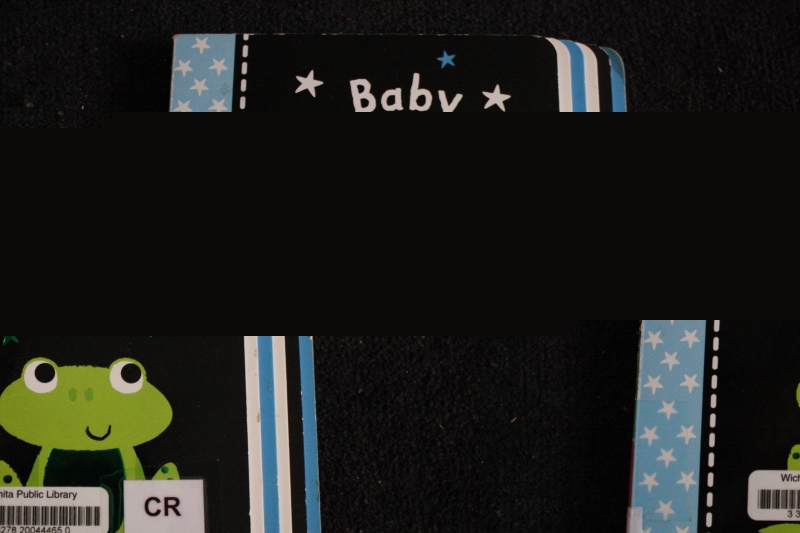
Baby Shine A Tiger Tales Book
Baby Shine

I thought this the biggest dud of all the books we checked out at the end of last month – pages contain a single word with a graphic or two, all in white, black, blue, green and metallic green. The words have little to do with one another, the book has no apparent theme except its color scheme.

But Tirzah Mae loved it. The metallic green caught her eye and fascinated her, especially when our distorted reflections showed up on its smooth surface. Go figure.

Opposites by Brian Wildsmith

Brian Wildsmith's Opposites

This was a smaller-than-usual board book with one or two pairs of “opposite” illustrations (and the corresponding “opposite” words) on each double page spread. Wildsmith is known for his nature illustrations, and these are delightful. In addition to the opposite words, there are plenty of things to point out – many different animals to name, certain animal behaviors to point out as normative (two young tigers wrestling) or as NOT (a pelican with a hippopotamus in his bill).

I will probably be checking this one out again when Tirzah Mae is older – I think she’ll enjoy it better when she can understand what we’re talking about. For now, the muted colors of the illustrations mean she frequently looks away while I’m reading.

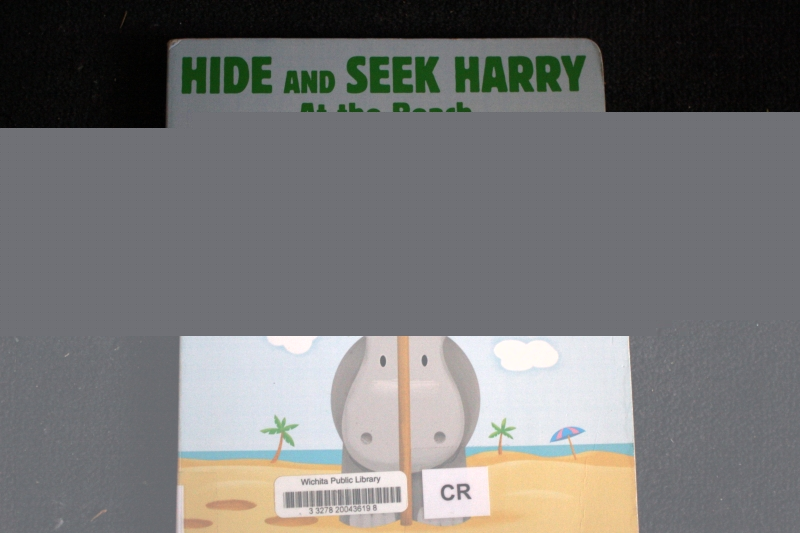
Hide and Seek Harry at the Beach by Kenny Harrison
Hide and Seek Harry at the Beach

A plot. Oh how I enjoy a plot, however simple!

Harry is a hippo, playing hide and go seek with his human friends at the beach. Being quite large, he never quite manages to hide completely (just as many toddlers and preschoolers have a hard time hiding themselves completely) – so he’s easy to spot.

Toddlers will no doubt enjoy the gentle silliness of this tale; and moms can also point out the various beachside gear found within the pages. Tirzah Mae, of course, was not quite so amused as a slightly older child would be.

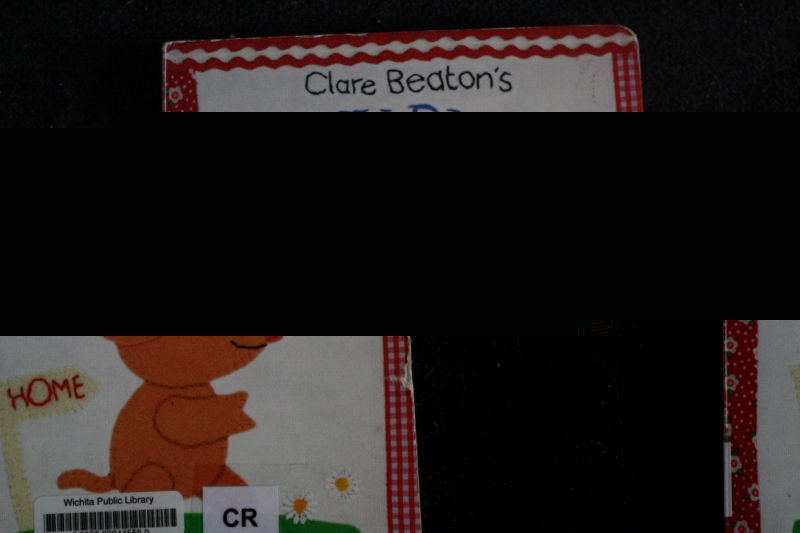
Clare Beaton’s Nursery Rhymes
Hide and Seek Harry at the Beach

Familiar and unfamiliar rhymes, one to a double paged spread, are accompanied by lovely appliqued and embroidered illustrations. I loved the illustrations (if I had the time and energy, as well as fewer projects already in my queue, I’d stitch up some similar pieces to ornament the nursery walls.) Tirzah Mae loved the cadence of the nursery rhymes (and that I played “This Little Piggy” on her toes when we got to that rhyme – one of her favorite games.)

Baby Loves to Boogie! by Wednesday Kirwan

Baby Loves to Boogie

This psychedelically colored book asks the question “Who likes to boogie?” before introducing a variety of animals who love to do a variety of dances (apes that orang-o-tango, moles who “dig it”). I enjoy dancing and think puns are fun, so I thought this was terrific. Tirzah Mae loves it when her mama rocks her about or dances with her, and enjoyed it when I drew out the “WHOOO likes to boogie” while squeezing her tight. Of course, we learn at the end that BABY likes to boogie.

For us, this book is just right. I find it enjoyable, Tirzah Mae finds it enjoyable, and it has just enough potential to keep it interesting as Tirzah Mae grows (learning about all the different animals, naming the different background colors on every page, learning about and maybe even doing each of the different dances – EELectric slide, anyone?)

Check out what other families are reading aloud at Read Aloud Thursday at Hope is the Word.


My Child “Choked”

Little scares a mother more than hearing that half-retching, half-coughing noise that she almost universally describes as “choking”.

But just because it scares a mother doesn’t mean it should scare a mother.

You see, that little cough/retch? That’s not choking. Generally, it’s gagging.

According to the Mayo Clinic, choking is “when a foreign object becomes lodged in the throat or windpipe, blocking the flow of air”. By definition, choking makes no sound, since no air is able to flow through a blocked windpipe.

Gagging, on the other hand, is a function of the gag reflex, defined by Merriam-Webster as “the reflex contraction of the muscles of the throat caused especially by stimulation (as by touch) of the pharynx”. Gagging is an involuntary reaction in which the the throat contracts to prevent choking.

Did you catch that?

Gagging prevents choking.

While the sound of gagging can make a mother’s heart jump into her throat, it isn’t a sign that something is going wrong with your child. It’s a sign that something’s going right. Your child’s body is working as it’s supposed to, protecting your child from choking.

What does this mean for the mother?

For one, it means you can breathe a sigh of relief. When I’m feeding Tirzah Mae and she gags on a bite, my heart leaps just like other moms’ hearts do – but since I know what gagging means, I can then relax and thank God that He created her body to help keep her safe.

For two, it means you need to be vigilant when feeding your child. A choking child isn’t going to give a cough to let you know to rush to her side. A choking child can’t breathe, can’t make noise. Which is why young children should sit down to eat and why mom should be right there beside them while they’re eating. Letting a child wander with snack in hand ups the choking risk in two ways: a child distracted by walking is more likely to chew insufficiently or to send something down the wrong pipe (I find this to be the case when I’m walking and eating) and a child who is wandering about while eating is not necessarily being supervised in such a way that a caretaker can quickly intervene were true choking to occur. (There are social and nutritional benefits of sitting down to eat as well, but I won’t go into those here.)

When I was working as a WIC dietitian, mothers mentioned choking often in reference to introducing solids to their babies. Often, mothers insisted that their eight to nine month old babies couldn’t eat anything but pureed baby foods because they choked on them. Of course, these moms didn’t realize that their children were gagging rather than choking. But what about their response? Is mom right to say that her child can’t eat a certain food or a certain texture because she gags on it?

Yes and no.

Gagging is an interesting thing. While the gag reflex is classically induced by touching the pharynx (that is, the soft tissue at the back of the throat), it can also be induced by smells (as of rotten food), by sight (as with seeing maggots), or even by a thought (such as the thought of eating rotten food or finding maggots in the bottom of your lunch pail). Additionally, some people have more or less sensitive gag reflexes – such that different textures, different smells, and different tastes cause them to gag.

For most children, gagging when introduced to a new texture is simply the body doing what it’s supposed to do, keeping foreign bodies from entering the airway. As a child becomes more adept with and used to the new texture, gagging should decrease. However, in certain circumstances, children with hypersensitive gag reflexes will have severe sensory issues with food which can be exacerbated by forcing a child to eat foods that stimulate their gag reflexes.

So what should mom do?

In general, if your child gags at the first taste of a new food (or first try with a new texture), I recommend waiting until your child is calm (which may be two seconds or may be much longer) before trying another bite.

If your child eats several bites of that new food, gagging two or three times throughout the feeding, this represents a normal response and there is no reason to stop feeding your child that food or texture. Gagging will become less frequent as the child becomes more familiar with the taste and/or texture of that food.

If, on the other hand, your child gags on three successive bites of the same food (or if your child turns away or clenches his/her teeth when you offer a bite), I recommend that you call it quits for the meal. This ensures that you aren’t creating unpleasant associations with that food in your child’s mind – those unpleasant associations can actually condition your child’s gag reflex to always respond to that particular food, a situation you definitely want to avoid.

Then, you’ll want to do a little Sherlock-style sleuthing. What do you think it was that triggered your child’s gag reflex? Was this a brand new flavor for your child or has he tasted it before? Was this a new texture for your child or has he had a similar texture before? If this was a brand new flavor, try mixing that food with another accepted food the next time you try it. If it was a brand new texture, try modifying the texture just a little bit the next time you try it (if baby has only had watery purees and baby gagged on a lumpy mix, offer a thicker puree before introducing a lumpy mix; if baby has only had purees with some lumps and gagged on chunks, try getting your child used to minced textures before introducing chunks; etc.) The goal is to ease a child’s transition into the next texture “level” or novel flavor.

It is valuable to continue working at introducing novel flavors and textures, despite the gag reflex (while being respectful of a child’s cues – remember to stop and try again later if a child gags on every bite or if the child turns away or clenches his teeth). Children who do not learn to eat textured foods by 8-9 months are more prone to persistent sensory food issues lasting into adulthood.

But what if your child does persist in gagging at every bite? This may be a sign of a hypersensitive gag reflex, in which case it would be worthwhile to ask your doctor about a referral to a multidisciplinary feeding therapy team that can evaluate causes of the difficulty and develop strategies for helping your child overcome these difficulties.


Nightstand (June 2015)

It’s been a decent month for reading and an excellent month for reviewing. I can’t remember a time when I’ve reviewed such a large proportion of the books on my Nightstand post. I’m going to blame my new scheduling/to-do system, which starts to make me think I’m getting a hang on this stay-at-home-helpmate/housewife/mothering gig. (Knock on wood :-P)

Fiction read this month:

  • The Isle of Swords by Wayne Thomas Batson
    Some kids from church recommended the author to me – and, while this book wasn’t spectacular, it was a clean fun adventure. Read my full review here.
  • The Sorcerer of the North by John Flanagan
    Newly minted Ranger Will is off to his first assignment – but he quickly needs to switch gears (and clothes!) His new mission is to find out all he can about the alleged sorcerer in a northern fief – while disguised as a jongleur. This book drew me in quickly, as all of the Ranger’s Apprentice series have. Unfortunately, it ended on a cliff-hanger when my library wasn’t open for me to get the next book!
  • The Little Prince by Antoine de Saint-Exupéry
    An absolutely delightful little book, complete with the author’s original illustrations. This was Amy’s pick for the Reading to Know Classics Bookclub this month – I’m looking forward to discussing it in the upcoming week.
  • 4 picture books author last name BROWN
  • 5 board books by various authors

Nonfiction read this month:

Books about Pregnancy, Birth, and Childrearing:

  • Vaginal Birth after Cesarean by Elizabeth Kaufmann
    Unhelpful. The author has a chip on her shoulder regarding her own VBAC, which she agreed to reluctantly and was not pleased with. But even beyond that, the circumstances against which the author rages no longer exist in our current medical system. Read my full review here.
  • Bouncing Back after Your Pregnancy by Glade Curtis and Judith Schuler
    I wish I could recommend this, as it is the best laid out of all the post-pregnancy books I’ve read. Unfortunately, it’s filled with misinformation. Read my full review here.
  • Sleep: The Brazelton Way by T. Berry Brazelton and Joshua D. Sparrow
    Gives a general idea of baby and child sleep patterns and specific advice for a variety of sleep issues. I wouldn’t recommend trying to follow Brazelton’s advice to a T, but it could be helpful as a collection of tips. You can read my full review here.
  • Getting Your Child to Sleep…and Back to Sleep by Vicki Lansky
    Lots of potential tips, but be aware that the author has a definite “children need to cry to learn to self-soothe” bent. Also, the first chapter is an absolute modge podge (including advice to “set your TV for Sesame Street that a small child can turn on alone” as a solution to waking up early) deceptively titled “Newborn Sleep Patterns”.
  • Didn’t I feed You Yesterday? by Laura Bennett
    Former “Project Runway” contestant writes about raising 6 children in New York City. She doesn’t give advice (and if she did, you wouldn’t want it – she’s admirable in not being a helicopter mom, not worth emulating because, well, she doesn’t make any effort to train her kids at all.) But it is a very funny book if you can get past the crudeness. Full review coming soon.

Books about Christmas:

  • Christmas in Australia by World Book
    Because it’s starting to feel like Australian Christmas in Kansas :-)
  • American Country Christmas by Mary Ellisor Emmerling
    Lots of pictures of country-style decorating accompanied by bits of old-fashioned poetry about Christmas. Fun to peruse, wouldn’t want to own.

Other nonfiction:

  • Nesting: It’s a Chick Thing by Ame Mahler Beanland & Emily Miles Terry
    Homemaking anecdotes and ideas from a variety of women – with a particular emphasis on female friendships. I didn’t particularly like it, probably because I don’t have that kind of female friendships at present. Read my full review here.
  • Horrible History: France by Terry Deary
    A collection of gruesome trivia from France’s history through the eighteenth century. I think a preteen boy would probably like this a fair bit, but I had some reservations about using it as part of a history curriculum. Read my full review here.

Abandoned:

  • The Hole We’re In by Gabrielle Zevin
    I enjoyed The Storied Life of A.J. Fikry, so I thought I’d pick up the other adult novel my library had by Zevin. But I abandoned it after 70 pages (per Nancy Pearl’s guidelines in Book Lust :-) and my own “Read Every Book in my local library” rules). Those 70 pages started with a man making a major decision for his family (with significant cost to his wife) without even talking with his wife. Then he kept secrets from his wife, who in turn keeps secrets from her husband. Surprisingly (NOT!), there’s an affair before page 70. The couple’s children add to the hidden drama – the high schooler is secretly dating a black kid, even though she knows her parents wouldn’t approve. The older daughter is planning her wedding despite secretly hating her fiancee. Oh, and did I mention that this family is made up of “conservative Christians”? Yeah, it was definitely worth quitting.
  • Quick Food: Gourmet Recipes in Just 30 minutes by Jenny Fanshaw and Annette Forrest
    I flagged a dozen or so recipes (out of more than 300) but only ended up making one, which was so-so. The food was just a little too frou-frou for everyday eating (even if it’s quick to make.)

Reviewed from last month’s nightstand:
I don’t usually go backwards – but I had several books that I read last month but hadn’t reviewed or written up notes on as of the last Nightstand post

At the beginning of the year, I set up some forward-dated library holds for the books on the Reading to Know Classics book club list. Come the middle of the month, a little after the request comes active, I get a notice that such-and-such a book is on hold for me now. This month, I hadn’t received a notice as of Sunday and started to get worried that I wouldn’t get my book in time. I began to contemplate actually going to Carrie’s blog and figuring out which book I needed to get so I could get it by another route – and then I remembered. Next month is July – which means WE’RE GOING TO NARNIA! (And also means I have no need to go to the library to get a copy – I have at least two copies of the series here at home.) If you haven’t already made plans for July (and even if you have), may I suggest that you visit Narnia as well?

Don’t forget to drop by 5 Minutes 4 Books to see what others are reading this month!

What's on Your Nightstand?


Book Review: Bouncing Back after Your Pregnancy by Glade B. Curtis and Judith Schuler

Of all the books on postpartum issues that I have read so far, Bouncing Back After Your Pregnancy is the most comprehensive and well-organized. Topics flow from immediate issues to infant feeding to maternal nutrition and exercise to marriage and family topics to returning to work and planning your next pregnancy. I’d love to be able to recommend this book.

Unfortunately, the content is simply ridiculous and filled with misinformation. Episiotomies are assumed and, to read the chapters on immediate postpartum care, you’d think the episiotomy is really the most important part of childbirth (before and after). The exercises in the exercise chapter are laughable – some aren’t really much by way of exercise and several list the wrong muscle groups as the ones being exercised. No distinctions are made between strength exercises and stretching and no attention is given to grouping exercises into any logical pattern. And the breastfeeding advice…

Let’s just say the authors probably couldn’t be more anti-breastfeeding if they tried.

Bottle-feeding is listed first in the infant feeding chapter and great pains are taken to list every possible advantage of bottlefeeding and to minimize any possible disadvantage you might have heard. Once the authors get around to discussing breastfeeding, a bold section heading offers “disadvantages to breastfeeding”. Almost every bit of breastfeeding advice is given as a blanket statement that assumes breastfeeding is uncomfortable, messy, and inconvenient. Mothers are educated on “warning signs” in a breastfed baby – but not told what signs suggest that breastfeeding is going well. The authors only recommed breastfeeding for six months and reassure moms that the majority of mothers don’t go that long.

Bad breastfeeding advice and attitudes aren’t limited to the breastfeeding chapter. In the chapter on nutrition, mothers are given lists of foods not to eat while breastfeeding (actually, most breastfeeding babies will grow and thrive even if their mothers make NO changes at all to their diet – even if the mother is eating unhealthfully in the first place.) The chapter on returning to work mentions the possibility of pumping and gives a little advice, but the advice is incomplete and doesn’t offer any middle ground. Yes, I’d rather a baby get only breastmilk, even while his mom’s at work – but feeding formula while you’re away and breastfeeding at the breast when you’re with baby is better than weaning completely, and is TOTALLY doable (I’ve seen dozens of women, mostly Hispanic, who have very good success with this.)

So no, I can’t recommend this book. I’ve focused on the breastfeeding issues mostly because that is an area in which I have expertise, but the problems with the breastfeeding advice are just an example of the poor research and rampant misinformation found within this book.

I do NOT recommend Bouncing Back after Your Pregnancy.


Rating: 0 stars
Category: Postpartum health
Synopsis: A look at issues facing postpartum moms.
Recommendation: Full of misinformation. Not recommended.


Recap (2015/06/20)

In my spirit:

  • Realizing that just because my mom is far away doesn’t mean I can’t ask her for advice – she has lots of experience as a wife and a mother and a homemaker, and I can definitely learn plenty from her.

In the living room:

  • We’re getting close to being ready to build a house. Wild.

In the kitchen:

  • The avian flu has hit my local Dillons – eggs were an extra $1 per dozen this week!

In the nursery:

  • While I used to be able to say that Tirzah Mae only cried if she needed something (was hungry, was wet, was in pain, was tired), I can say so no longer. Tirzah Mae has discovered that screaming is a great way to communicate her frustration at not getting her own way.
  • Daniel put Tirzah Mae down for bed! He’s good at getting her to fall asleep, but she stubbornly refuses to stay asleep after he transfers her to her crib. We usually have to transfer her to me first and then I put her into her bed. This week, though, Daniel laid her down and she stayed asleep. Yippee!

In the craft room:

  • I’ve finally gotten around to making another sheet for Tirzah Mae’s crib (besides the one we got as a shower gift). I used this tutorial, which was easy to understand and worked well. If I ever make more, I will use woven fabric instead of jersey. Trying to sew the casing for the elastic was torture.

On the web:

  • My Child Feels Deprived of Junk Food – “Real Mom Nutrition”, by a fellow RD, is a great resource for moms who want to feed their children well. This particular scenario is one I hear often – and Sally’s guests do a great job of helping moms work through it.

Book Review: Horrible Histories: France by Terry Deary

Daniel heard Mike Duncan (a history podcaster who we both enjoy) mention this book as a child’s introduction to the French Revolution – so he requested it via interlibrary loan to review as a potential homeschool resource. Of course, that meant that I would review it as a potential homeschool resource – both since I would likely be the one using it and because I’m the one with more time for reading.

Horrible Histories: France delights in retelling all the, well, horrible things in France’s history through the nineteenth century. As such, it details not a few novel means of torturing and executing enemies, ridiculous and disgusting ways to cure diseases, and as many “potty” kings as possible. Yes, “potty” aka “mad” aka “crazy”. This is a British book, and includes not a few British colloquialisms.

Horrible Histories intersperses time-based chapters “Murky Middle Ages” and “Savage Seventeenth Century” with categorical chapters like “Kurious kings” and “Awful for Animals”. The majority of the chapters, up until the “Savage Seventeenth Century” are made up of anecdotes and trivia, such that I had a hard time placing the anecdotes within any historical context or meta-narrative. This, I think is the primary weakness of this book as a homeschool resource.

On the other hand, as Daniel pointed out when I discussed the book with him, many youngsters enter the world of history as lovers of trivia – and later go on to develop a thirst for the greater narrative (as he himself did.) This is very true. I can see a preteen boy loving the grotesque trivia, as well as the many little quizzes (not over the material, as if to test knowledge, but in order to impart information through a guessing game) and cartoons found throughout.

I don’t think I would deliberately put this book into a preteens hands, in part because its format isn’t my own favorite way of receiving information and in part because of the rather snotty attitude it has towards parents and teachers. That said, if I had a child who got interested in history and picked this up at the library, I doubt I would dissuade him from reading it. (Of course, if he started copping that sort of attitude toward me? We’d be having a little talk about the divine right of mothers.)


Rating: 2 stars
Category: Middle Grade History
Synopsis: A catalog of every gross or awful anecdote you can think of from France’s history through the eighteenth century.
Recommendation: I wouldn’t seek it out, but I also wouldn’t keep my child from reading it if he found it on his own.


Thankful Thursday: Help

Thankful Thursday banner

Due to Tirzah Mae’s clinginess at the end of last week, I delayed grocery shopping until the weekend (hoping that the clinginess would subside.) The clinginess continued, but Daniel agreed to come along and help out. And am I glad he did.

This week I’m thankful…

…for for Daniel’s help while shopping
He dropped me off at the library and sat in the car with Tirzah Mae while I ran in to drop off books and get new ones. He went in and bought our coffee (and some ground mustard) at the Spice Merchant while I stayed in the car with Tirzah Mae.

…that Daniel was with us when we got a flat tire
Yep. On our way from the Spice Merchant to ALDI, the passenger back tire went flat. Like, TOTALLY flat. It was undriveable, the rim was on the ground. But because Daniel was there and actually knows how to change a flat (versus me, who would have spent hours pouring over the owner’s manual trying to figure out just how to get the equipment out from under the seats), it wasn’t that terrible.

…for Oscar lending us a jack
One of the residents of the neighborhood we’d stopped in saw us systematically emptying our vehicle (Tirzah Mae’s big Diono Rainier had to be removed to get at the jack and tire iron and whatnot.) He came out to see what was up and loaned us his floor jack for Daniel to use while changing the tire. What a relief to not have to use the flimsy jack the vehicle is stocked with!

…for a full-size spare
If you’ve ever driven on a donut, you know the relief that is a full-size spare. We could drive comfortably through the rest of our errands, and even leave replacing the blown tire to a more convenient time this week instead of having to get it done that very moment.

…for Providence
Little trials such as these remind me of God’s providence. For every tribulation we face, a dozen more are forestalled. And even in our minor sufferings, God’s faithfulness can be clearly seen in every little (and big) help. May I ever be reminded, in those times when His providence is less visible, that His providence is nevertheless just as real.

“The Lord is my strength and my shield;
in him my heart trusts, and I am helped;
my heart exults, and with my song I give thanks to him.”
~Psalm 28:7 (ESV)


Book Review: Cut, Stapled, and Mended by Roanna Rosewood

The first chapter includes a sex scene, bodily possession, and a token reference to “a woman’s right to choose”. So I think it’s safe to say that Roanna Rosewood and I have very different philosophies of life.

The rest of this VBAC memoir confirmed that. From the beginning I was inclined to not like Rosewood very much. I felt somewhat heartened when she told the reader that though she’d been raised in the mystic spirituality of the hippy 60’s, she had considered it useless as an adult – but she quickly found that particular brand of spirituality again. Rosewood also has a antipathy towards doctors that transferred from her hippy heritage – one that I don’t share (I’m squarely in the Western medical establishment – I just believe that for the majority of cases, childbirth is not a medical event.) Furthermore, Rosewood has a complete lack of discernment regarding alternate practitioners.

The short of Rosewood’s story is that she intended to have a homebirth but didn’t prepare her body at all because childbirth is natural and why did she need to learn about it? Her waters broke to start labor, but then labor piddled around for days until her midwife insisted that she did indeed need to go to the hospital. There, she received a c-section. She felt great failure, didn’t bond with her baby, etc. etc. I felt like she set herself up for what she got.

Determined to have a home VBAC, Rosewood threw herself into physical preparation and childbirth education. She learned the stats and became one of those annoying VBAC proponents (yes, I say this with tongue in cheek). She actually learned about the stages of labor and management techniques this time around. She walked like her midwife encouraged her to so she could have some strength and stamina when labor rolled around. And she engaged in every quack therapy you can think of (and some you can’t think of).

Her second labor followed the first’s example, and she ended up with a second c-section. This one was better, because she knew what to expect and had done some things to prepare. She had skin to skin, got started breastfeeding more quickly, etc. But it was still failure.

She didn’t plan to get pregnant the third time, it was an accident born of “goddess sex”. And she didn’t plan on keeping the baby, she just kept putting off taking the Plan B her doctor had prescribed. What she did plan was a home birth, acting expressly against the policy of the OB she was also seeing, in case she needed to deliver in the hospital. This pregnancy actually seemed more medically risky – she bled clots early on and had various other scary signs – but this time she did some inner work in addition to the physical stuff. She discovered that she was a bitter woman who pushed other women away, that she had never learned how to relax and just be, etc. So she went on a voyage of emotional and relational discovery (including a “goddess week” in Hawaii). Then she had a successful home birth when her inner goddess pushed for her.

I don’t recommend this story. Rosewood is a flake. Both her methods and her beliefs are highly suspect.

Which doesn’t mean that I didn’t have a takeaway. The truth is, childbirth isn’t simply a physical thing. A woman’s mind and emotions do impact the progression of labor – and it’s important to not ignore that. Relationship with your labor support is important. Having a goal beyond “not failing again” is important.

That said, there are many differences between Rosewood’s sections and mine. I do not feel my c-section was a failure. It was not forced on me, I chose it. While Rosewood experienced a very difficult labor after premature rupture of membranes, I never went into labor. Rosewood’s initial experience of premature rupture of membranes followed by stop and go labor was repeated in each of her pregnancies. At present, I have never gone through labor and have no reason to expect that my labor should not proceed normally.

I will be preparing for my first labor and delivery, which just happens to be after a c-section. Rosewood was trying to correct what she’d done wrong in her first labor and delivery in order to avoid the undesirable outcome she had. It’s a very different experience – and one that causes us to have very different mindsets from the outset.


Rating: 1 star
Category: Childbirth memoir
Synopsis: Rosewood tries for a home VBAC twice – and learns that childbirth isn’t just physical.
Recommendation: I don’t recommend it.


Powerful Dreams

I watched paralyzed as she dunked my little brother again and again under the bathwater. He struggled and then went limp.

When at last she relented, he was alive but not alive.

My bundle-of-energy, always-sociable, never-without-a-grin-and-a-fresh-face-scrape brother was an automaton, going through the motions, but no longer with any sign of his former animation.

Then I awoke. It was two in the morning. I could check on him in his crib, but that wouldn’t do any good to reassure my troubled mind, my racing heart. When he was sleeping was the only time John didn’t display his characteristic energy – the energy the faceless old woman had robbed from him in my dream.

I went into the living room with my Bible, turned on a lamp, curled up in the couch and read. I started in Matthew. By the time I reached John, I had at last calmed enough to fall back asleep.

Nevertheless, the dream continued to haunt my future, when any ordinary occasion could make my heart race again with fear for my little brother.

Other times I dreamed of friends, family members sinning against me or against another loved one in terrible ways. I’d awaken knowing that it was only a dream, that nothing had happened, that my friend or family member was innocent of the nightmarish accusations. But I struggled nonetheless to avoid hurt, anger, and bitterness towards those who had offended in my dreams.

Yet other times, I dreamed that I was engaging in some illicit act, taking pleasure in evil. Even when I knew it was only a dream, that I had neither done the evil deed nor chosen the wicked contents of my dreams, I felt ashamed, guilty for what I’d done in my sleeping dreams, for how I’d enjoyed what I truly abhorred.

Dreams are powerful because they’re not under our control. They’re powerful because while they aren’t reality, while we can know they aren’t reality, we still experience them as reality while we dream – and still feel the effects of those experiences once we awaken.

I am usually a rational person. I like to think things out. I like to believe things based on thoughtful consideration. But dreams circumvent my thoughts and go straight to my emotions.

When I dream, I’m not relating to the world through what I know to be true. I’m relating to the world through my emotions. And when I wake up, those emotions, those responses are still there.

And just like when I first started dreaming these powerful dreams, the Word of God is the antidote.

It is insufficient for me to tell myself that my brother is fine, that my sister hasn’t done something horrific, that I haven’t rejoiced in something perverse.

Instead, I must steep myself in the character of God, in the reality of sin, and in the hope found in the cross of Christ.

In himself, my brother is a dead man walking, devoid of life. But in Christ, he is a new creation, a new creation such that neither disability nor death can rob him of life.

In herself, my sister is a sinner who offends against me and God and others. But in Christ, she is a saint who is being transformed more and more into the image of Christ.

In myself, I do indeed glory in the worst of debauchery. But in Christ, I was created for good works and delight to do God’s will.

Yes, I need to know that the dream is not reality. But even more, I need to know that sin is real – and the solution is real.

Christ died for sinners. For me, for my family, for faceless women who abuse children. If anyone is in Christ, he is a new creation. Me, my family, the person who tried to hurt us. No one can kill what God has made alive in Christ. Not me, not my family, not anyone.

“For I am sure that neither death nor life, nor angels nor rulers, nor things present nor things to come, nor powers, nor height nor depth, nor anything else in all creation, will be able to separate us from the love of God in Christ Jesus our Lord.”

~Romans 8:38-39

That’s the truth, more powerful than any dream.


Book Review: Vaginal Birth after Cesarean by Elizabeth Kaufmann

What would you do if you had a cesarean with your first child and just happened to get pregnant with your second child when a national push to lower cesarean rates was forefront in everyone’s mind? Your doctor says you’re a good candidate for vaginal birth after cesarean (VBAC), your HMO wants to pay less money (and is therefore rooting for vaginal birth), and societal pressure pushes you toward VBAC.

In Elizabeth Kaufmann’s case, she reluctantly agreed to a trial of labor with certain stipulations. The VBAC was successful, but the baby was delivered with forceps and Kaufmann experienced significant tearing.

Then, she wrote Vaginal Birth after Cesarean: The Smart Woman’s Guide to VBAC to keep other women from experiencing the horror of vaginal delivery.

Or at least that’s how this book seems. While Kaufmann does share some potentially useful information regarding cesarean sections, VBACs, and repeat cesareans, every page is infused with her experience and subsequent antipathy toward anyone suggesting that a woman who is a good candidate for VBAC should indeed go through a trial of labor.

Who does Congress, who does the HMO, who does the doctor think they are to tell a woman how she should give birth? Since when should medical standards or money be a factor?

But those are political topics that I won’t go into here.

The part that makes Kaufmann’s book most unhelpful to the modern-day mama who wants information about VBAC isn’t her obvious bias, though. It’s that the world Kaufmann is raging against doesn’t exist.

In 1996, when this book was written, VBAC was supported by medical policy and by insurance companies – and doctors were employing the same active management to VBAC as they were (and still are) to other vaginal deliveries. Women were being induced with Cytotec, Cervidil, and pitocin. Labors that weren’t progressing according to Friedman’s curve (an antiquated description of the labor process based on a significantly different population than today’s moms and describing labor under significantly different circumstances than either normal or currently managed labors) were augmented with Pitocin. Surprisingly (can you hear the sarcasm?), these women whose VBAC attempts were managed thus ended up with increased labor and delivery complications.

And, of course, the good people who write policies decided that meant VBAC wasn’t quite as good an idea as they’d originally thought, so they set new policies in place to make it hard to try a VBAC, much less to succeed at it.

And that’s where we’re at now.

Few women are being coerced by doctors or insurance plans into having unwanted vaginal deliveries. Instead, many women who would love to deliver normally and who have a good chance at being able to, were the natural processes allowed to unfold naturally, are being denied the possibility of VBAC.

So Kaufmann’s book is simply unhelpful. It is written to try to give women who were feeling coerced into VBAC an out – but women aren’t being coerced into VBAC these days. The situation is quite the opposite.

For those who are interested in the history of VBAC, the Well-Rounded Mama has an excellent overview


Rating: 1 star
Category: Medical/childbirth
Synopsis: Kaufmann has a chip on her should and rages against VBAC policies that no longer exist.
Recommendation: Singularly unhelpful for the modern woman interested in learning about VBAC.