Tirzah Mae’s Birth Day

I’d already told Daniel I wanted a c-section, but he paid me no mind. I told him that as I cried angry tears, frustrated that I couldn’t stop shaking.

Maybe it was the IV magnesium – they’d said it could give one the shakes – but I hadn’t had a problem with my first dose a week earlier. Maybe it was the cervidil that was attempting to ripen my cervix. Or maybe it was that my condition was rapidly deteriorating – the reason we were inducing at 32 weeks.

Whatever it was, I was weak and out-of-control and I knew that I would need a c-section.

Daniel, knowing how set on a vaginal delivery I’d been, ignored my emotional outbursts.

Then, around midnight, in a rare break from the shaking, I explained myself more rationally.

I was shaking uncontrollably. I couldn’t move my limbs because they were so full of fluid and because I was hooked up to so many monitors and IVs and catheters. I was weak from 8 days of hospitalized bed rest and a week and a half of modified bed rest before that. Between the preeclamptic visual disturbances (poor color vision and dancing lights) and the fluid filling my face, I could barely see. If I was this much of a mess before we’d even gotten my cervix ripened, there was no way I’d make it through Pitocin-induced contractions to deliver vaginally.

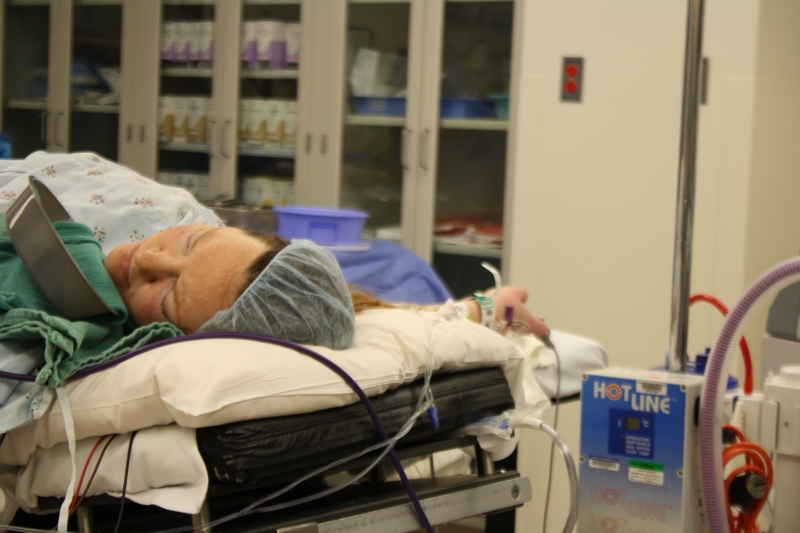
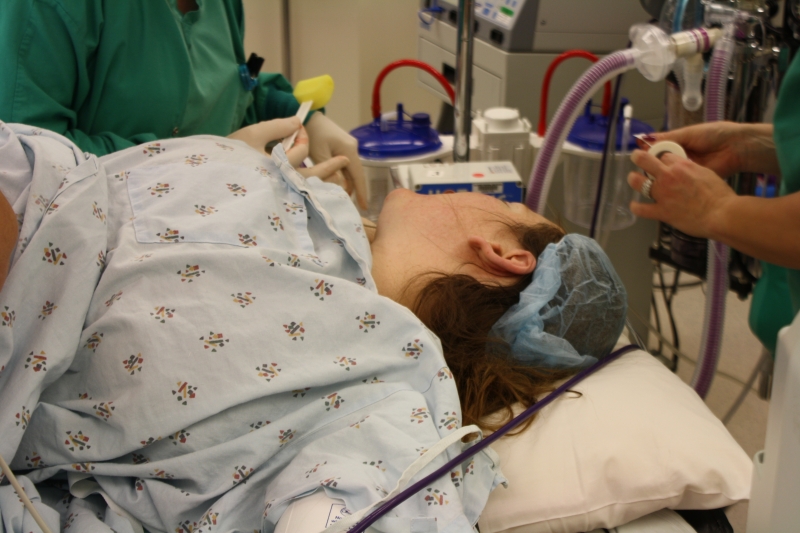
Prepping for the c-section

Hearing my calm explanation, Daniel agreed – we would ask for a c-section.

Dr. Tackett came in to check on me – and I told him our decision. He agreed that my request was reasonable. They’d prepare for a c-section.

I had no idea what to expect with a c-section. Until that day, I’d planned for a vaginal delivery. So everything was unfamiliar as they wheeled me into the operating room, made me drink a foul-tasting beverage to neutralize my stomach acid, and had me lie very still on my side while they administered the spinal block.

Ready to vomit

Daniel was there at my head, holding my hand and looking over the curtain along my chest to see the operation.

I felt tugging, I heard a gasp and Daniel asking “Is that the water breaking?”

No, Dr. Jensen replied, he hadn’t even cut into my uterus yet. The water was ascites – excess fluid in the abdominal cavity, indicating that my liver had shut down.

There was more tugging, and the announcement that it was a girl – followed by “And her umbilical cord is wrapped tightly around her neck twice.”

I was overwhelmed with thankfulness – thankful that our baby was born, thankful that we’d chosen a c-section instead of having an emergency one once she’d shown distress.

I don’t remember hearing her cry, but she had to have – I read it in her Apgar scoring when I was reading through her chart later on. I do remember Daniel announcing her name in response to one of the medical staff’s questions – she was Tirzah Mae Eloise.

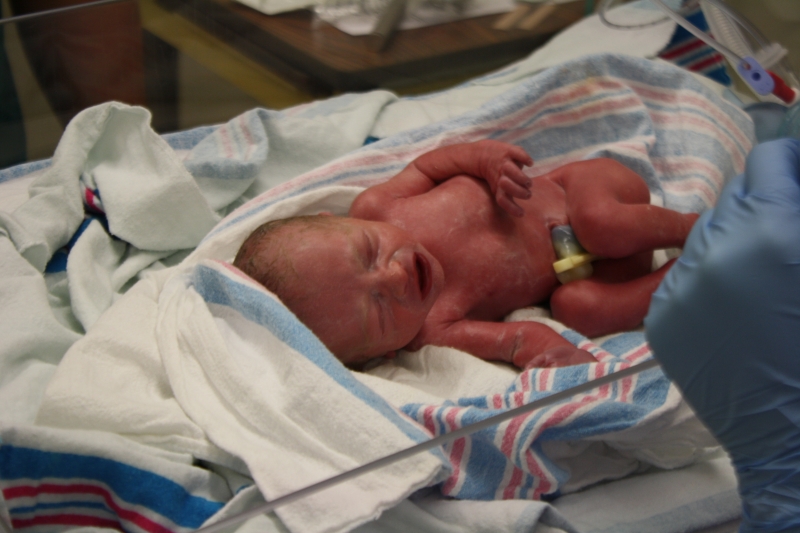
Pink and crying

Then Dr. Jensen was telling me he was sewing me double tight so I can have that VBAC – and I was again overwhelmed with thankfulness . Thankful that we had a relationship with the doctor who did our c-section. Thankful that he knew our desire to deliver vaginally. Thankful that he believes in VBAC and has helped many women successfully have them.

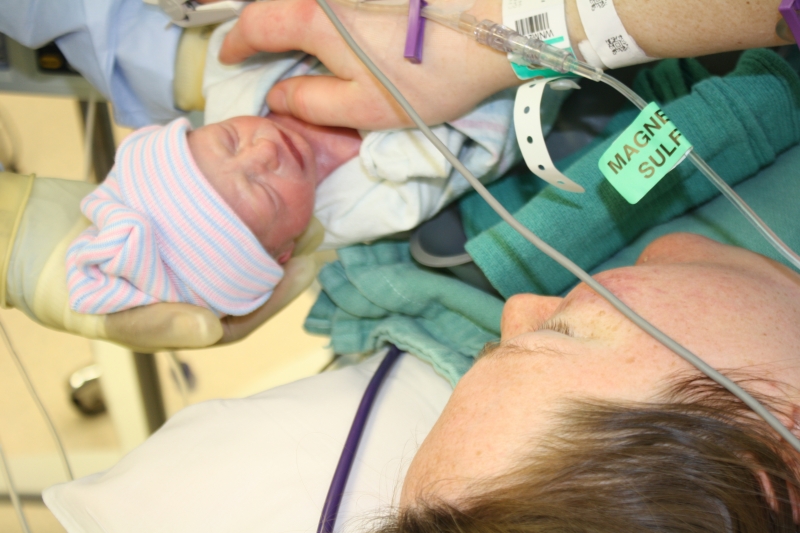
They brought my daughter close so I could see her and touch her. Still weak and uncoordinated, I flailed my arms in her direction – and stuck my finger in her eye.

Mama's first look

She was so tiny, so red, so clearly not supposed to be out of the womb. But she was alive – my daughter had been born.

“Daughter,” I told her. “I love you, my Tirzah Mae Eloise Garcia.”

They took her off to the NICU and wheeled my bed into the recovery room.

To be continued at a later date…


The Incarnation: God become infant

** This post was copied from our Christmas letter this year – so don’t feel bad about skipping it if you’ve already read it. Otherwise, you are definitely obligated to read it in its entirety :-) **

It’s cliché to talk about how having children changes your view of God – but having a newborn this Advent season has definitely given me a whole new perspective on the Incarnation.

God became man. It’s a weighty thought any time – but this Advent, I’m struck with the reality that God became infant.

Part of being a human is having physical and psychological needs – a need for food and clothing and shelter, for comfort and companionship. And part of being a human newborn is having no way of fulfilling those needs by oneself – and only one way of expressing those needs to others. An infant cries.

As Tirzah Mae squalls in her bed or on a blanket or in my arms, I contemplate that Jesus – God Himself – cried. And as I run through the list of possible causes of Tirzah Mae’s distress, I contemplate that Jesus had an earthly mother who was just as clueless as I, who struggled to meet the needs of her newborn. I contemplate how the Creator of the Universe became dependent on His creation. What humiliation! And for what cause?

Philippians 2:6-8 tells us why Jesus came: “…though he was in the form of God, [He] did not count equality with God a thing to be grasped, but emptied himself, by taking the form of a servant, being born in the likeness of men. And being found in human form, he humbled himself by becoming obedient to the point of death, even death on a cross.”

Jesus had all the needs humans have save one. Everything my Tirzah Mae needs, He needed – except one thing. Tirzah Mae, perfect though she may seem, was born sinful, under the wrath of God. Jesus was not. He had no need to be saved from the wrath of God because He didn’t deserve the wrath of God. Yet Jesus Christ came, bore the humiliation of being a human infant so that He could go to the cross – so that He could bear the wrath Tirzah Mae and I deserve. I can feed and clothe and comfort my Tirzah Mae, but I can never save her. Yet Jesus – Jesus came as a little infant like her so that He could save her.

Cliché though it may be, as I reflect on and care for my wonderful early Christmas gift, I am reminded of the greatest Christmas gift of all – and I am thankful that God became infant in Jesus Christ, that God became sin in Jesus Christ, that God bore the penalty of my sin in Jesus Christ, and that in Jesus Christ my greatest need is met.

I pray this Christmas that we all may come to know the great salvation for which Jesus humiliated Himself.


2015 Reading Challenges

While I’m not setting grandiose plans for 2015, I do hope to participate once again in some of the book-related challenges and book clubs available in this neck of the internet – and I hope to participate with my church’s in-real-life book club as well.

L. M. Montgomery Reading Challenge To kick the year off, I’ll be joining with Carrie’s L.M. Montgomery Reading challenge – rereading one of the Anne books (I’m not sure which) and possibly making another Anne outfit for “Black Anne”, my American girl doll (named thus because I happen to own Addy, the original black American girl doll). I also may or may not find and read a book about Lucy Maud from my local library. It’s certainly not too late to participate yourself – check out Carrie’s opening post at Reading to Know.

Reading to Know - Book Club Participation in the L.M. Montgomery challenge happily doubles as participation in the RTK Classics bookclub – a monthly classics book club that participants are welcome to jump into for as many or as few months as they choose. We’re going with relatively short books this year, since most of the participants are busy moms. I hope to participate as often as possible – and will be hosting the November reading of Grimm’s Fairy Tales (I’ve started reading already – but you’ll be welcome to read only a few tales if you want to, so consider joining in at least for my month :-P). To see the complete list of reading selections for 2015, check out this introductory post.

The other challenge I know I’ll be wanting to participate in this year is Barbara’s Laura Ingalls Wilder reading challenge in February. I plan to read Farmer Boy and to make as many Farmer Boy inspired recipes as possible! Learn more about Barbara’s challenge here.

Apart from those, I’m laying low – except, of course, that I continue my ongoing quest to read every book in my local library (except the ones I don’t read.) I haven’t tallied my numbers or blogged progress recently, but I’m definitely still going strong!

Are you participating in some reading challenges this year? I’d love to hear which ones. Are you not participating in any reading challenges this year? Consider joining one of the above.


This Year, I have a Baby

Come January first of every year, I have a list of a hundred dozen things I want to do that year. Some years I even blog about those things.

Last year, I had a goal game.
Two years before that, I was going to do 2012 Things in 2012.

This year, I have a baby.

My Early Christmas Gift

That doesn’t mean I don’t have plenty of things I want to get done this year, plenty of things I’m not itching to get started on (or finish up). But it does mean that I’m not making any beginning-of-the-year resolutions.

Every year past, I knew that my grand schemes would peter out somewhere between February and April – and I was okay with that. Grand schemes are fun while they last and I have no problem abandoning them once they’re dead. Generally, I still glean a few good things, establish a few good habits, and get a few things done to make them worth their while.

But this year, I know that any grand schemes would never even hit the ground.

Two unplanned months of being a stay-at-home wife and mother of a newborn has taught me that.

I used to talk about all the things I would do once I was a stay-at-home and didn’t have to devote 40 hours of every week to an outside job. Now I’ve learned that I replaced a 40 hour a week job (teaching mothers how to feed their children) with a job that’s at least as time consuming (feeding my own child). Between pumping and breastfeeding and cleaning pumping supplies and dealing with spit-up, I’ve spent at least 40 hours a week over the past 8 weeks just feeding Tirzah Mae.

So I’m adjusting my expectations down.

Maybe come February to April (when my usual grand schemes are sinking into oblivion), I’ll be ready to scheme grand schemes again – or maybe I’ll discover that life post-newborn is still too taxing for grand schemes.

That’s okay.

I’m a different woman today than I was last year and the year before and the year before.

This year, I have a baby.

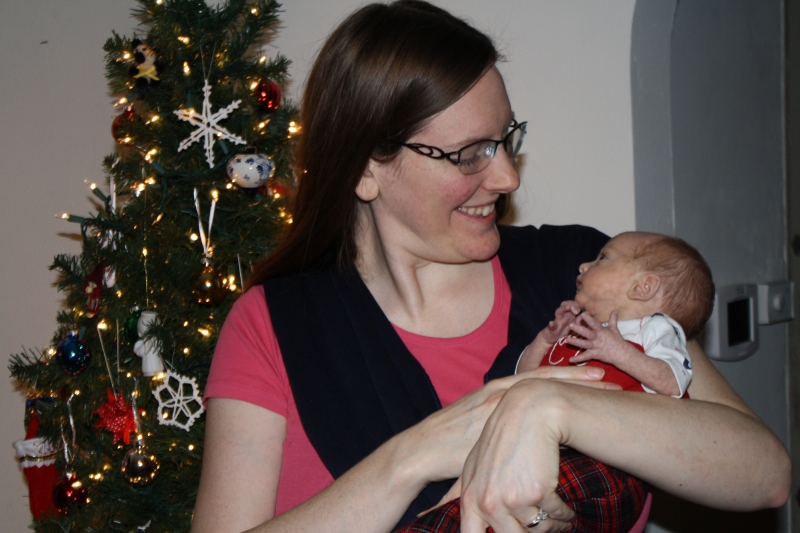
Gazing into each others' eyes

She’s changed my life. And that’s okay.


Book Review: Parenting with Love and Logic by Foster Cline and Jim Fay

“How to manipulate your kids into doing what you want.”

I was trying to figure out how to explain to my husband what Debbie and I had been learning from Parenting with Love and Logic as we read – and that was the best I could do.

The “Love and Logic” parenting style is one in which parents are consultants, establishing options within limits. The practical outerworking of this is that parents set firm limits by giving two options, both of which are acceptable to the parents and which can be enforced if the child decides to do nothing in response. For example, if a child is dawdling over a meal at a restaurant, instead of trying to force the child to eat (or make an ineffective threat “Do you want me to leave you here?), a parent offers the option: “We are leaving in fifteen minutes. Would you like to leave hungry or full?” In this case, the decision is in the child’s hands and the parent is okay with either choice. Furthermore, unlike the threat of leaving the child in the restaurant, the parent can actually follow through with letting the child go to the car hungry. The second part of the parenting style is empathizing with a child when he encounters problems and then handing the problem and its consequences back to the child. For example, when the above child complains later that he’s hungry, mom and dad sympathize “I’m so sorry that you’re feeling hungry. I often feel hungry when I skip a meal. Our next meal is at five, but if you’d like to buy a snack, I suppose I could accomodate that.”

Reading my summary above, the approach seems logical and appropriate. And really, I think there are lots of valuable applications of Love and Logic principles. But I did feel like a lot of the examples given in the book involved manipulating situations to get what you want from your kids. For example, the authors describe a parent who, after months of threatening, actually left his child at a restaurant. He’d planned in advance for a friend to be in the corner of the restaurant descreetly watching the child. And then there’s the parent who dropped her squabbling children off at the corner on the way home from school, insisting that she couldn’t drive with such a racket going on – the kids could either sit quietly and receive a ride or they could walk home. Of course, yet again, the mother had arranged for a friend to travel behind the kids as they walked to make sure they were okay.

The other part that felt manipulative was the prescribed language. According to the authors, Love and Logic parents sound like a broken record, always saying the same things. When they offer choices, they use language like “Would you rather…eat at the table or play in your room? …wear your coat or carry it?”, “Feel free to…join us for dinner when your room is clean.”, or “You’re welcome to…settle this argument yourself or we could draw straws.” When children refuse to make a decision when offered an option, the parents start the “Uh oh” song – “Uh oh, looks like you just chose to to go home hungry” – followed up with “Would you like to go to the car under your power or mine?” and “Uh oh, looks like you just chose to go under my power.” and so on and so forth. When a child defies his parents and the options they’ve given, the parent says “No problem!” (Honestly, I didn’t pay any attention to what comes next because, while I agree that it’s better not to let a child get and be aware that he has the upper hand in a conflict with his parents, I don’t see myself answering defiance with “No problem!”) When a child ends up experiencing consequences from his actions, the parent gives a pat response (that the authors insist cannot be pat but must be truly empathetic) of sympathy, describes how they feel when something similar happens to them, and then asks the child how they’re going to deal with it (or asks the child if they think there’s anything they could have done to have avoided it.)

Of course, I have to admit that the authors put me off in the second chapter and that may have influenced how I read the rest. You see, in chapter 2, the authors describe what they see as two ineffective parenting styles, helicopter parents and drill sergeant parents, before describing their own consultant parenting.

As I read, I was immediately transported to a screened-in awning in a campsite outside of Rocky Mountain National Park. Having had a rather unworshipful experience visiting a church during our last vacation (to Branson, Missouri), my father chose to have our own worship service on Sunday during this vacation. He prepared a sermon on lessons he’s learned as a parent – and he shared how he’d discovered that his parenting approach had to change as his kids grew older (lest you get the wrong impression, this was NOT the primary point of the sermon.) He said you have to be a helicopter while your kids are infants, from the time they start rolling around to when they start talking – you spend your time hovering, moving them out of dangerous situations and removing dangerous items from their path. In the toddler years, you have to be a drill sergeant – issuing orders of “Yes”, “No”, “Do this”, “Don’t do that.” According to my dad, reasoning with a child and giving them choices in this stage is silly. But as the child develops reasoning skills, the parent can move towards a consultant role.

In other words, my dad described their ineffective parenting styles as stages of parenting. According to him, it would be inappropriate to continue being a helicopter or a drill sergeant once your child needed a consultant – but it would be equally inappropriate to try to be a drill sergeant with your six month old or a consultant with your toddler.

Now, my father has raised seven children to adulthood – and all of them have turned out rather well (if I do say so myself.) My siblings are smart, respectful, thoughtful, good citizens. They work hard and take responsibility for themselves. Any parent could be proud of them. So having the authors suggest that my dad did it wrong is not the best way to get on my good side.

That said, I feel like the general concepts – of setting firm limits by giving two options, both of which are acceptable to the parents and which can be enforced if the child decides to do nothing in response, and of providing logical real-world consequences when limits are breached – are good. Similarly, several of the “pearls” (short chapters describing how one might apply Love and Logic concepts and techniques to different scenarios) were useful.

Overall, while I have some quibbles with certain parts of the authors’ technique, I’m glad Debbie and I read this book – and I will likely plan on returning to it when our children reach the age to try some consultant-type parenting, probably around late preschool age?


Rating: 3 stars
Category: Parenting
Synopsis: How to manipulate your child into doing what you want or how to provide limits that help you maintain sanity as a parent – it’s all in how you frame it.
Recommendation: The bones are pretty good, if you can manage to get to them through the psychobabble in the first several chapters (let’s just say I had to re-read the book two or three times and write up some notes while reading in order to get to the concise summary of the technique you see above.) Read it looking for the bones and a few fun features and you’ll do well – don’t think you should implement it all as written.


Thankfullest Thursday: Ten Thousand Blessings

Thankful Thursday banner

It’s been an eventful year, a full past couple of months. I could write volumes on the adventure of pre-eclampsia, of bedrest, of a NICU stay. I could try to list the events for which I’m thankful, the people for whom I’m thankful, the ways God has been faithful throughout – and I will, but I’m aware that I could never come close to listing them all. I’ve been blessed beyond belief, such that I could never come close to giving thanks enough.

As my husband prayed at breakfast this morning, we have so much to be thankful for – for material blessings, for relationships, but most of all for Christ.

This week I’m thankful…

…for a last vacation
My blood pressure was high, I was swelling, pre-eclampsia was imminent – and Daniel’s family had already scheduled a vacation to Williamsburg, Virginia. My midwife gave the okay for us to go – after giving a list of warning signs to send me directly to the nearest emergency room and instructing me that this was to be a true take-it-easy-curl-up-and-read-a-book vacation.

Thank you, God, for a restful vacation before our long hospitalization. For how my in-laws adjusted their plans to my restrictions, dietary and otherwise. For my husband pushing me around the sights in a wheelchair. For a whirlpool tub in our room. For pool time with my nieces. For my sister-in-law taking pictures so I didn’t miss any shots (and so there are actually pictures of me on vacation, albeit in a wheelchair). For being able to visit with my bloggy friend and her family. For Davene and Jeff and Josiah and David and Tobin and Shav and Moriah. For Davene’s dad taking my blood pressure.

…for excellent care of the pre-eclampsia
The appointments were already set up before my vacation – one on Monday with my midwife, one on Wednesday with our OB. Things went quickly once they got going. The visit with the midwife confirmed what I’d suspected, protein in my urine. The visit with the OB sent me to the hospital. Once in the hospital, I received excellent care from a maternal-fetal specialist (who also gave me advice on raising bees), a collection of residents, and some very caring nurses.

Thank you, God, for Deidre’s care – and that she knew when to refer me up. For ending up at St. Joseph. For expectant management from Dr. Wolfe. For all the caring nurses. For the unexpected surprise of being cared for by an old friend, now a medical resident. For the switch to a postpartum room for the majority of our stay. For food that was okay, served by staff who were friendly. For good books to pass the time. For an uncomplicated c-section.

…for a healthy daughter
Tirzah Mae breathed room air from the day she was born. She needed a few days of bili lights, but had no serious complications of prematurity at all. She received excellent care as well, from the many wonderful neonatalogists, nurse practitioners, and nurses at the NICU.

Thank you, God, for a one-minute Apgar of 7. For nurses who cared for Tirzah Mae faithfully and involved us in her care. For those who helped us breastfeed, who trained us and updated us. For those who appreciated our daughter and let us know how special she is. For the neonatalogist who reminded me that God answers prayer. To the lactation nurses who encouraged and supported us.

…for family and friends
I can’t list how much we’ve been blessed by e-mails, texts, Facebook messages, cards, offers of assistance, gifts, prayers. We have been blessed to have a wonderful community who loves and cares for us.

I wish I had something deeply profound to close with – and I could surely list a dozen spiritual blessings that are far more profound than any of these earthly things. I am truly thankful for Christ, for the cross, for reconciliation with God, for adoption into the family of God… the list can go on and on. But today, just today, even though I can list a thousand blessings, one thing especially causes my heart to overflow with thankfulness.

Today I am thankful to God that

OUR TIRZAH MAE IS HOME!!!!!


Nightstand (November 2014)

Last month, I sat in a hospital room typing up my Nightstand post, trying to hold off my baby’s delivery as long as possible. This month, I eagerly await news that I can return to a postpartum hospital room, room in with my daughter and BRING HER HOME.

It’s been an eventful month, full of traveling back and forth from home to hospital and pumping endless gallons of breastmilk (nope, not exaggerating, you should see my deep freeze). It has not been a particularly reading-rich month, since I’ve been rather busy with Tirzah Mae. But, there are still books on my Nightstand – can a fish live without water?

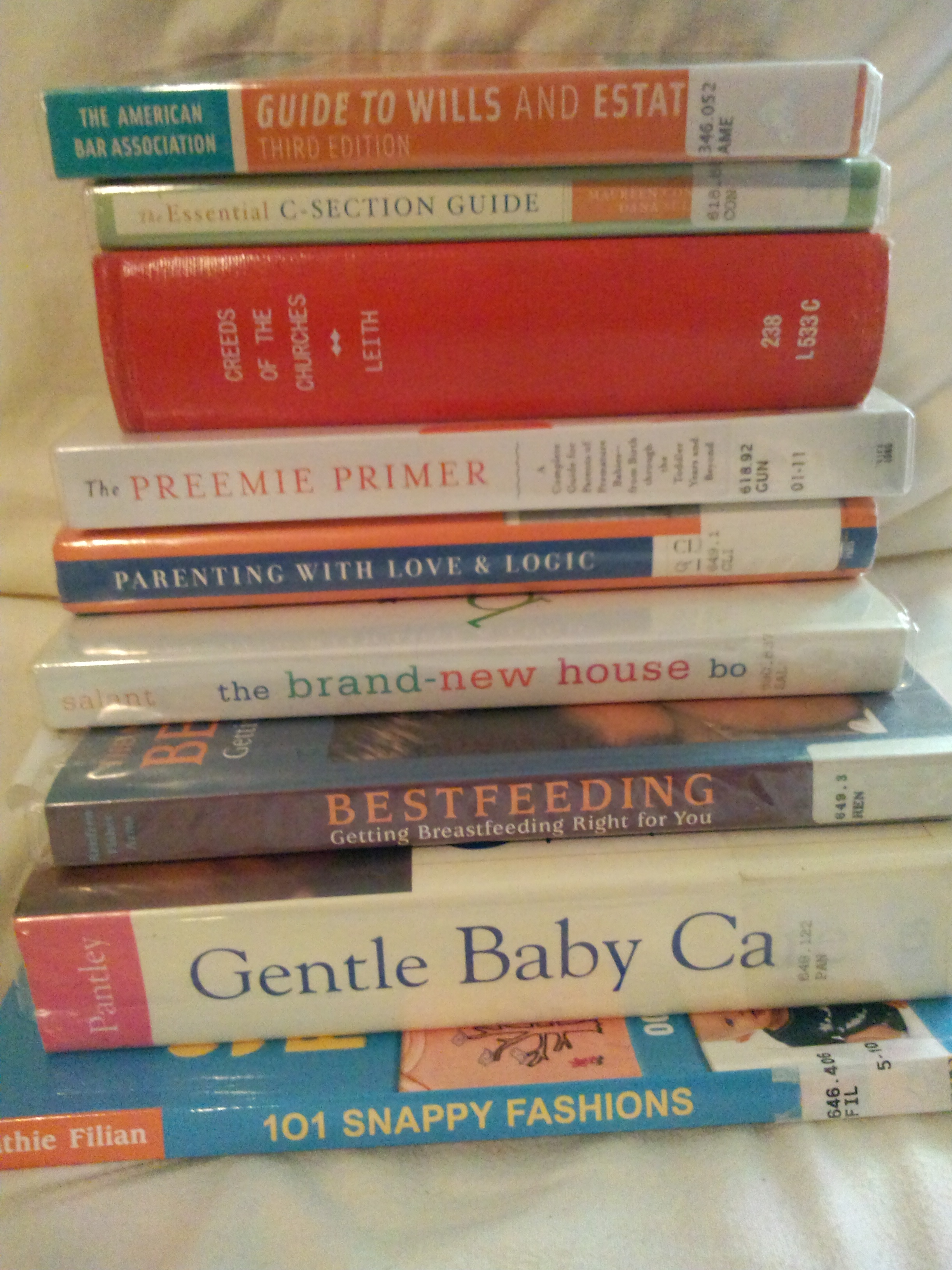
Book pile

This month, I read:

  • The Essential C-Section Guide by Maureen Connolly and Dana Sullivan
    Since about 30% of American births take place via c-section, the authors attempt to fill a gap in prenatal education, teaching women what to expect before and after a c-section. Reading this, I was a) frustrated that the c-section rate is as high as it is (much of it due to repeat c-sections without other indications) and b) thankful that I didn’t have a c-section – except that, oh wait, I did. The authors seem to go out of their way to try to present a c-section as a normal and appropriate birthing experience (though they stop just short of encouraging the completely elective c-sections that are normative in some South American countries). Meanwhile, the typical side effects/after effects of a c-section that the authors describe are so truly horrific that this reader is convinced (if she wasn’t already) that VBAC is the way to go (I was blessed to NOT experience anything particularly awful after my section – but why risk those side effects if you can avoid them entirely?) I really want to review this book more fully, but don’t know if I will, since, well – I am recovering from my c-section and taking care of my preemie, which doesn’t exactly leave a lot of room for other things.
  • 1628 Country Shortcuts from 1628 Country People by editors of Country and Country Woman magazines
    “Who knew” type tips from before Pinterest.
  • Christmas in Williamsburg by Taylor Biggs Lewis, Jr. and Joanne B. Young
    Lots of pictures of Colonial Williamsburg dressed up for Christmas. A fun review from our trip.
  • Preemies by Dana Wechsler Linden, Emma Trenti Paroli, and Mia Wechsler Doron M.D.
    A great comprehensive look at the questions and concerns parents have while their preemies are in the Neonatal Intensive Care Unit. Read my full review.
  • Christmas Customs around the World by Herbert H. Wernecke
    Many of the customs described in this little book, published in 1959, are depicted elsewhere with equal or greater artistry – the real strength of this particular volume compared to others is the missionary vignettes shared throughout. While I can’t find the passage that gave me the impression, it seems that the author was involved with some Presbyterian missions agency, and he shares a variety of missionary’s depictions of how their community (often a mission school or orphanage) celebrates Christmas in Africa or Asia.

image

On the docket for next month:

  • Books about preemies/childcare
    ‘Cause we have a daughter who needs to be cared for
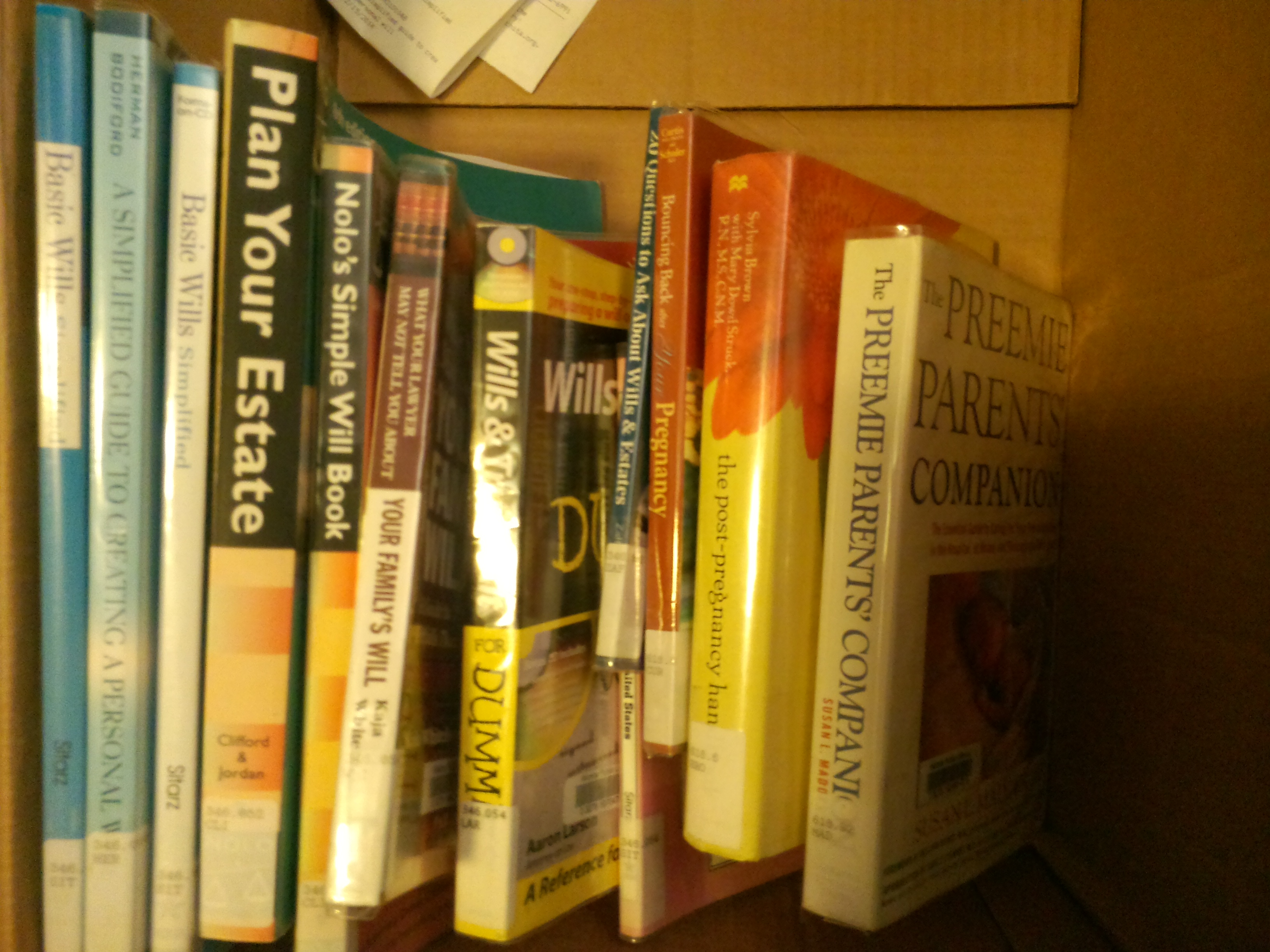
  • Books about estate planning
    ‘Cause we have a daughter who needs to be cared for
  • Books about postpartum body stuff
    ‘Cause there are special rules for recovering from a c-section and I didn’t study up in advance because I didn’t expect to need it.
  • Books about building houses
    ‘Cause we’ll need to be thinking about the process of putting a house on our land.
  • Books about gardening/homesteading
    ‘Cause I’m dreaming of what else we can put on our land.

image

Don’t forget to drop by 5 Minutes 4 Books to see what others are reading this month!

What's on Your Nightstand?


Grace for Today

All my worst fears came true in Tirzah Mae’s birth.

Is it odd that I never really feared for our baby’s safety? There were days when I was distracted or particularly active and didn’t notice movement so I worried – but, in general, I was at peace.

What I really feared was risking out of home birth, having to deliver in a hospital. When I started retaining water, I feared pre-eclampsia. Most of all, I feared a c-section.

All my worst fears came true in Tirzah Mae’s birth.

And God’s grace was there for each circumstance as it arose.

God’s grace was not there for the fear and anxiety leading up to delivery.

I worried and fretted and stressed over the potential of pre-eclampsia, of risking out of home birth, of having a hospital birth, of a c-section. In all that, grace was absent.

God gave His command long ago when He told the people not to worry about tomorrow.

Worrying about tomoorrow is fruitless- tomorrow will have worries, sure, but God’s grace is available for today’s trials.

Despite my weeks of increasing dread, when the time came, God’s grace and peace was there.

When the urine test at the midwife’s office showed 3+ protein, I went into the waiting room and told my husband and grieved for less than 5 minutes over the loss of a homebirth. God’s grace was there.

When the OB checked my blood pressure and my protein and sent me to the hospital, I settled in for a long hospitalization with a calm every nurse remarked upon. God’s grace was there.

When the perinatalogist said that my platelets were droping and we needed to induce at 32 weeks, God’s grace was there.

When 12 hours of magnesium and cervidil left me exhausted and feeling a foreigner in my own skin, I calmly discussed with my husband and God’s grace was there as I asked the doctor for what had been my worst fear – a c-section.

I learned that God gives grace, not for the worries of tomorrow He commanded us to cast on Him, but for the actual events He gives us in today.

The hymn proclaims

“Strength for today
and bright hope for tomorrow
Blessings all mine
With ten thousand beside.”

And the hymn is absolutely right. God gives the strength and grace for every today – but gives only the hope that allows us to cast every tomorrow’s anxieties upon Him.

May I, may we ever bask in today’s grace – and ever cast tomorrow’s anxieties on Him whose grace is sufficient when tomorrow becomes today.


Lactose intolerance in babies

It happens in my office all the time. A mother declares that her infant is lactose intolerant: “Everyone in my family is”.

The professional in me keeps a neutral facial expression while I internally groan. And since the doctor has marked that the infant should receive Similac Sensitive for Fussiness and Gas, helpfully providing an additional diagnosis of “lactose intolerance”, I issue the infant checks for the lactose-free formula.

I groan because lactose intolerance in babies is incredibly rare. Babies’ guts make the lactase enzyme so they can break down the lactose found in their mother’s milk (all mammals’ milk includes lactose). It is only as children grow older and less dependent on mothers’ milk that their bodies stop producing the enzyme to process it.

The few exceptions are 1) primary lactase deficiency, which rarely ever occurs, 2) secondary lactase deficiency, where a gastrointestinal illness temporarily wipes out the body’s ability to make lactase, and 3) prematurity, where an infant is born before her gut lining has started to produce lactase.

Which brings me to my biggest groan.

Tirzah Mae had only ever received my breastmilk, slowly increasing feedings as the IV nutrition was decreased. Most of what she got was via the feeding tube, but she’d started taking it by bottle in the last few days – and we’d started practicing breastfeeding once a day as well.

As I prepared myself for our breastfeeding practice, I noticed that Tirzah Mae had spit up – and I mentioned it to the nurse, who observed that the spit up was bright yellow (my color discrimination has been poor since I delivered, so I didn’t notice anything odd about it under the dim lights.) When the nurse checked the residuals left in Tirzah Mae’s stomach, they were green. Feedings were put on hold and breastfeeding practice suspended.

That evening, the nurse practitioner came in to discuss the situation. She explained the plan: to start again with smaller feedings and work our way up again – and asked me how much dairy I consumed.

She explained how preemies sometimes don’t yet have the ability to process lactose and requested that I reduce my intake of dairy down to maybe one serving a day – and maybe I could try lactose-free milk instead of regular.

I put on my patient face, inquiring about what she thinks might help, while inwardly groaning.

You see, despite the opinions of plenty of doctors and nurses, lactose intake by a woman actually has no impact on the amount of lactose present in her milk.

In a lactose-tolerant woman, any lactose she eats is broken down into its component sugars in her gut, from which the component sugars are absorbed into her blood stream. Then, independently, her breasts take sugars from her blood stream and synthesize them into lactose for her breastmilk.

In a lactose-intolerant woman, any lactose she eats passes through her gut into her colon unabsorbed – and bacteria in her gut ferment it, producing the typical symptoms of lactose intolerance (gas, diarrhea, abdominal cramping, etc.) Then, independently, the mother’s breasts take sugars from her blood stream and synthesize them into lactose for her breastmilk.

It’s simple science, really. But doctors and nurses didn’t spend their educations studying the science of digestion and absorption and metabolism like dietitians do.

So they give silly, unscientific advice related to diet and mothers swear by it because they see improvement when the prematurity (or the GI illness) that caused the problem in the first place resolves (sort of like thinking the antibiotic cured your child’s cold when it resolves in 7-10 days)**.

I choose not to argue and dutifully consume just one serving of dairy daily (actually, I only ever consumed one serving of lactose-containing dairy daily – since my former pattern was one cup of milk, one cup of yogurt, and one serving of hard cheese daily). I label my breastmilk “low dairy” and dream of the day when I can go back to eating whatever I want to without being dishonest. (Since the only reason I’m not eating the dairy now is so I wouldn’t be dishonest in writing “low dairy” on my breastmilk – I already know the restriction isn’t affecting her at all.)

**Caveat: Some women who are told that their infant has lactose intolerance and who reduce dairy as a result discover that this truly is helpful (and symptoms resume when milk is reintroduced). This is generally a case of mistaken identity. While lactose in mom’s intake and lactose in breastmilk are not related, the more cow’s milk a mother consumes, the more cow’s milk proteins will end up in her milk – and some babies do have sensitivities to cow’s milk proteins, which would resolve when mom reduces dairy intake.**


Thankful Thursday: Myself Again

Thankful Thursday banner

I’m not generally a vain person – and I didn’t dread the weight gain that would come with pregnancy. I correct women all the time when they disparage themselves in my office. “You’re not fat,” I tell them, “You’re pregnant.”

And despite the wound to my pride when my weight gain surpassed the goal curve somewhere around 20 weeks, I felt fine with my pregnant body – until I didn’t.

I’m not sure at what point the swelling went from being just a part of pregnancy to I-no-longer-am-at-home-in-my-own-body, but by the time we were hospitalized, I was there.

Now, as the swelling goes down and my blood pressure finally decreases too, I am thankful to be myself again.

This week I’m thankful…

…for normal shoes
I never wear tennis shoes, preferring to pair ballet flats or loafers with my skirts or slacks. But when my feet started swelling around 22 weeks, I requested (and was granted) permission to wear tennis shoes at work. Before long, my feet has swollen to the point that I couldn’t have worn my other shoes even if I wanted to – my feet widened to the point that there was sock peeking out on either side of the tongue of my tennies. Now, I’m thankful that my feet are returning to normal, which means that I can return to my normal footwear.

…for the ability to breathe
Not too long into our hospitalization, I started to have difficulty breathing. The X-ray showed a spot of fluid on my lungs but (thankfully) no widespread pulmonary edema. The residents began me on a regimen of incentive spirometry, where I tried to blow 1750 mL of air into a little device to fully empty my lungs – and then allow them to fully reinflate. It felt magnificent after delivery to be able to breathe again without laboring. I’m so thankful that I can breathe.

…for my face looking back in the mirror
We didn’t weigh me that last day before delivery, so I don’t know how much I gained ultimately in my 32 week pregnancy. Weights from earlier in the week showed at least 50 lbs of gain – but I know I gained quite a bit more even in that last day. How do I know? Because my face went from being thin (at the beginning of pregnancy) to being rounded (when I entered the hospital) to being look-who-we-just-carved-out-of-the-recliner-she’s-been-sitting-in-for-ten-years (at delivery). That last day, I gained so much additional fluid, that I could barely see through slit-like eyes and couldn’t recognize the face I saw in the mirror. I’m so grateful that I can now look in the mirror and see my own face looking back at me.

Tirzah Mae and I two hours after her birth

Me and Tirzah Mae two hours after her birth – note my swollen face

…for limbs that move at my will
I didn’t experience any terrible side effects (except for a single emesis) from my first course of intravenous magnesium, but my second dose, once we began induction, was awful. I shook uncontrollably almost constantly and couldn’t really move myself willingly at all. While I hated the Foley catheter during the first course, I took refuge in it during the second – since there was no way I could have controlled my own body enough to walk into the bathroom, or even keep myself seated on the commode. Having not had any control of my body for 12 hours during the induction, I am so thankful to again be able to move my own limbs when and only when I want to.

It’s harder for me to be thankful that my belly is almost flat, able to fit into many of my old clothes. But the conversation I overheard in the operating room makes me thankful even for that.

I could hear an audible gasp, I’m not sure who from – and then Daniel asked “Is that the waters breaking?” The doctor replied, “No, I haven’t gotten to her uterus yet – that’s ascites.”

I don’t know if the doctor explained ascites or not – but I knew what it was and was (and am) grateful that we delivered when we did. Ascites is a buildup of fluid in the abdominal cavity, generally because the liver has stopped functioning. While my liver function tests were still normal at the point we began induction, my liver had clearly shut down in the twelve hours between the start of induction and Tirzah Mae’s birth. My womb would have quickly become a toxic environment for her.

So I’m thankful. Thankful that the fluid in my belly is gone – and even though it’s bittersweet that my baby’s gone too, I’m so thankful that she is safe in the NICU rather than being poisoned by my body no longer working.

God has been good, so very good.

“Whom have I in heaven but you?
And there is nothing on earth that I desire besides you.
My flesh and my heart may fail,
but God is the strength of my heart and my portion forever.”
~Psalm 73:25-26 (ESV)